Reach the ball with a reply you can control
When you chase a drop shot, move promptly toward a usable contact, then choose a reply that fits the ball you actually reach. A comfortable ball above net height may let you attack. A low ball that you can still control asks for clearance and placement. A desperate stretch may leave only a simple attempt to keep the point alive. Being close to the net does not make all three situations attacking opportunities.
This guide concerns singles and the receiving player. Our Alcaraz feature explains when to play the original drop shot; here the question is what to do when that short ball is coming toward you. The aim is to connect recognition, movement, reply and recovery, rather than judge the chase only by whether the racket touched the ball.
Read the flight, then leave room for the racket
Watch the opponent through contact and respond as the shorter flight becomes clear. A change in preparation can be a clue, but a clue is not a guarantee. Committing forward before you have read the ball can leave you stranded against a deeper shot. Equally, waiting for the bounce before deciding to move can spend time you needed for the chase.
Move toward where you can intercept the ball, leaving room beside your body for the racket. Running directly onto the bounce can put the ball under your feet or force you to reach backward. USTA’s beginner contact-point guidance identifies crowding the ball as a common problem; its introductory spacing exercise is not a fixed measurement for every moving shot.
Use the available distance to organize your speed. You may need quick initial steps followed by shorter adjustments, or a running contact when there is no time to settle. Do not force a complete stop before every strike. But do not assume maximum speed through contact is always helpful either. In a study of 18 professional players, Giles and Reid found that changing running speed altered forehand movement and hitting mechanics. It was not a study of drop-shot retrieval, and it supplies no universal braking distance or footwork prescription for recreational players.
Let the contact change your ambition
If you arrive early enough to contact above net height with control, look for a generous open area. You may be able to direct the ball more firmly without lifting it first. Still check the opponent: an apparently empty corner can disappear while you prepare. A reachable target inside the court is more useful than a spectacular angle you cannot repeat.
If the ball is below the top of the net, it must travel upward to clear it. That changes how much pace and angle you can use. With the opponent staying back, a controlled reply with depth can give you a workable next exchange. With the opponent closing, consider a low reply that makes their next contact awkward. A lofted escape may sometimes be available, but a poorly controlled lob can simply offer an overhead.
At full stretch, simplify the job. Use the racket action you can control, allow room over the net and accept that the reply may be defensive. Some drop shots are too good to retrieve. Do not turn a lost point into a dive, a collision with the net or a chase through loose balls. In practice, shorten the starting distance before asking for more speed.
Choose the direction with the opponent in view
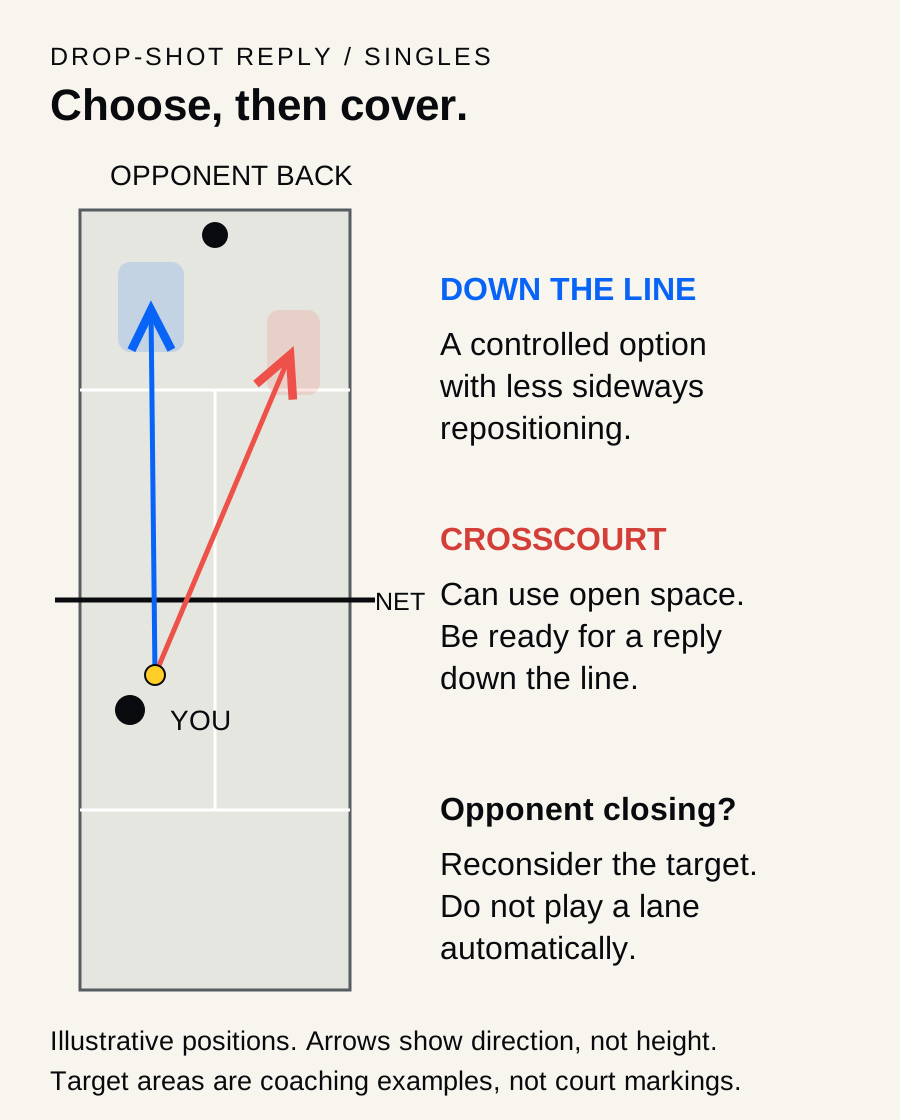
In his own drop-shot-defense lesson, Feel Tennis coach Tomaz Mencinger favors a controlled deep reply down the line followed by net coverage as a recreational starting option. He also distinguishes a comfortable counter-drop shot from an attempt made while stretched. These are coaching preferences, not measured success rates; his article does not provide data establishing a statistically best reply.
Use that starting idea conditionally. A down-the-line reply can simplify your next position. But sending it at an opponent already occupying that lane may give them an easy volley. Crosscourt can exploit space while leaving a down-the-line response to cover. Both players’ positions matter.
A counter-drop shot means answering short with short. It becomes more plausible when you can reach the ball comfortably and the opponent remains far away. It is a poor automatic response to being surprised: trying to land the ball just beyond the net adds a precision demand when you may already be struggling to make contact.
Recover for the next contact, not to a favorite spot
Explore the sequence in FLOW Tennis, then connect it to the approach, split and first-volley guide.
After the reply, keep watching. If you have sent the opponent back and remain inside the court, organize a ready position that covers their available pass and lob. If your reply sits up, expect less time. Moving close to the net can help with a volley, but it also leaves more space behind you. Neither touching the net with your momentum nor immediately retreating to the baseline is a complete recovery plan.
Use the opponent’s next strike to organize a small split step and become ready to move as the reply becomes readable. The split is a preparatory action, not a compulsory stop on the service line. Our baseline-to-net guide develops that sequence in detail; the drop-shot chase adds the challenge that you may arrive lower, closer to the net and with fewer options.
This is a specific application of FLOW Tennis’s Read → Move → Organize → Strike → Recover sequence. ‘Organize’ includes managing the space and speed you bring into contact; ‘Recover’ follows the reply you produced. The framework helps structure the practice below. It is not a claim that the pictured professionals use FLOW.
Practice three arrivals before adding surprise
After easing into the session, start inside the baseline with a partner feeding manageable short balls. Agree on one side, keep the movement area clear and reset between attempts. Begin close enough to reach the feed without a desperate lunge. The partner should give you time to return to the start rather than feed continuously.
First compare a comfortable higher contact with a lower but reachable one. Describe which target remains manageable in each case. Then let the feeder stay back or move forward after the feed, so your reply has to account for their position. Use short groups with role changes and rests; there is no required repetition count. For a junior or newer adult, use the court size and ball that make the task playable.
Finally, play points from a gentle rally in which either a deeper ball or a drop shot is possible. If every fourth ball must be short, you can rehearse moving forward without learning to recognize when to do it. Keep the pace manageable while adding that uncertainty.
Record three observations: did you reach contact with usable racket space, did the target fit the contact height and opponent, and were you ready for another ball? Note a crowded arrival separately from a reply hit into the net. For a parent, a useful question afterward is ‘What could you control once you got there?’ That gives the next session a clearer purpose than simply asking the player to run faster. These are GEN Tennis practice suggestions, not a validated test or a guarantee of improvement.
Our editorial standards · Questions or corrections? Contact the editor.
Sources
- USTA — Find your optimal contact point, March 27, 2018; checked October 19, 2026
- Giles and Reid — Applying the brakes in tennis, 18 professional players; 2021 journal publication, original abstract
- Feel Tennis / Tomaz Mencinger — How to defend against the drop shot; coaching interpretation, checked October 19, 2026
- USTA — Approaching the net in singles, March 16, 2020; geometry and position, checked October 19, 2026
- ITF Rules of Tennis 2026 — court geometry for the original illustration