Give both players a reason to be there
You book a court to work on returns, but your partner wants to practice serving. After a few minutes, they are chasing aces while you are trying to keep a ball in play. Neither task is wrong. You have simply started two different sessions on the same court.
A useful arrangement gives the server a placement task and the receiver a return task, changes roles regularly, and ends with points that neither player can script. Start with a predictable serve, add uncertainty, then see whether the return still helps you play the next ball. The sequence below is a GEN Tennis coaching suggestion, not a scientifically validated training dose.
Agree on the serve before counting the returns
Warm up together, including serves at a manageable effort. Then name the problem: perhaps a fast body serve crowds your contact, or a slower second serve tempts you into swinging too hard. Choose one service side and one serve type for the first comparison. A deuce-court second serve and an ad-court first serve are different tasks; mixing them into one success percentage hides what changed.
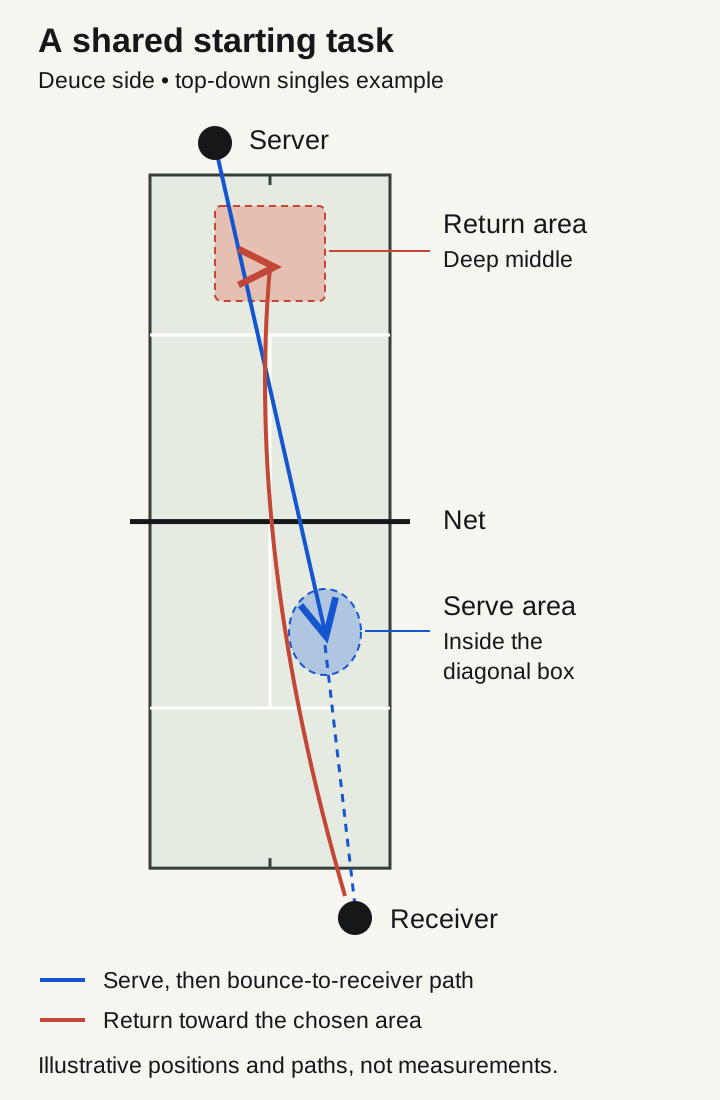
Give the server a broad area inside the correct service box. Ask for a repeatable pace they can control, rather than a maximum-speed attempt every time. The receiver chooses a generous landing area on the other side. In our illustrated example, both players begin on the deuce side, the serve goes toward the middle of the service box, and the return aims deep through the middle. This is a starting arrangement, not the correct target for every serve.
Agree on short turns—perhaps six serve attempts each—then swap. Count the attempts so a difficult serving spell does not become an endless basket. Separately note how many legal serves actually offered the intended return task. A fault is useful information for the server; it is not a missed return. Rest and collect balls together, clearing loose balls from the playing area before restarting.
Choose the return from the ball you receive
The USTA’s first- and second-serve guidance offers a practical starting point: favor a higher-percentage response to a first serve, with crosscourt space on a wide ball and the middle on a body or T serve. It encourages stepping in to use depth and spin against a second serve. Those are coaching options, not instructions to attack every ball labeled “second serve.”
A slower serve that sits comfortably can give you room to take initiative. A second serve that kicks high, bends away or reaches your body may still require a less ambitious response. For this practice, agree on the intended serve but react to what actually arrives. Do not force the planned target when you are stretched.
The LTA’s return guide connects preparation and swing size to the incoming speed: a fast serve can call for a compact response, while a slower one may allow more swing. It also treats return position as adjustable. If you test a different starting position, keep the serve task similar; changing the speed, target and your position together makes the comparison hard to interpret.
First, learn something from a predictable ball
For the first short round, announce the serve area. The server practices finding it; the receiver works on one intention, such as making comfortable contact and sending the return beyond the service line with margin inside the singles court. That depth target is a training choice, not a requirement on every defensive return.
Let the server hit the next shot whenever the return is playable, then stop and reset. Watch where that shot was struck: could the server step well inside the baseline, or did the return keep them nearer the back? Do not declare a return good solely because it landed deep. A high, slow ball can still be comfortable to attack, and the server’s next shot also reflects their skill and intention.
Keep the feedback short. “Three returns stayed short when the serve reached my body” gives you a problem to investigate. “Bad return” does not. If most serves miss the agreed area, enlarge the target or reduce the server’s effort before diagnosing the receiver. If the returner cannot make a playable contact, simplify the incoming ball.
Next, take away the advance notice
Once the arrangement produces useful balls, give the server two broad options in the same service box and stop announcing the choice. The receiver now has to read direction and organize space. Keep the general serve effort similar before adding more speed. Swap roles and repeat on the other service side when both players are ready.
Expect the task to feel different when the destination is unknown. A drop in successful returns does not, by itself, mean the earlier work failed. Compare what breaks down: reading direction, making room, controlling the racket face, or recovering after contact. Pick one response rather than changing the whole stroke between turns.
This fits FLOW Tennis through a specific teaching connection: reading, preparation, spacing and recovery belong to one playable sequence. On return, prepare around the opponent’s action and continue adjusting to the serve; do not wait for the bounce to begin organizing. FLOW is a coaching framework here, not evidence that this drill guarantees improvement.
Finish with points the server can try to win
Now play a short, normally scored game or a handful of complete points. Use the usual first- and second-serve sequence, remove announced locations and let both players choose their shots. The server is allowed to look for the weakness that the cooperative round helped you explore.
Keep the match score separate from the practice notes. A return can start a competitive rally even if you later lose the point. A return winner is not the only useful outcome. Conversely, winning after a weak return does not make the return itself repeatable.
If the controlled task looked sound but the point-play version did not, go back to a short round with two unannounced locations. If both versions were manageable, test another serve type or service side next time. If contact remains consistently difficult, a coach watching the exchange can help identify what needs attention.
Leave with one comparison you can repeat
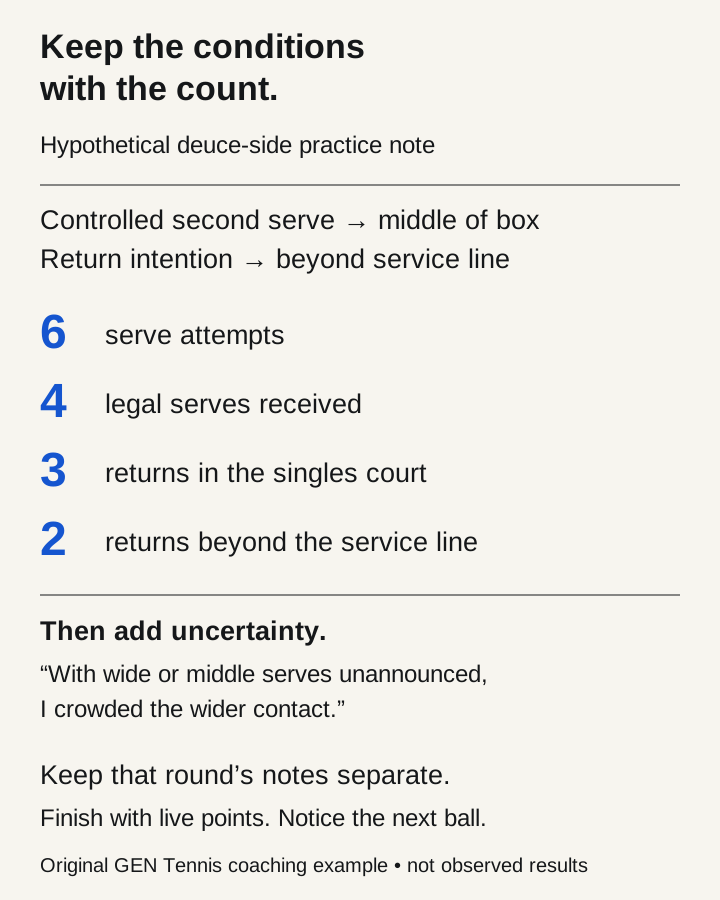
Write the service side, serve type, intended area and return intention. For each turn, record legal serves received, returns in, returns reaching your chosen area, and one observation about the server’s next contact. Keep first- and second-serve notes separate. A tiny sample is a session note, not a reliable ability rating or proof that a technical change caused improvement.
For example: “Deuce side, controlled second serve to the middle of the box; six attempts, four legal serves, three returns in, two past the service line. With unannounced wide or middle serves, I crowded the wider contact.” That is a hypothetical note, not a GEN Tennis test result. It points to the next task more clearly than a total winner count.
Our Practice Planner can organize time with a partner, a court and the “Reading the return” focus. It supplies broad practice blocks, not serve statistics. For a closer look at how to compare conditions, use the independent-practice feedback check. The useful result of this session is a question both partners can test again.
Our editorial standards · Questions or corrections? Contact the editor.