Start with a target, not a winner
For recreational doubles against a conventional one-up, one-back formation (server back, partner at net), start with a crosscourt return toward the server’s side. Then adjust its depth and height: give a server staying back a deeper ball, and make an approaching server handle a lower one. If the net player is moving across that route, a different direction or a well-judged lob may be the better choice. These are starting decisions, not rules that override the incoming serve.
Imagine getting four returns in play and losing all four points to the server’s partner. Telling yourself to be more consistent misses the problem. Your returns are legal, but their height, direction or predictability gives someone an easy first volley. The useful question is: who will play the next ball, and from where?
This guide concerns ordinary recreational doubles positioning. I-formation and Australian formation change the picture because the serving team starts differently and may switch sides. Do not apply the diagram to those formations without adjusting for the actual players.
When the server stays back, use the space in front of them
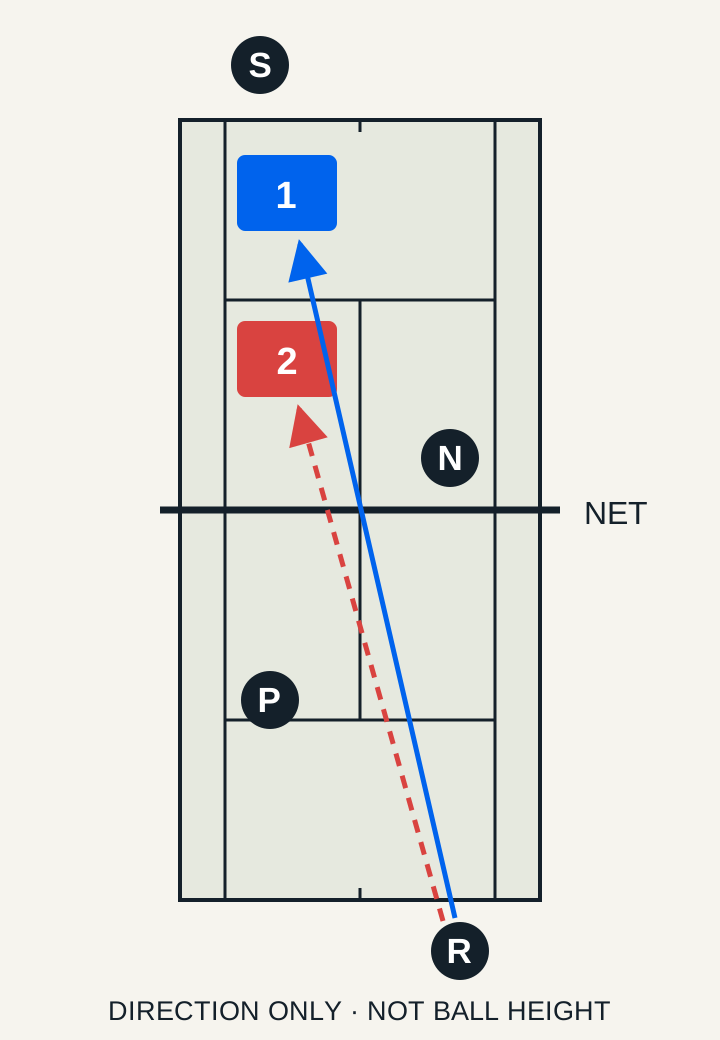
A generous crosscourt landing area gives you a plan without asking for a sideline winner. Picture the server’s half of the backcourt, with room inside both the baseline and sideline. Your return still has to pass the opposing net player; simply naming a destination does not make the route safe.
Peter Farrell’s club-player guidance for Tennis Ireland identifies crosscourt as the standard return and recommends depth when the server remains at the baseline. The practical aim is to make the server play the next shot from farther back, rather than hand the partner a comfortable volley.
For example, when a wide serve pulls you toward the doubles alley, trying to redirect it sharply down the line adds a new problem to an already difficult contact. A controlled crosscourt return with space from the lines is a sensible first experiment. If it repeatedly floats into the net player’s reach, review its height and route rather than merely swinging harder.
When the server comes forward, change the height and depth
A return that works against a stationary baseliner can sit up invitingly for someone arriving at net. In that situation, low matters more than landing near the baseline. The USTA’s serve-and-volley guidance suggests low crosscourt returns; a ball the opponent must contact below net height asks for a different volley than one they can hit downward.
Imagine the server taking several steps forward after serving. A controlled ball dipping toward their feet may be more troublesome than a harder, higher return. You are choosing the opponent’s contact problem, not trying to hit the fastest ball you can produce.
Low does not mean scraping the net with every attempt. Leave clearance you can control. An intended low return that never crosses the net has achieved nothing. The shorter target in our diagram represents a situation to practice, not a prescribed landing point for every approaching server. Adjust for their speed and where they actually reach the ball.
When the net player keeps crossing, change the question
Poaching means the net player moves across to intercept a ball that might otherwise reach their partner. The USTA’s poaching instruction emphasizes reading the hitter’s position. Your opponent is making decisions too; a return pattern that was open during the warm-up may no longer be available.
Look at the formation before the serve and notice movement as the point begins, without abandoning attention to the ball you must strike. If the opponent commits across early and you have comfortable contact, a return into the space they leave can be worth trying. Do not force that change if the serve leaves you off balance.
A lob is another option when you can send it beyond a net player’s reach with enough depth to avoid an easy overhead. Tell your partner about the plan between points. A short lob can make the next shot harder for both of you. If you are stretched or jammed, choose the controllable ball rather than insisting on a last-second trick shot.
Let the serve change your ambition
A second serve is not automatically an invitation to hit a winner. One may sit comfortably in your strike zone; another may kick above your shoulder or arrive close to your body. Decide from the ball and your balance, not just from hearing “second serve.”
Against a ball that leaves you rushed, make the return task smaller: a manageable preparation, a broad available route and enough clearance to start the point. Against a serve you can meet comfortably, move into a position that gives you a useful contact and choose a more demanding target if you can control it. Stepping in only helps if you still have time to organize the contact.
After a miss, separate the decision from the execution. A sensible crosscourt choice can miss long. A desperate line shot can catch the sideline once. Judge whether the choice fits the situation over several comparable returns, rather than treating the last outcome as proof.
Try a twelve-return comparison
With four players, agree on a manageable serve and start from the same receiving side. Play three blocks of four returns, then rotate jobs. Collect loose balls between blocks. Twelve is simply a convenient sample; shorten or extend the blocks to suit your group.
- First four: the server stays back and their partner holds position. Choose a generous crosscourt backcourt area. Play out each point.
- Next four: the server follows the serve forward and their partner still holds. Try to make the server’s first volley uncomfortable with height and placement. Play out each point.
- Last four: let the serving team choose whether to stay or move. Read the situation and select a return. Stop treating the first two targets as compulsory.
Record what the return allowed next
For each return, note whether it landed in, who played the opponents’ next shot, and whether that contact was comfortable or under pressure. Keep those observations brief. A return can land in and still invite an easy volley; another can start a neutral exchange that gives your team a real chance.
If the second block produces many net errors, increase clearance before pursuing a lower ball again. If the final block produces repeated interceptions, ask whether you missed the opponent’s movement, chose an unavailable route or failed to execute the intended shot. Change one thing and repeat a short block.
Take one sentence into the next match: “When the server stays back, I’ll start with a generous crosscourt target; when they move in, I’ll change the height and depth.” Keep watching what actually happens. A plan helps most when it remains adjustable.
Our editorial standards · Questions or corrections? Contact the editor.
Sources
- Tennis Ireland / Peter Farrell: Doubles – Return of Serve (November 19, 2025; checked October 1, 2026)
- USTA: Beating a serve-volleyer (April 22, 2017; checked October 1, 2026)
- USTA: Poaching in doubles (December 6, 2019; checked October 1, 2026)
- ITF 2026 Rules of Tennis, Rule 1: court proportions; target areas are GEN Tennis suggestions
Keep reading.
How to make social doubles work across ages and levels
Why your tennis rally keeps breaking down—and what to change