Give the return a job before choosing a position
Move back on return when the extra time helps you make a more useful contact and start the point on workable terms. Do not move back simply because a professional does it. The tradeoff is space: a wide serve can keep traveling away from you, and a short serve can make you cover more ground forward. Your position has to answer the serve in front of you.
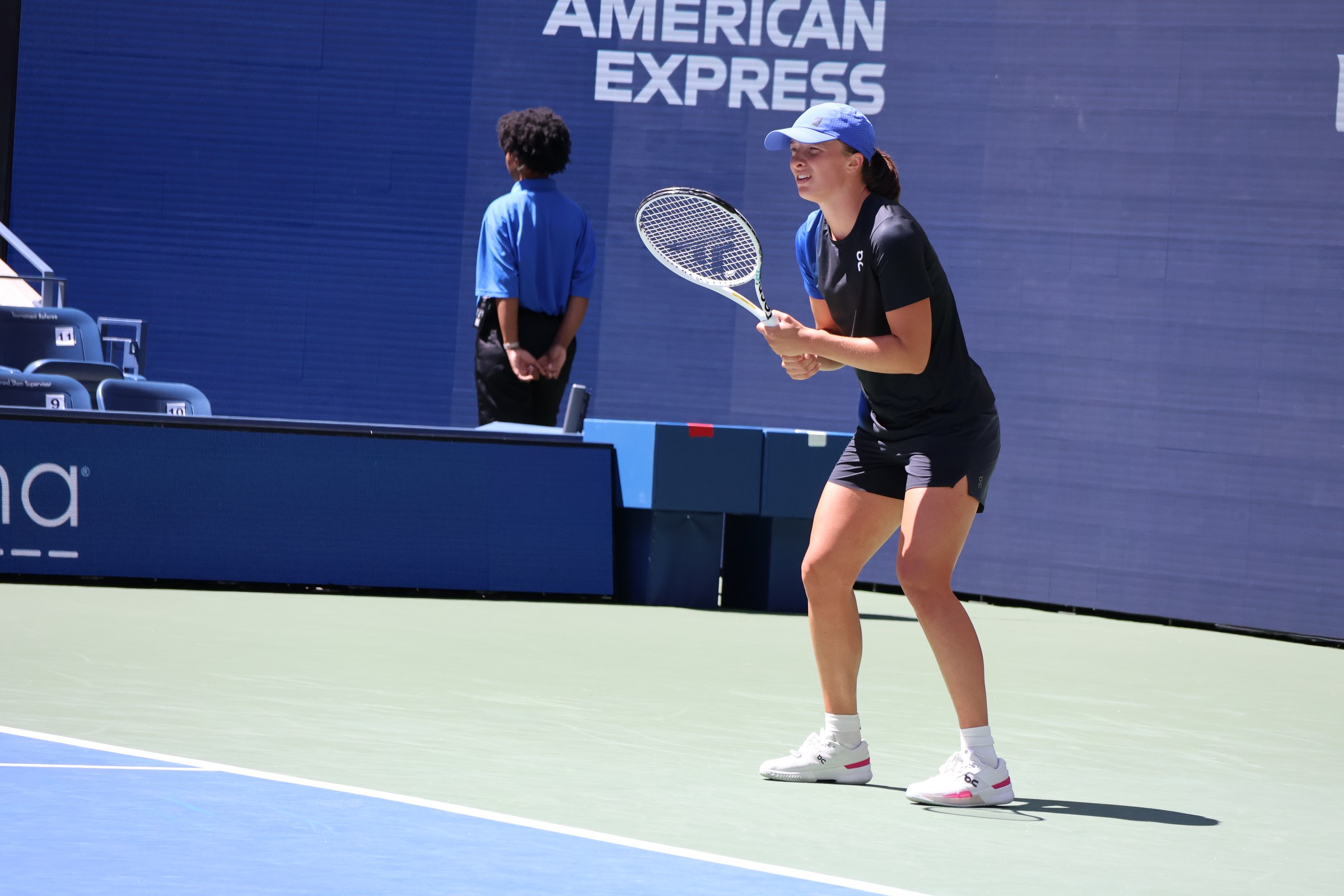
Iga Świątek’s adjustment against Elena Rybakina at Roland-Garros on June 1, 2025, offers a specific example. It is not a prescription for where she always returns, or where every recreational player should stand. The lesson is to change a condition that is limiting you, then judge what happens to the point—not whether your starting position looks sufficiently aggressive.
What Świątek actually said
Świątek won that fourth-round match 1–6, 6–3, 7–5 after trailing 2–0 in the second set, according to Roland-Garros’s match report. In her post-match press conference, she explained that her coach had encouraged her to try returning farther back. She had been reluctant because returning aggressively had helped her before.
Against Rybakina’s pace, however, she needed time. Describing the change, Świątek said, ‘it gave me more time to just play back some balls.’ Her explanation concerned making more first-serve returns and finding a way into rallies. The result does not isolate return position as the cause of the comeback; her forehand and the rest of the match also mattered.
There was a separate hard-court example later that season. The WTA’s August 18 report on Cincinnati described her moving her return position back against Rybakina’s wide serves in the previous day’s semifinal, which she won 7–5, 6–3. That is another reported adjustment to this opponent—not evidence that farther back is always better.
More time is useful only if you use it
A returner close to the baseline can meet the ball earlier and give the server less time before the reply. But that opportunity has a cost: less time to recognize direction, organize the racket and find space beside the body. If contact repeatedly feels rushed, trying to swing harder from the same place may not address the actual problem.
A deeper starting point gives the incoming ball farther to travel before a typical deeper contact. That can make reading and organizing easier. It does not automatically produce a better return. If you spend the extra time making a larger, slower preparation, or simply wait while the ball crowds you, you may recreate the same difficulty farther from the court.
Keep three things separate: where you wait for the serve, how you move as it arrives, and where you actually contact it. Starting back does not mean standing still there. You may move forward to a shorter serve, sideways toward a wide one or make small adjustments to clear a body serve. A photograph of a starting position cannot tell you the whole sequence.
Notice what moving back gives away
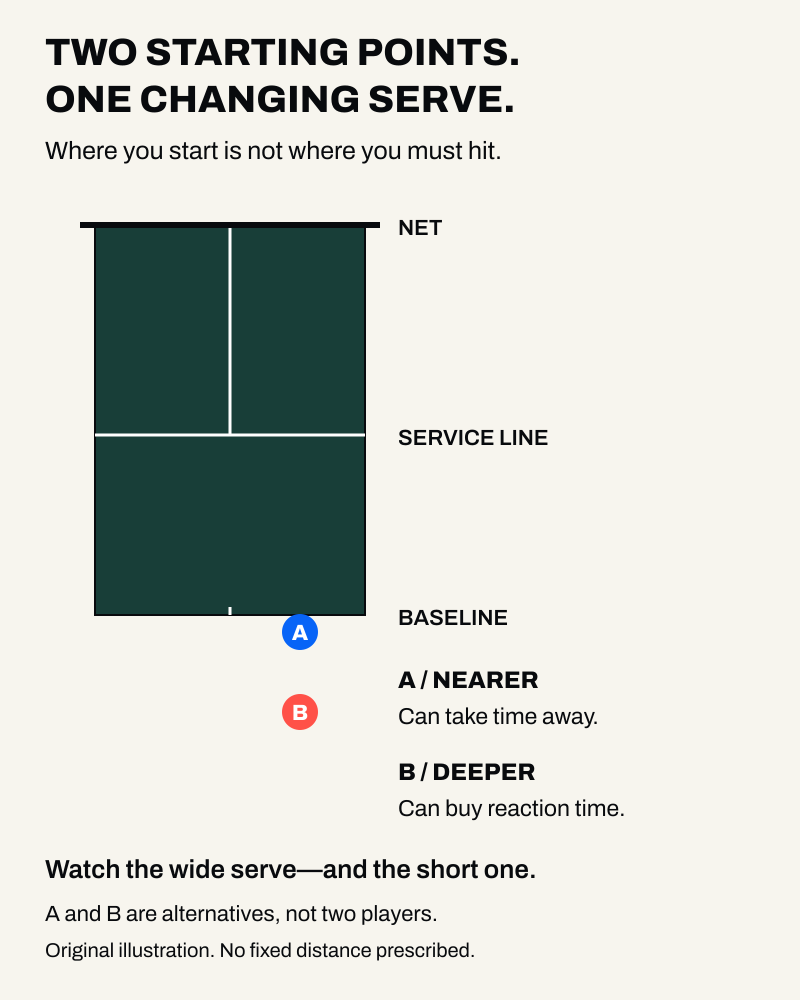
A serve that travels diagonally toward the sideline can continue carrying the returner outward after the bounce. Waiting deeper may buy time while also leaving you farther from the center when you finally strike. The relevant question is not just ‘Can I reach it?’ but ‘Can I return with enough control to handle the next ball?’
A shorter serve creates a different problem. If you have backed up automatically, you may need to come forward a long way just to make contact. A return that drops short can then invite the server into the court. Spin, bounce, surface and the server’s placement all change the comparison; ‘fast serve means back, slow serve means in’ is too crude to be a complete plan.
Your actual court matters too. Do not copy a tour player’s depth if the fence, neighboring play or available run-off leaves you without safe movement space. Nor should a junior copy a professional’s position on a different court size and ball stage. Work within the environment and the player’s present ability to read and move.
First and second serves deserve separate decisions
USTA’s return guidance offers a useful starting contrast: choose high-percentage replies against first serves, while looking for opportunities to step in and use depth and spin against second serves. Treat that as a strategic starting point, not an instruction to attack every ball labeled ‘second serve.’ A well-placed or high-bouncing second serve may still make contact difficult.
For a recreational player facing a strong first serve, the first improvement may be a controlled return through a generous central area rather than an immediate winner. Against a manageable second serve, moving closer can help you take time away without aiming near a line. If that closer position makes you late or cramped, adjust the position, preparation or target instead of defending the choice because it sounds attacking.
Keep the purpose of this example clear: it is a singles decision about time and court position. Doubles adds a net player and a partner, changing which return targets are available. A return that safely starts a singles rally may be an inviting volley in doubles.
Try a comparison, not a permanent conversion
In a practice session, ask a partner to serve at a manageable pace into an agreed area. Begin with your familiar receiving position. Then try a modest move back while keeping the server, target and intended return target as similar as practical. Alternate short groups of returns rather than doing all of one version while fresh and all of the other while tired. There is no universal distance to copy.
Notice three things: whether you can identify the direction without feeling rushed, whether contact feels usefully spaced rather than jammed or stretched, and what the server can do with your reply. A simple count of returns in is useful, but write down whether those returns landed short or allowed a controlled next shot. A position that produces more balls in but leaves you defending every next ball needs a second look.
Once one location feels workable, vary the serve direction and play out a few points. Repeat on the other receiving side, and assess first- and second-serve situations separately. A predictable practice is a way to compare an adjustment, not proof that it will survive match uncertainty. If no position makes contact manageable, ask a coach to watch your reading and preparation before making the next move larger.
Connect the position to the rest of the point
In FLOW Tennis, the receiving position is a way to support READ → MOVE → ORGANIZE → STRIKE → RECOVER. The extra time is useful when it helps you organize contact and stay involved in the next shot.
Our coaching application is to connect the return to a complete sequence: read the opponent’s contact, move toward the developing ball, organize spacing, strike toward a useful target and recover for the reply. Changing the starting position can help one part of that sequence; it does not replace the others. This is our teaching interpretation, not a claim that Świątek uses or endorses our method.
For a parent watching a developing player, the useful conversation afterward is not ‘Why were you standing so far back?’ It is ‘What did that position help you do, and what became harder?’ Let the player describe the problem and the experiment. The aim is a returner who can adapt when an opponent changes the serve, not one who needs permission to leave a favorite spot.
Our editorial standards · Questions or corrections? Contact the editor.
Sources
- Świątek’s post-match press conference — June 1, 2025 (ASAP Sports transcript)
- Roland-Garros — Swiatek turns tide against Rybakina, June 1, 2025
- WTA — Cincinnati finalist analysis, August 18, 2025
- USTA — returning first and second serves
- ITF Rules of Tennis 2026 — court dimensions used in the original diagram