A good match decision should leave room for development
You have a short ball, an opponent recovering across the court and a small opening available. You can see the shot. Whether you should attempt it depends partly on what you can execute from that position. Whether you should learn it is a different question.
That distinction matters for players who want to improve. A generous target can be the right choice in a match, while a more demanding placement can be a worthwhile project in practice. If every training decision is judged only by whether it wins the next point, a player may have little opportunity to develop shots that are not reliable yet.
Precision deserves deliberate practice, including demanding passing shots, short angles and accurately placed lobs alongside dependable rally placement. The aim is to expand the range of useful placements a player can produce, then learn which situations support them. A smaller target is one possible training tool. It is not, by itself, a better drill or a reason to attack the lines on every ball.
The discussion that prompted the question
Screenshots shared with GEN Tennis show coach Joel Myers, @joel_myers_tennis, explaining a court angle of 19.1 degrees and the importance of choosing large targets. They also show a humorous inset attributed to Casper Ruud, @casperruud, about intending to hit crosscourt. The original post permalinks could not be independently verified, so we are describing the supplied screenshots rather than presenting a verified account of Ruud’s shot intention.
Myers’s illustrated point is useful: a small difference in direction can produce a meaningful difference in where the ball goes. His margin explanation provides a starting point for a further question: how much directional control can a player develop, and how should practice help?
A highlight or a joke cannot answer that. To assess precision, we need repeated attempts, a known intended target and an understanding of the conditions in which the player hit.
What the 19.1-degree angle actually describes
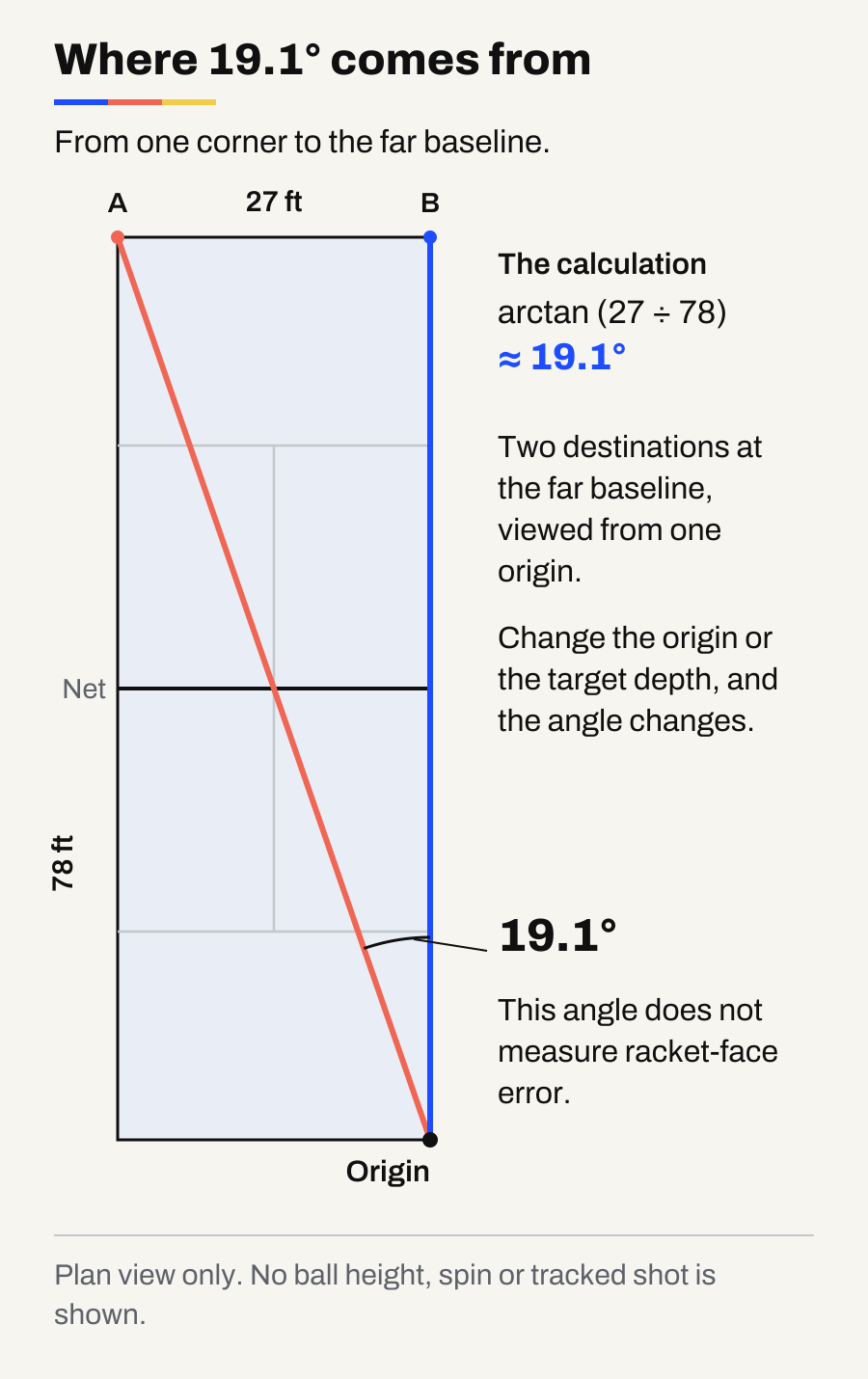
A standard singles court is 78 feet long and 27 feet wide. Imagine standing exactly at one baseline corner and drawing two straight lines to the two opposite baseline corners. The angle between those lines is approximately 19.1 degrees, calculated as the arctangent of 27 divided by 78. That construction is consistent with the diagram in the supplied screenshots.
It describes the horizontal opening between those particular destinations from that particular origin. Move the contact point, choose a shorter crosscourt destination or change the reference position, and the angle changes. The number is not an allowance for error around every shot, and it is not the angle through which a racket face should move.
The drawing also leaves out height. A real tennis shot must travel over the net and land within the intended area. Its pace, spin and vertical trajectory matter alongside direction. A plan-view angle explains one part of the problem; it cannot establish how much accuracy a player is capable of learning.
For the player, the useful lesson is to understand both the geometry and the pattern of their own shots. The court tells you where the boundaries are. Practice can tell you how reliably you place the ball relative to them.
How learned movement supports precision
Skilled movement does not require a player to consciously calculate the exact angle of every joint and the racket before contact. Research on internal models in sensorimotor control supports the idea that the nervous system uses predictions about movement. Experience and sensory feedback help connect intended actions with their consequences.
In tennis terms, that gives us a useful way to think about practice: the player experiences an incoming ball, organizes a response, sees the result and has information for the next attempt. An explanation of grip, spacing or racket motion can help the player understand what to explore. The skill still has to be developed through actual contact with the ball.
Research on optimal feedback control also distinguishes achieving a task from reproducing every detail of a movement. Reliable outcomes can coexist with variation in how the body moves. For a coach, this is a reason to examine the ball’s result and the player’s adaptability alongside the appearance of the stroke. It is not evidence that technique is irrelevant or that any movement will work.
These are findings and theories from motor-control research, not direct validation of a tennis teaching system. They support taking learned control seriously. They do not show that confidence alone produces accuracy, or that everyone can develop the same level of precision.
“Trust your game” becomes more useful when the player has experience to trust: they have attempted the placement, learned about their misses and tested the shot under changing conditions.
A precise target can sit inside a generous margin
Consider a player aiming at a small mark well inside the baseline and sideline. The intention is precise, but the ball has room to miss that point and remain useful. Another player may aim vaguely toward the corner, hit one spectacular winner and miss the next several balls. The successful highlight does not establish the more reliable skill.
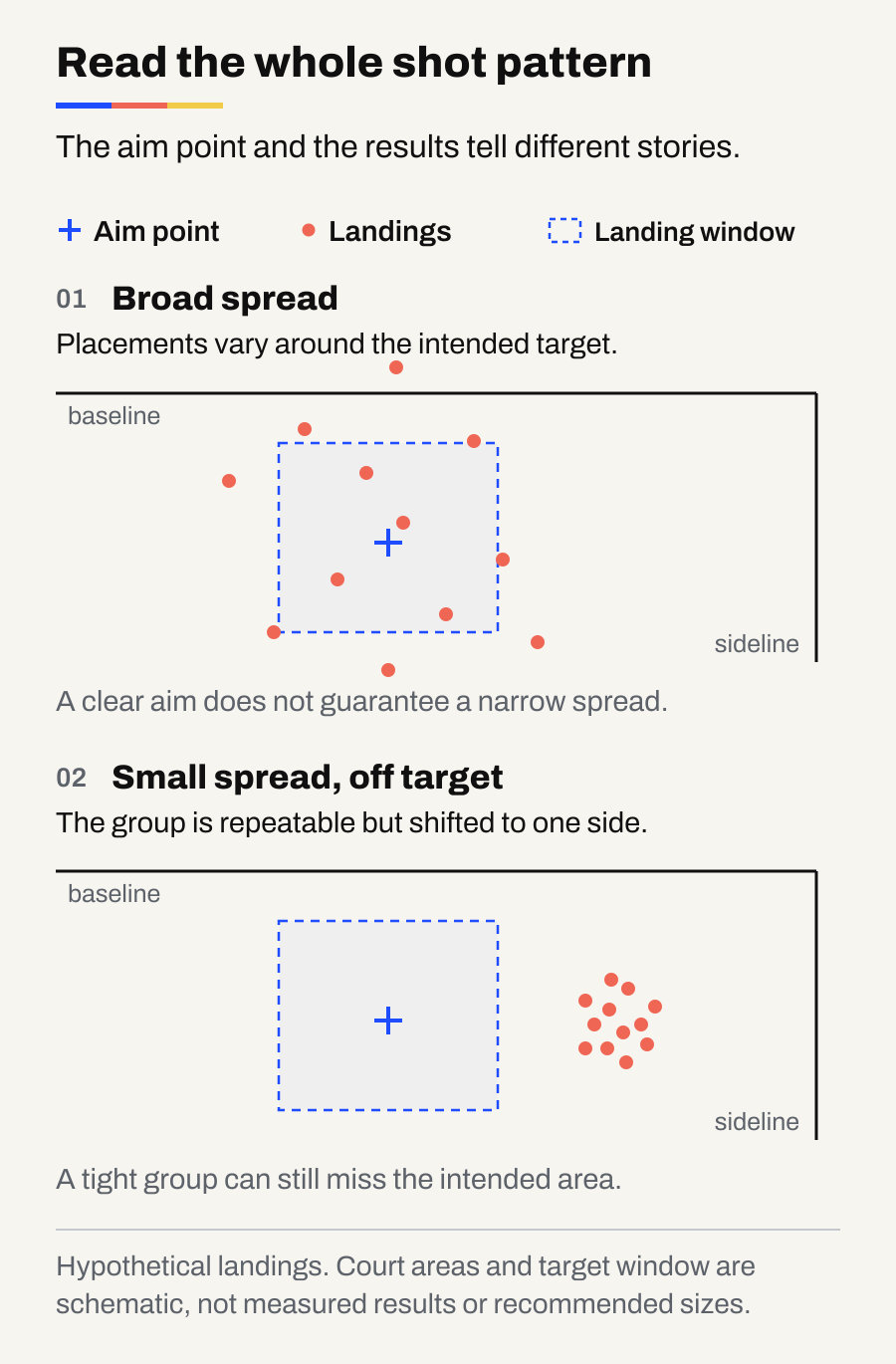
It helps to separate accuracy from repeatability. A tight group of balls landing to the left of the intended target is repeatable but biased. A scattered group with one ball exactly on the target contains a successful attempt, but considerable variation. Useful control involves understanding both where the group tends to land and how widely the attempts spread.
The target, the actual shot pattern and the court boundary are three different things. Improving control may allow a player to select more demanding placements while retaining an acceptable chance of success. It may also make an ordinary rally pattern more dependable. There is no requirement that improved precision always be spent on a riskier shot.
Our down-the-line guide addresses the separate tactical question: when does changing direction make sense given the incoming ball, your contact and the opponent’s position?
What tennis can ask of shooting sports and hockey
Target sports make precision an obvious part of the task. Biathlon adds the challenge of shooting within an endurance event. Hockey offers a different comparison: a player may try to send the puck through a gap that is changing as defenders and the goalkeeper move.
These examples make a worthwhile coaching question harder to dismiss. Are we giving a tennis player enough opportunity to develop demanding placements, recognize openings and learn what their movement can produce? The ability to imagine the shot can become the start of a learning task, rather than the end of the conversation.
The comparisons also have limits. A tennis player is receiving and redirecting a moving ball, often while changing position, across a net and into a court defended by an opponent. After the racket and ball separate, that shot cannot be steered in flight. Each sport combines perception, movement and scoring demands in its own way. Excellence in one does not establish a tennis player’s potential or supply a ready-made tennis training method.
The productive comparison concerns how precision is developed and tested. A training task can develop a demanding placement while leaving the player free to choose when it is useful.
Practice accuracy has to survive the move into points
Tennis already includes target practice. The USTA’s Target Practice activity, for example, organizes crosscourt and down-the-line hitting around a depth objective. The question is how a particular task develops the ability a particular player needs.
A 2017 study by Tim Buszard and colleagues makes an important distinction. Its training experiment involved 16 skilled players aged 11–13, ten practice sessions and a focus on serving down the T. Players practiced with different amounts of switching between skills, then were assessed in a target test and match play.
The results depended on the setting. The group using less switching improved its placement in the skill test. The match-play results showed a different pattern of change between the groups. That finding needs restraint: neither group’s individual improvement or deterioration in match play was statistically significant, the researchers did not record each player’s intended serve location, and serve speed was not measured in the match-play test.
The study therefore gives us a reason to evaluate transfer carefully, rather than a universal instruction to randomize practice. It also did not test whether aiming at extremely small targets is better than using larger ones. For that question, we should treat a proposed practice task as something to evaluate, not a proven shortcut.
How to make precision a useful practice project
Start with a shot that has a purpose in your game. A recreational singles player might want a forehand that goes behind an opponent who is recovering early. A junior might work on directing a serve toward a particular part of the box. A doubles player might need a return that passes the net player without becoming an easy ball for the server.
The following is a GEN Tennis coaching suggestion, to adapt with a coach or practice partner. It is not a validated assessment or a fixed training prescription.
1. Define the task. Agree on the incoming ball, your starting position, intended direction and useful depth. Choose a pace you can describe and reproduce reasonably. Precision on an easy feed and precision while defending are different tasks.
2. Establish your current pattern. Identify the intended target before the attempt. Note where all the balls go, including net, long and wide errors. Keep enough detail to distinguish a repeated miss in one direction from a broad scatter. Repeat the observation on another day before treating it as a stable measure of your game.
3. Try a more specific aim. One option is a small visual reference inside a larger acceptable landing area. Keep markers out of running and landing paths. Compare what happens without quietly making every ball slower, shorter or easier to receive. A coach can help determine whether the useful adjustment concerns the target, preparation, spacing or stroke.
4. Change the receiving problem. Once the task is manageable, vary depth or height, require movement, then bring the shot into points. Change one demand at a time when that helps you understand the result. Return to a simpler condition if the task no longer produces useful attempts or feedback.
5. Look at the next ball. Did your placement force a difficult reply, create an opening or simply put the ball within the opponent’s reach? Record the shot’s execution separately from whether you won the point. A technically successful placement can be the wrong tactical choice, and a sensible choice can lose a point.
6. Check again after a delay. An encouraging round is a reason to continue investigating. Use the independent-practice feedback guide to compare conditions and decide whether to repeat, simplify or progress the task.
For juniors, the coach should adapt the challenge and equipment to the player rather than turn a small target into a constant pass-or-fail judgment. For adults rebuilding a stroke, a temporary drop in practice consistency may accompany a useful experiment, but repeated failure alone does not demonstrate learning. The task needs understandable feedback and a reason to continue.
Choosing when to use the shot
Training a demanding placement does not create an obligation to attempt it whenever an opening appears. Your available time, contact position, balance, opponent and likely next ball still matter. A shot that works from a comfortable short ball may be a poor choice when you are stretched behind the baseline.
Equally, “high percentage” should not become a label attached to the same target forever. As a player develops, the placements they can execute may change. The decision should be informed by current experience rather than by a permanent assumption that ambitious tennis is beyond them.
The relevant outcome is the point, not simply whether the shot lands in. A slower, central ball may be easy for the opponent to attack. A more demanding placement may sometimes offer the better chance of winning. That judgment depends on the situation and the player’s control; a single highlight cannot settle it.
Where this discussion fits within FLOW Tennis
FLOW Tennis organizes play through READ → MOVE → ORGANIZE → STRIKE → RECOVER. Precision belongs within that connected task: reading the ball and moving into a usable contact position support the intended strike, while recovery prepares the player for what follows. A target drill becomes more meaningful when it eventually asks for that whole sequence.
FLOW already distinguishes developing the game you want to play from competing with the game you have today. This article proposes making precision development more explicit within that philosophy: practice should create room to expand a player’s shot capabilities, while competitive targets reflect how reliably those capabilities work in the current situation. This remains an editorial proposal for the method, not evidence of an experimentally validated FLOW protocol.
For your next lesson, bring one useful question: which placement would you like to make available in your game, and how will you and your coach find out whether it is becoming more reliable? That gives ambition a practical task and gives practice a result worth examining.
Our editorial standards · Questions or corrections? Contact the editor.
Sources
- Joel Myers — Instagram profile; exact reel permalink unverified
- Casper Ruud — Instagram profile linked by his official website
- Casper Ruud — official website and social links
- Casper Ruud — X profile; exact quoted post permalink unverified
- Wimbledon — official singles-court dimensions
- Wolpert, Ghahramani and Jordan (1995) — An internal model for sensorimotor integration
- Todorov and Jordan (2002) — Optimal feedback control as a theory of motor coordination
- Buszard et al. (2017) — practice organization and transfer in skilled youth tennis players
- USTA — Target Practice, March 25, 2021
Keep reading.
How to practice returns with a partner
Federer’s backhand slice: when a slower ball helps you attack