A slower shot can still ask a difficult question
You are trading backhands, and each ball seems to bring back another version of the same rally. A slice changes the pace. But has it changed the point in your favor? The useful answer comes from the opponent’s contact and your position for the next ball—not from how elegant the stroke looked.
A slice can help you attack when it makes the opponent play from an awkward height, position or balance, while leaving you ready to use the reply. If it floats into a comfortable hitting zone, the reduced pace may give them exactly the time they wanted.
Roger Federer provides a useful starting point. In its 2019 feature on his backhand slice, the US Open reported that he credited Tony Roche with emphasizing its offensive value, including setting up a faster shot. That is a tactical idea worth exploring without trying to reproduce Federer’s entire game. The scenarios and practice exercise below are GEN Tennis coaching suggestions, rather than a reconstruction of a particular Federer point.
Give the slice a job before choosing it
The same general family of shot can serve different purposes. Under pressure, a sliced backhand may help you get a difficult ball back and recover. In a more balanced rally, a lower, different-paced ball may ask an opponent to adjust. From a suitable shorter ball, a slice can also become an approach shot. Those intentions need different judgments about height, depth and the next position.
Imagine a player stretched wide who sends back a high, deep slice and regains the court. That shot may have done its job even if the opponent attacks again. Now imagine a player balanced inside the baseline who floats the same kind of ball short and follows it forward. Calling both shots “slice” does not make the second one a good approach.
Before the shot, choose a manageable purpose: recover, change the opponent’s contact, or approach. After it, check whether that purpose survived the execution. You are allowed to revise the plan.
Read the opponent’s contact, not just your bounce
Federer also gave the idea a limit in that US Open interview: “Some conditions allow you to hit it better than others.” He said slower conditions could make the shot harder to use. His observation is a reason to test the variation in your own setting, rather than assume that adding slice always adds pressure.
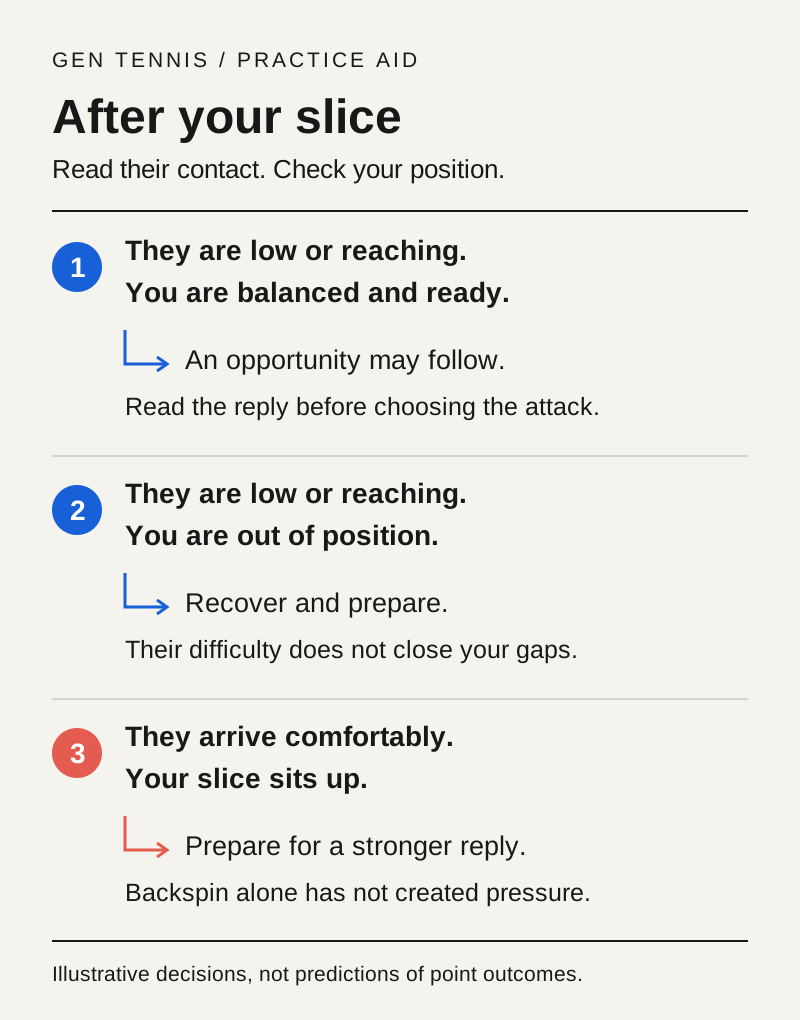
A low contact can require the opponent to lift the ball to clear the net. A reaching contact can limit their available swing. Either may create a useful next ball, but neither guarantees one: a skilled opponent can still find depth, an angle or a passing shot from an uncomfortable position.
Look at the whole situation. Did the opponent have to move away from a comfortable hitting position? Did they arrive with time to organize? Where are you while they strike? An awkward contact is much less useful to you if your own recovery has left a large space open.
The opposite case is easy to miss. A slice that hangs up and lands short may allow an opponent to move forward, settle and choose a strong reply. Their contact can be comfortable even though your ball had backspin. Spin alone does not specify the bounce you will get; flight, speed and the court also matter. Judge what happens on this court, against this player.
Depth and height change the bargain
A sufficiently deep slice can keep the opponent from stepping well inside the baseline. A shorter one may draw them forward into a low contact. These are different ways of changing the rally, and they carry different risks.
For a recreational player, deliberately shortening the ball is most useful when the opponent actually has to hurry forward or lift from a difficult position. If the ball sits up, you have brought them closer to the net with time to attack. Do not treat “short” as a synonym for “clever.”
A deeper target offers more space to work with than a delicate short slice, but it still needs a controllable flight. Start with a generous area you can reach repeatedly. The right first experiment is usually whether your ordinary slice changes the reply—not whether you can carve an extreme angle.
Following it to the net is a second decision
An approach slice works as part of a sequence: a playable incoming ball, a purposeful placement, forward movement and readiness for the opponent’s answer. The USTA’s singles approach guidance emphasizes the value of taking time away and judging court position and geometry. A change of spin does not remove those requirements.
If you can contact a shorter ball with balance, make the opponent play from a less comfortable position and cover a sensible reply, moving in can be worth testing. If you are reaching, the ball floats, or the opponent arrives comfortably, expect a tougher pass. Continuing blindly because you had already decided to approach is not the lesson to borrow.
Use our baseline-to-net guide for the approach, split and first-volley sequence. This article’s question comes one step earlier: did the slice create conditions that support that move?
A cleaner flight starts with a simpler intention
In USTA guidance on the backhand slice, Karl Davies warns that a high-to-low cue can lead players to chop the ball into the net. His high-to-level cue encourages a more forward-moving racket path. Treat that as a coaching cue to explore with someone watching you, not a literal path every slice must follow.
For your own session, notice whether the ball travels toward the intended area or repeatedly pops up or dies in the net. Reduce the difficulty of the feed before adding more swing instructions. A familiar grip, a workable contact distance and a controlled target give a coach something useful to observe.
In FLOW Tennis, the relevant connection is keeping reading, movement, organization, contact and recovery linked. The slice’s different pace should not become a pause in your attention. Once you strike, organize for the next contact rather than watching your own technique.
Try a comparison that includes the next ball
This is a GEN Tennis partner exercise, not a validated performance test. Use it after a comfortable warm-up, with feeds and pace both players can manage. Begin from the same backhand-side starting position and agree on a broad target away from the lines.
Play one small set of points using your familiar backhand from the starting feed, then another using a controlled slice toward a similar area. For example, six starts of each is enough to begin noticing a pattern; the count is a practical choice. Change roles and alternate which shot you try first. Allow restarts when the feed is clearly different.
Record three things: whether your ball reached its intended area, whether the opponent contacted comfortably or had to adjust, and whether you were ready for the reply. Include misses. A slice that occasionally produces a weak ball but frequently floats short may be a poor choice in the situation you tested.
Only then add the option to approach. Choose it from the incoming ball and the quality of your shot, while preparing for the opponent to respond well. If the exercise becomes rushed, return to the rally comparison. Use the practice planner to give the experiment a manageable place in your session.
Borrow the question Federer’s slice raises
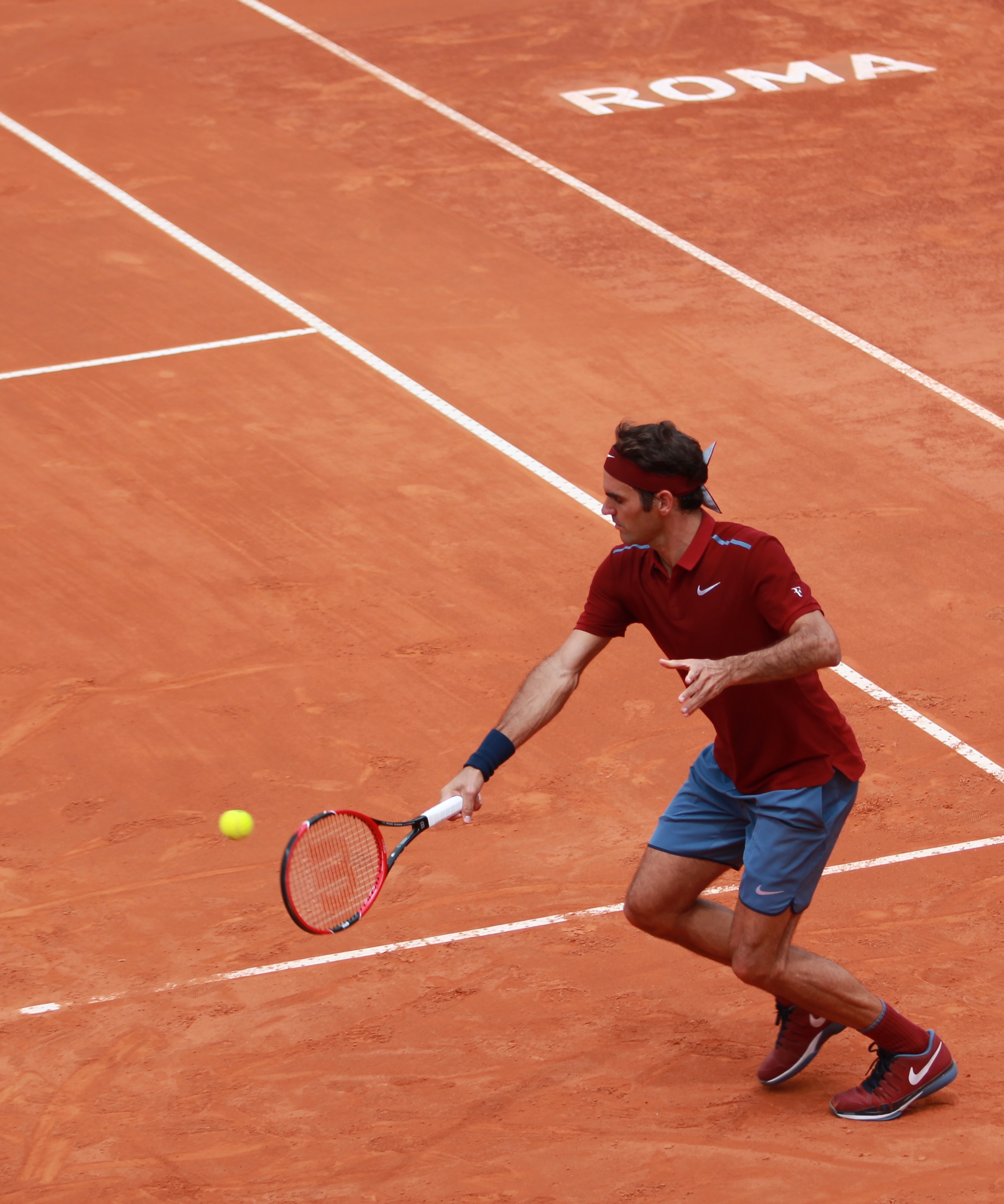
For a younger player, the useful model is the purpose of the variation. Ask what the shot did to the opponent’s next contact and what it allowed the hitter to do afterward. A photograph of a graceful follow-through cannot answer either question by itself.
Keep the slice when it helps you solve a problem you can describe. If it only changes the appearance of the rally while making the opponent more comfortable, work on its execution or choose another ball. The attacking opportunity belongs to the sequence, not to the name of the stroke.
Our editorial standards · Questions or corrections? Contact the editor.
Sources
Keep reading.
How do you move from the baseline to the net without rushing?