
You got there. Why is the shot still awkward?
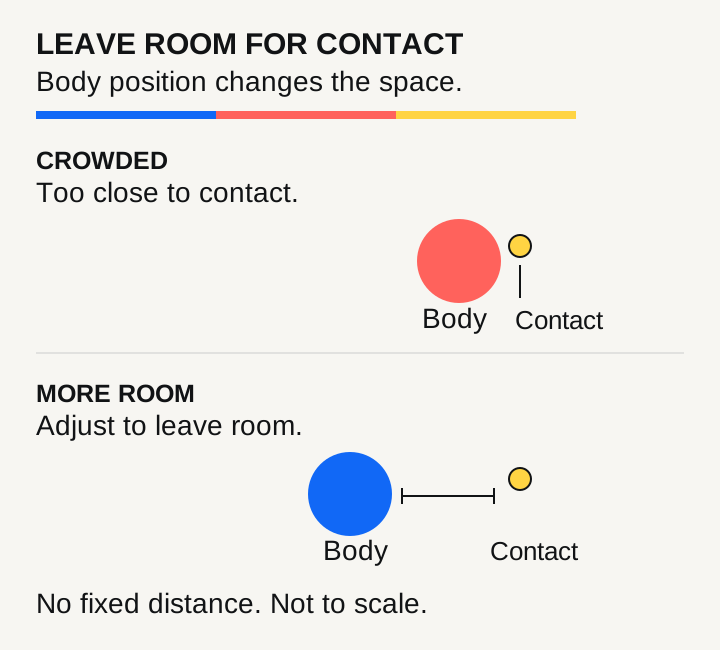
Getting to the ball does not guarantee a comfortable shot. You also need room between your body and the intended contact, preparation that fits the available time, and movement you can organize into a swing and recovery. Running faster solves only some of those problems.
Picture a short ball. You sprint directly toward its bounce, arrive beside it and discover that your elbow is crowded against your body. Now the arm has to rescue the shot. On another ball, you arrive early, plant your feet and wait. The ball rises or travels farther than expected, leaving you reaching. The first player overruns the space; the second stops updating it.
The following groundstroke exercise is a coaching suggestion for recreational players. Start with manageable feeds and adapt it with your coach. The aim is to connect reading, movement and hitting—not to impose one footwork pattern on every ball.
Separate where, when and how the movement connects
Spacing is where your body is relative to the contact you intend to make. Timing is when the racket arrives there. Rhythm is how preparation, adjustment, swing and recovery connect as the available time changes. Movement includes traveling, slowing down, adjusting, supporting the stroke and getting ready again.
A player can have enough space but start the forward swing late. Another can swing at the right moment yet be so close that the racket has no comfortable route. Calling both problems “bad timing” makes the next instruction less useful. First notice whether you were crowded, stretched or simply rushed.
The USTA’s contact-point guidance identifies getting too close as a common beginner difficulty. Its basic forehand guide describes contact to the racket side and somewhat in front. That is a starting picture, not a ruler: grip, ball height, stroke and situation change the position. Seek usable room, not a compulsory number of inches.
Travel toward a hitting position
Watch the incoming ball and move toward a place from which you can strike it, rather than treating its bounce as the place your body must occupy. On a manageable feed, cover the larger distance first, then use the steps needed to refine your position. Keep reading the flight and bounce; your first estimate can be wrong.
For the short ball that keeps jamming you, try slowing your approach sooner and leaving space to the racket side. For a ball that keeps pulling you into a reach, check whether you stopped adjusting too early. Neither correction means shuffling constantly. Sometimes one adjustment is enough; sometimes the incoming ball forces contact while you are still traveling.
Braking belongs in tennis. Giles and Reid studied 18 professional players hitting running forehands at different entry speeds and found that movement speed changed aspects of stroke and lower-body mechanics. That supports considering travel and hitting together; it does not establish one ideal rhythm for recreational players. Smoothness is a useful coaching image, not a claim that players never stop or decelerate.
Prepare while you move, without guessing the shot
As the direction becomes clear, let your shoulders and upper body turn with the racket. The USTA’s forehand instruction emphasizes this unit turn rather than simply taking the racket back with the hand. Preparation can happen during the journey; arriving and only then beginning a large backswing leaves another job to do under pressure.
Early does not mean committing to a forehand before you can read the ball. Be ready around your opponent’s contact, then organize for the direction you see. On a faster ball, a smaller preparation may fit the time better than trying to reproduce your full practice swing.
Think of legs, hips, trunk, shoulder, arm and racket as parts of a coordinated action, not isolated switches to activate in a forced sequence. Your arm still has an essential job. In this exercise, “arming the ball” describes trying to manufacture the whole shot with the arm after spacing or preparation has broken down. Check those earlier jobs before demanding a harder swing.
Use 1–2–3 as events, not equal beats
The numbers below follow the ball. The gap between the opponent’s hit and the bounce will not necessarily match the gap between the bounce and your contact. Say the numbers at the events, not at a fixed metronome pace.
- 1 — Opponent contact: read the direction and prepare as it becomes clear. Coordinate your readiness and first movement with what you see.
- 2 — Bounce: check your spacing and preparation. Keep adjusting if the ball requires it. Being organized early is an aim on an easy feed, not a universal deadline to freeze your feet.
- 3 — Your contact after the bounce: send the ball toward a generous target, then recover for the likely next reply. Recovery position depends on the point, not an automatic trip to the exact center.
Try it first with a predictable ball
Ask a partner or coach for gentle forehand feeds to roughly the same area. Use a slower ball or shorter distance if that makes contact manageable. Clear loose balls before each block. This progression is an original practice suggestion; the counts are convenient, not research-derived.
- Six predictable feeds: quietly call 1 at the feed contact, 2 at the bounce and 3 at your hit. Notice whether you are crowded, reaching or ready to swing without a rescue movement.
- Six feeds with modest depth variation: keep the pace manageable but mix slightly shorter and deeper balls. Continue adjusting after the bounce when needed. If rushed swings return, reduce the variation before adding speed.
- A cooperative rally: use the same checkpoints without speaking. Choose a broad target and include recovery. See whether the adjustment survives a less predictable exchange.
Change the part that actually broke down
After the block, choose one observation. Repeatedly crowded? Change the approach and leave more room. Plenty of room but a rushed swing? Review when preparation starts. Comfortable contact followed by a desperate chase? Include recovery in the task. If you cannot tell, ask your partner to watch one of those details rather than judge the entire stroke.
Take one useful sentence into the next session: “I’ll read early, leave room and keep adjusting.” Rhythm does not mean moving at one speed. It means coordinating the jobs around the ball you actually receive.
Our editorial standards · Questions or corrections? Contact the editor.
Sources
- USTA: Find your optimal contact point (March 27, 2018; checked October 2, 2026)
- USTA: Tennis 101 — the forehand (January 1, 2017; checked October 2, 2026)
- USTA: Get your forehand flowing (June 29, 2018; checked October 2, 2026)
- Giles & Reid: Applying the brakes in tennis (published online September 16, 2020; February 2021 journal issue). Original research in 18 professionals; abstract supports the limited movement/stroke discussion above.
Keep reading.
Open or neutral stance: why did two coaches teach me differently?