
What should the colored stages help a child do?
Your child can hit a hard forehand, but a rally still ends after the first return. Another child hits more gently and can start a point, move for the reply and keep the score. Which one is ready for the next group? The answer needs more than a birthday or a look at the fastest shot.
Britain’s LTA Youth program offers a useful way to examine that question. Its published approach connects learning strokes with movement, decisions and playing the game. For a parent, the practical aim is to understand what the current group is teaching and what a change of stage would ask the child to do.
This is the first focused British-methodology installment in our federation development series. It examines the LTA’s published junior coaching framework, rather than ranking national systems or assessing an individual club. A program description tells us what is intended; a visit and a conversation reveal more about its local delivery.
Five stages, with more to learn than a different ball
The LTA currently presents five coaching stages: Blue, Red, Orange, Green and Yellow. Its parent guide lists Blue at ages 4–6, Red at 6–8, Orange at 8–9, Green at 9–10 and Yellow at 10+. Use those descriptions to start a placement conversation with the provider. They are not a diagnosis of an individual child’s ability or a substitute for a competition’s entry rules.
In the LTA’s descriptions, Blue emphasizes movement and coordination through games. Red introduces rallies, volleys, overarm serving and friendly competition on smaller courts with softer balls. Orange adds more tactical problems and serving-and-returning experience. Green moves to the full court while developing technique and independence. Yellow continues full-court play with the standard ball and exploration of playing styles.
There is an important parenting distinction here. Moving up changes the task; it does not merely award a more prestigious color. Before requesting a change, ask what becomes different in the next group and what the coach wants the player to manage there. A child might welcome a new challenge but still need help organizing the next shot.
The curriculum connects six kinds of learning
The LTA Youth competency document covers motor, technical, tactical, mental, social and competition skills. Those categories include movement and coordination, stroke control, choosing how to play a point, managing attention and mistakes, working with others, and understanding play and scoring. It is a broader description of development than reproducing an attractive swing.
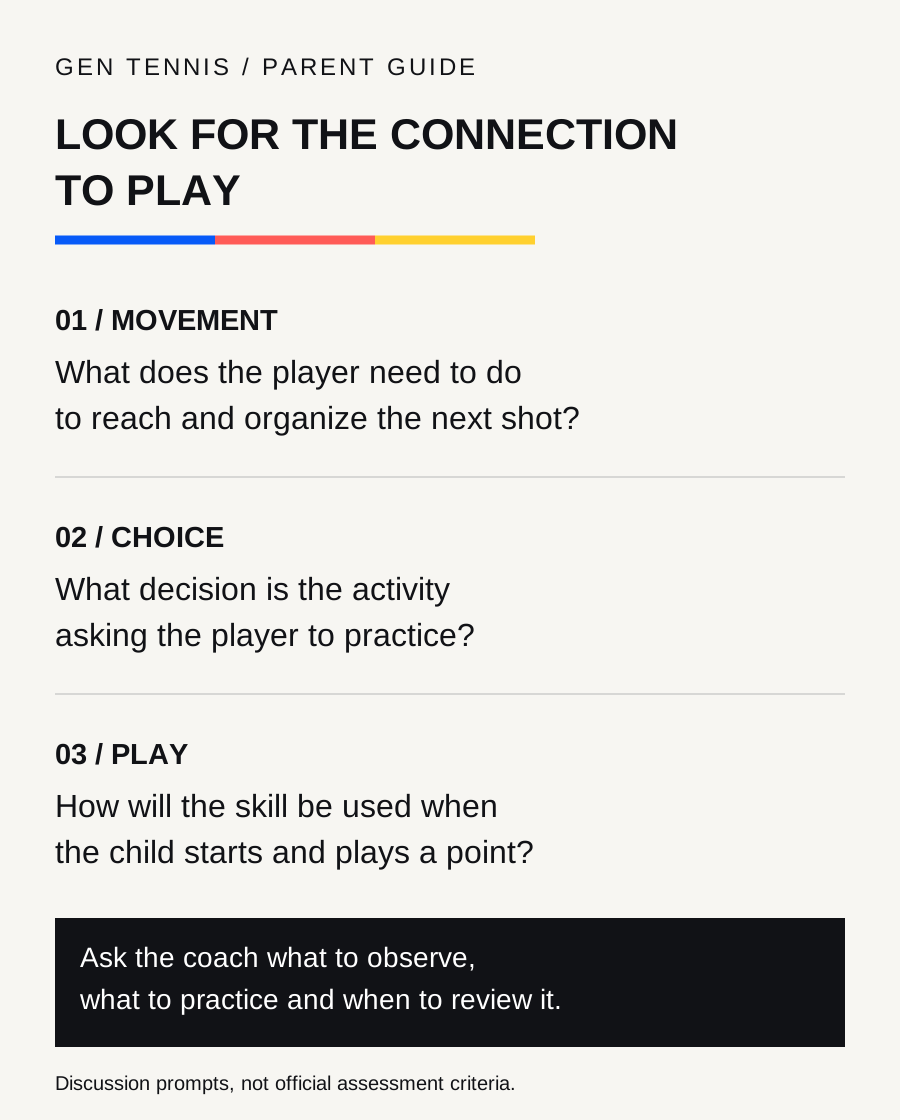
Consider a simple cooperative rally. In this GEN Tennis example, the pair tries to send each other a ball they can return. The player has to judge the incoming ball, move into a usable position, control the shot and recover. The partners also need to agree on pace and restart without blaming each other. One task can therefore raise several learning questions at once.
Now let each player choose between two generous target areas. The technical problem remains, but a decision has been added. If the rally collapses, the coach can simplify the feed, space or target before adding that choice again. This is an illustration of connecting a skill to a game problem, not a prescribed LTA lesson or a claim that every drill should take this form.
The useful question from the sideline is: what is this activity helping the child do when a point starts? A basket drill can have a clear purpose, and a noisy game can have a clear purpose. Neither its appearance nor its entertainment value alone establishes that learning has occurred.
Moving up: separate readiness from eligibility
Suppose an eight-year-old enjoys Red lessons and asks to join a friend in Orange. Ask the coach to explain the actual demands of that group: the space to cover, the ball, the serve-and-return task and the expectations for independent play. Discuss the child’s experience across several sessions, rather than using a single excellent or difficult day as the whole assessment.
A useful observation might be that the child starts points comfortably but struggles to recover when the opponent sends the next ball farther away. That gives practice a specific purpose. A vague verdict such as ‘not talented enough’ does not. There is no universal pass mark in the example here; the coach should explain the criteria they use and when they will review them.
A lesson placement and eligibility for an organized event are separate questions. Before entering, read that event’s current age, ball and entry requirements or ask the organizer. Do not assume that being invited into a training group automatically changes tournament eligibility. Equally, an older beginner needs a suitable learning experience, not an assumption that an age label means the underlying skills are already present.
Competition can be an introduction, not a final exam
The LTA’s Youth Matchplay offer is described as a first experience of individual competition: events of around two to three hours, singles and doubles with players of similar ability, and no overall event winner. That is a specific format. It does not mean every junior tournament follows those arrangements, or that children never count scores or win and lose individual matches.
For a first event, ask who helps with scoring, how players are grouped, what happens between matches and what your child needs to bring. Those details may matter more to the day’s success than whether the child has a polished backswing. Our first-tournament parent guide helps organize the practical side.
Afterward, ask about an experience rather than conducting a technical interrogation. Did they know when to serve? Could they restart after a disputed score or a missed ball? Was there someone they enjoyed playing? Choose one observation to discuss with the coach. These are suggested conversation starters, not an official assessment form.
What the federation supplies, and what to check locally
The LTA provides a competency framework, coach training, lesson resources and program support. Its coaching page specifies relevant qualification, accreditation and LTA Youth training requirements for delivery. Families can use its course and coach search tools, then verify the actual instructor and arrangements with the venue. The existence of a national framework does not establish that every session is delivered identically.
Ask who leads the class, how much time children spend participating, how mixed experience levels are handled, and how the coach communicates the next learning priority. Check the full cost and what it includes, the weather or cancellation policy, available court access between lessons and any adaptations the child needs. Those are local questions; this article has not surveyed providers or established a national price.
The LTA also describes a separate performance Player Pathway. Do not read the five coaching colors as automatic admission to county or national performance activity. Families considering that route should inspect the current criteria for the specific program. Our junior selection explainer considers why a selection decision and a prediction about a child’s future are different things.
Leave the next lesson with a useful plan
The LTA’s parent guidance includes playing with children or arranging opportunities with friends between lessons. If you do not play yourself, ask the coach for a simple activity you can support in a safe, appropriate space. You do not need to turn home practice into another lesson or add instructions you cannot evaluate.
For the next visit, watch one agreed task, ask what it is teaching and find out what to try before the following session. For example, the plan might be to start a gentle rally, recover after each shot and notice what changes when the partner sends the ball to a different place. Keep the task manageable and stop or simplify when it no longer serves its purpose.
Then agree when to review it. A useful update describes something the child can increasingly do and the conditions in which they can do it. That is more informative than collecting colors, counting lessons or treating every session as a trial for the next squad.
Our editorial standards · Questions or corrections? Contact the editor.
Sources
Keep reading.
Building confidence in junior tennis
Your child’s UTR: how to use it without letting it run their tennis