Give a player something they can use
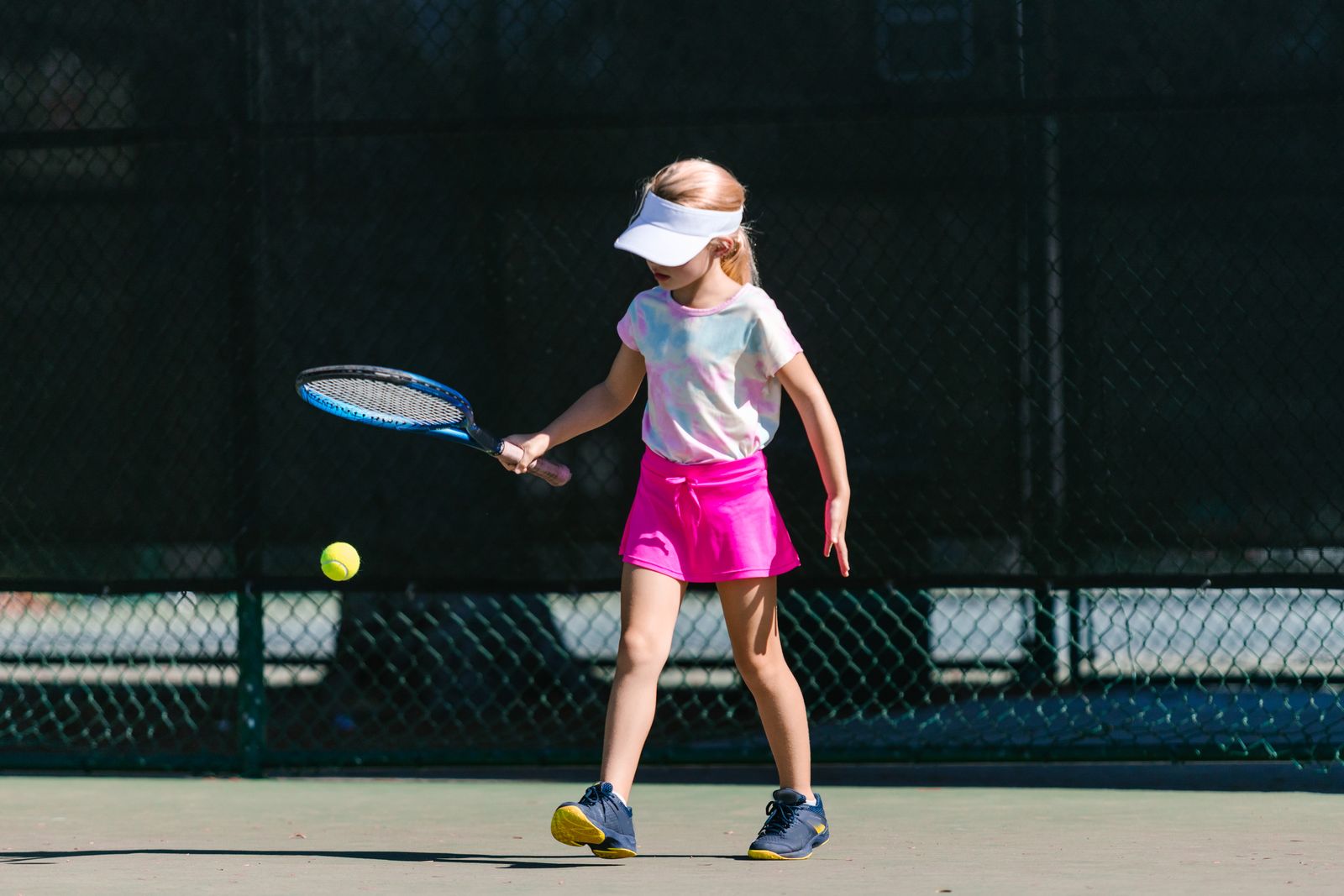
A young tennis player needs feedback they can use: what happened, what needs to change and how to work on it. Calling a child weak, unstable or hopeless supplies none of that information. A coach can demand concentration, effort and respectful behavior while keeping judgments about the player’s character out of the conversation.
An Instagram carousel by Ali Collins (@alicollins27), shared with GEN Tennis, brings that distinction into focus. Collins writes that a coach called her “mentally unstable” when she was 12. She also recounts later judgments that she lacked weapons and potential. These are her descriptions of her experience; GEN Tennis has not independently verified the conversations.
Her subsequent record includes ITF doubles titles and a Wimbledon women’s doubles appearance with Freya Christie in 2023. But her argument deserves attention regardless of those results. Respectful treatment should never depend on a child eventually proving an adult wrong.
What the evidence supports
Collins describes a damaging possibility: an adult’s repeated judgment becomes the language a young player uses about themselves. Her experience cannot establish how often that happens, or how many careers it changes. Research does, however, give us reason to examine the environment adults create.
A 2017 study by Yago Ramis and colleagues surveyed 1,166 Spanish athletes aged 9–18 across five sports, including tennis. Athletes who perceived more controlling coaching also reported more competitive anxiety. Because the study collected questionnaire data at one point in time, it establishes an association, not proof that a particular coaching behavior caused a child’s anxiety.
Intervention research offers another perspective. In a 2007 basketball study, Ronald Smith, Frank Smoll and Sean Cumming found that players whose coaches received training in a mastery approach reported decreases in sport anxiety across the season, while the comparison group’s anxiety increased. The approach emphasized learning and improvement. The study concerns a broader coaching environment, not a test of one phrase, and its results cannot be treated as a guaranteed tennis outcome.
Our reading is that adults should take their contribution to the learning environment seriously. Neither study supports a promise that changing vocabulary will produce champions. Neither makes humiliation a sensible development strategy.
High standards need specific language
A coach must sometimes say that a player’s effort was inadequate, a training goal was missed or a behavior was unacceptable. Useful feedback makes the issue observable and the next step understandable.
Consider a practice situation: a junior double-faults, throws a racket and refuses to continue. The coach needs to protect others and address the conduct. “Put the racket down. We are pausing because throwing it is unsafe” establishes a boundary. A discussion about what triggered the reaction, and what to do next time, can follow when the player is ready to engage.
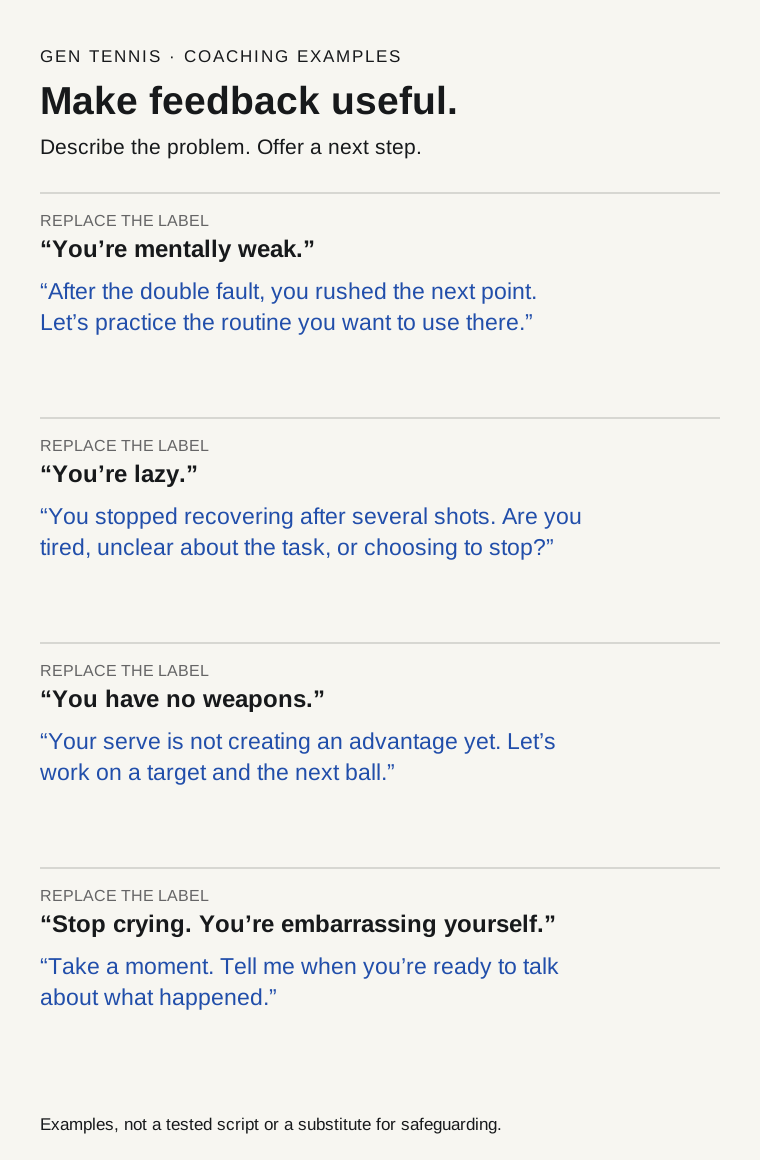
The comparison below offers GEN Tennis coaching examples, not quotations from Collins or findings from an experiment.
Precision also matters when praising. “You returned to your plan after that mistake” tells a player what was effective. Constantly calling someone a natural winner can leave just as little guidance for the next difficult day.
Check the tennis before diagnosing the mindset
A player who misses under pressure may have several problems at once. Calling the entire episode a confidence issue can close the investigation too early.
Suppose a junior repeatedly misses a short forehand. Did they recognize the shorter ball? Move far enough forward, then make room beside it? Organize the stroke while moving? Choose a target their contact position allowed? Or did they execute those parts reasonably well and become preoccupied with the score?
Those questions connect with the approach behind FLOW Tennis: examine ball recognition, movement, organization, contact and recovery together. FLOW is currently presented as GEN Tennis’s adult development framework; the relevant principle here is to investigate the task before judging the person.
A coach might simplify the feed, restore comfortable spacing, then gradually reintroduce variation and scoring. If the skill breaks down as those conditions change, that provides a specific practice question. It does not reveal a permanent character trait. Our guide to timing, spacing and rhythm develops this technical side.
Practice recovering from a mistake
“Be tougher” is difficult to practice. A short, agreed response to a missed shot is more concrete.
For an age-appropriate practice game, coach and player could choose a simple sequence: acknowledge the miss, take a comfortable breath, select one intention for the next point and get ready. The intention might be a generous return target or making room for contact. It should fit the player and the task.
Rehearse that sequence in manageable conditions before expecting it to survive a close match. When adding scoring pressure, review whether the player used the routine as well as what happened to the score. A good decision can still lose a point.
This is a coaching suggestion, not a treatment or a proven universal routine. The aim is to help a player act usefully while frustrated or nervous. Requiring a child to look cheerful after every mistake creates another performance demand.
Where the Instagram message needs more nuance
Collins is right to challenge adults who turn emotional struggles into identity labels. But it would also be too simple to assume every struggling child merely needs an emotional skill they have not yet been taught.
A coach cannot determine the cause from a difficult changeover. A child’s circumstances, health and experiences outside tennis may matter. Equally, a tearful defeat alone does not establish a mental health condition.
The National Institute of Mental Health advises considering professional help when a child’s emotions or behavior persist for weeks, cause distress or interfere with life at home, school or with friends. A pediatrician or another qualified health professional can help assess the concern.
Coaches can listen, adapt practice and involve parents appropriately. Where support exceeds their competence, referral is part of responsible coaching. A mental health diagnosis, if one exists, is also not a character flaw or a coaching insult.
What parents and clubs should notice
After a difficult session, start with an open question: “What happened, and what was that like for you?” Listen before offering a technical explanation or defending either adult. Record the child’s account accurately if there is a concern, including the words used, context and whether it has happened before.
For an ordinary communication problem, ask the coach what they observed, what they were trying to teach and what the player should do differently. Our guide to changing coaches offers a framework for that conversation.
Repeated personal attacks, intimidation or humiliation require a different response. The 2026 SafeSport Code includes repeated and excessive personal verbal attacks without a productive training or motivational purpose within emotional misconduct. The LTA’s child safeguarding policy also identifies persistent denigration, humiliation and threats as concerns. Applying a policy to a particular case requires its facts; a family does not need to make that determination before raising a concern.
Use the appropriate safeguarding route, such as USTA Safe Play or the LTA’s reporting process. A private confrontation with the coach should not be a prerequisite for reporting a safeguarding concern.
Clubs also need to make speaking up possible. The LTA identifies dependency on coaches for selection and progression as a potential vulnerability for elite children. In GEN Tennis’s view, a program should provide a clear contact beyond the player’s own coach, review how staff communicate and respond to concerns without making the child responsible for solving the institution’s problem.
Adults need to practice repair, too
A coach who has used a damaging label should address it directly. For example: “I called you lazy. That was unfair. I should have described what I saw and asked what was happening. We still need to work on recovery, and here is how we will do it.”
That is an example of taking responsibility while keeping a legitimate training goal. An apology does not replace safeguarding action where that is needed, and its value depends on changed behavior.
Collins’s post asks adults to consider the voice a player carries onto court. The practical test is what that voice helps the child do. Does it leave them defending their worth after a missed forehand? Or does it help them understand the problem, ask for support and attempt the next point?
A young player should be able to leave a demanding lesson knowing what needs work and believing they are still entitled to learn.
About the source post
This editorial was inspired by Ali Collins’s seven-slide Instagram carousel supplied to GEN Tennis. Her account is linked above; the original post permalink, full caption and exact publication date were not independently verified. Her experiences are attributed to her. The evaluation and practical examples are GEN Tennis’s.
Our editorial standards · Questions or corrections? Contact the editor.
Sources
- Ali Collins: Instagram account and source attribution
- LTA: Ali Collins career record
- Ramis et al. (2017): controlling coaching and competitive anxiety
- Smith, Smoll and Cumming (2007): coaching climate intervention
- NIMH: Children and Mental Health
- U.S. Center for SafeSport: 2026 Code
- LTA: Safeguarding Children Policy and Procedure
- USTA: Safe Play reporting
- LTA: safeguarding and reporting