
Use the number to choose the next question
Your child has won a match, lost another and opened their profile before getting back to the car. The number has barely moved. Should you change the tournament schedule, add lessons or worry that they are falling behind?
Use UTR as an estimate of current competitive level, informed by recorded results. It can help identify suitable opponents and investigate college programs. It does not tell you what a child should achieve at a particular birthday, diagnose a stroke or predict their ceiling. Before changing the plan, check the results behind the number and connect them to something the player and coach can actually work on.
What UTR measures, and which rating you are reading
Universal Tennis Rating places players on a 1.00–16.50 scale. UTR Sports says the calculation uses results rather than age or gender. Its published method combines recent match ratings, ordinarily up to 30 within the previous 12 months, with different weights. Opponent level and the share of games won matter; match format, opponent reliability and recency also affect weighting.
That means the score matters beyond the win or loss. A competitive defeat and a one-sided defeat against the same opponent provide different information. Neither score, on its own, tells you the exact change to expect in the overall rating.
Check the label before comparing players. Singles and doubles are separate. Verified UTR uses verified event results; the broader UTR can also include self-posted and practice results. A projected rating, marked P, is provisional. UTR Sports says roughly five results are needed for reliability. That is not a five-match development test, and two displayed decimal places do not make a small difference a decisive selection rule.
What is a good UTR for a 10-, 13- or 16-year-old?
A useful answer needs a goal and a setting. A number that helps a 16-year-old compare specific college teams does not establish what every 13-year-old should already have achieved. USTA’s American Development Model asks coaches to consider developmental level, rather than age alone. Its youth-development guidance also recognizes physical differences between children of the same chronological age.
Consider three hypothetical families. For a 10-year-old beginning competition, ask whether the ball, court and event make serving, rallying and scoring manageable. Check the actual event’s progression rules. For a 13-year-old with uneven results, compare recent match situations and learning priorities before adding travel. For a 16-year-old interested in college, start a dated program shortlist alongside academics and eligibility planning.
Those ages illustrate different questions, not deadlines. Starting age, experience, opportunity and development can differ. Ask what the player can do now, what is improving and what the next environment requires. A rating-by-age chart cannot make that decision for the family.
Choose competition that produces useful tennis
Suppose your child is winning easily every weekend but rarely has to defend or solve a different ball. A more demanding event may reveal useful work. If every match is an overwhelming defeat with few sustained exchanges, another expensive trip to the same level may provide little new information. These are coaching judgments to discuss, not automatic rules based on a rating gap.
Use current ratings to help find a competitive group, then ask the organizer about formats, opponents, guaranteed play and result reporting. Check reliability as well as the headline number. A recently rated player may be harder to place than an established one.
UTR Sports recommends varied opponents above and below your level. That does not mean packing the calendar to feed the algorithm. Include opportunities to manage being the favorite, respond to pressure and try a developing skill. Choose a schedule the family can sustain, with practice between events. Never make avoiding a lower-rated opponent the purpose of the competition plan.

A flat rating needs a closer look
UTR recalculates daily. Its help center explains that opponents’ changing ratings and older results dropping out can move your number even when you have not played. A small change is therefore not a clean measurement of what happened in yesterday’s lesson.
Review a block of matches with the coach. Is the same problem recurring, or is a new skill appearing more often even though results remain uneven? Imagine a player learning to return deeper: record the task, the type of serve faced and whether the return creates a playable next ball. Those observations help explain the tennis behind the score.
Agree on one practice priority and a review point. Watch it in practice and then in points. Improvement in that task does not guarantee a rating increase, but it gives the next lesson a purpose. If the rating and the observed tennis both stagnate, investigate the practice design, competition fit and player’s experience before simply buying more hours.
High school: ask how your own team selects players
Before tryouts, ask the school coach whether ratings are used, what on-court evaluation involves and how singles and doubles opportunities are decided. There is no useful national UTR cutoff for making every high school team. The relevant comparison is that program’s current players and selection process.
A new player should ask about beginner, junior-varsity or other participation options rather than assuming an unrated profile closes the door. For an experienced tournament player, clarify attendance, team commitments and doubles expectations. A rating cannot answer those practical questions.
College: compare programs, then verify the opportunity
UTR Sports’ College Fit tool, offered through its Power subscription, lets families compare a player with college rosters across NCAA, NAIA and NJCAA programs. It is a research starting point. Matching the number of someone on a roster does not establish an available place, admission or scholarship.
Build a small, dated comparison sheet. For each program, record the academic fit, current roster, recent lineup, likely graduating players, full cost and the coach’s stated recruiting needs. Compare with several players, including those actually competing. A team average can hide substantial differences within the squad.
When contact is permitted, the player can introduce their graduation year, academic interests, match results, video and reasons for considering that school. Ask how the coach sees their level fitting the program. Check current sport- and division-specific recruiting rules, and handle academic and athletics eligibility through the governing body and institution. NCAA Division III does not award athletics scholarships.
Also know which rating the event uses. UTR is one part of the landscape: the ITA identifies World Tennis Number as its exclusive official rating and states that its 2026 Summer Series results are shared with WTN. Do not assume every college-related result feeds every rating, or treat a number from one system as interchangeable with another.
Leave the next review with a decision
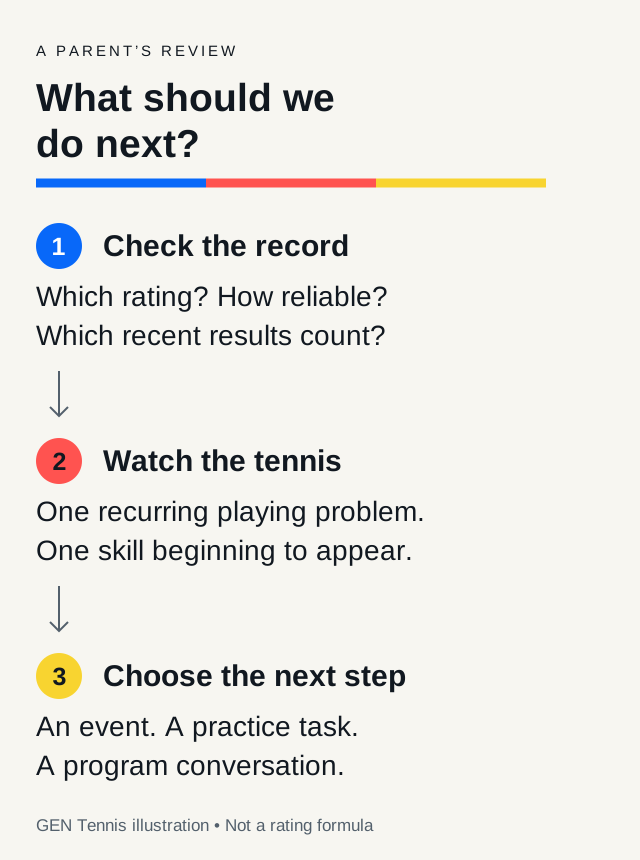
Bring three things: a checked match record, one recurring playing problem and the next real decision. That decision might be choosing a local event, changing a return exercise or contacting a realistic college program. Ask your child what they want help with, too.
The rating earns its place when it helps you choose a useful next step. Keep the practice plan, schoolwork, budget and the player’s willingness to return to the court in the same conversation.
Our editorial standards · Questions or corrections? Contact the editor.
Sources
- UTR Sports: rating scale, results and algorithm summary
- UTR Sports: match rating and weighting calculation
- UTR Sports: projected ratings, Verified UTR and algorithm FAQ
- UTR Sports: why a rating can change without new play
- USTA: American Development Model principles
- USTA: Positioning Youth Tennis for Success, physical development discussion (PDF, page 63)
- UTR Sports: College Fit and college-pathway tools
- NCAA: recruiting rules and current calendars
- NCAA: academic and athletics eligibility
- NCAA: Division III and athletics scholarships
- ITA: 2026 Summer Series and World Tennis Number
Keep reading.
Your child’s first tennis tournament: a parent’s practical guide