Start with the lesson your child actually receives
A child can hit a tidy forehand from a coach’s feed and still struggle to start a point, reach an unfamiliar bounce or choose where to send the next ball. That gap is a useful place to begin when a club describes its program as a “development pathway.” What connects the lesson to the game?
Federations help build that connection through teaching frameworks, adapted equipment, coach education, competition and, for selected players, performance support. Their published programs are not all identical. Nor does a national framework tell you exactly what happens in every affiliated club. For a family, the useful test is whether the local coach can explain what the child is learning, how it appears in play and what would justify changing the next task.
This overview compares published guidance from the United States, Great Britain and France. It is a guide to asking better questions, not a ranking of national systems or a claim that GEN Tennis has observed these programs in operation.
The smaller game is a teaching environment
The ITF’s Tennis Play and Stay approach puts serving, rallying and scoring near the beginning of learning, using slower balls and adapted courts. The point is to make an exchange possible while skills are developing. A player can work on direction, recovery and the consequences of a choice before managing a standard yellow ball over a full court.
Progression therefore changes the problem, not just the equipment color. A larger court asks the player to cover more space; a different ball changes the time and contact demands. Ask what the child can do with the current setup and what becomes difficult with the next one. Our coaching suggestion is to look beyond a neat stationary swing: can they start the rally, organize around different bounces and continue after their first shot?
Training readiness and competition eligibility are separate checks. In the U.S., USTA’s PlayTracker has age and progression requirements for its 10-and-under events, including a coach-assessment route in specified circumstances. Check the child’s current eligible level and the actual event rules before entering. A coach’s useful practice choice does not automatically change tournament eligibility.
Three frameworks, with different teaching emphases
United States: USTA’s American Development Model emphasizes coaching and play appropriate to developmental level, foundational movement, a player-centered environment, multi-sport participation and informed parents. For a family, that supports a concrete question: how is this session adapted to what this player can currently do, rather than only to their birthday or the group’s label?
Great Britain: LTA Youth describes a progression from early movement games through red, orange, green and yellow stages. Its competency framework connects motor skills with tactical, technical, mental, social and competition skills. Groundstrokes include positioning around the ball; tactics include controlling space and time. Technique is part of solving a playing problem, not a separate graduation requirement before a child may compete.
France: the FFT’s Galaxie Tennis optimization guide makes match play central to the session and combines technical and tactical workshops with movement activities. Its teaching objectives include recognizing easier and harder balls, choosing targets and trajectories, finding balance and controlling contact. The guide asks coaches to use match observations to adjust what they teach. These are published expectations, not evidence that every French club follows the same lesson.
What connecting technique and tactics can look like
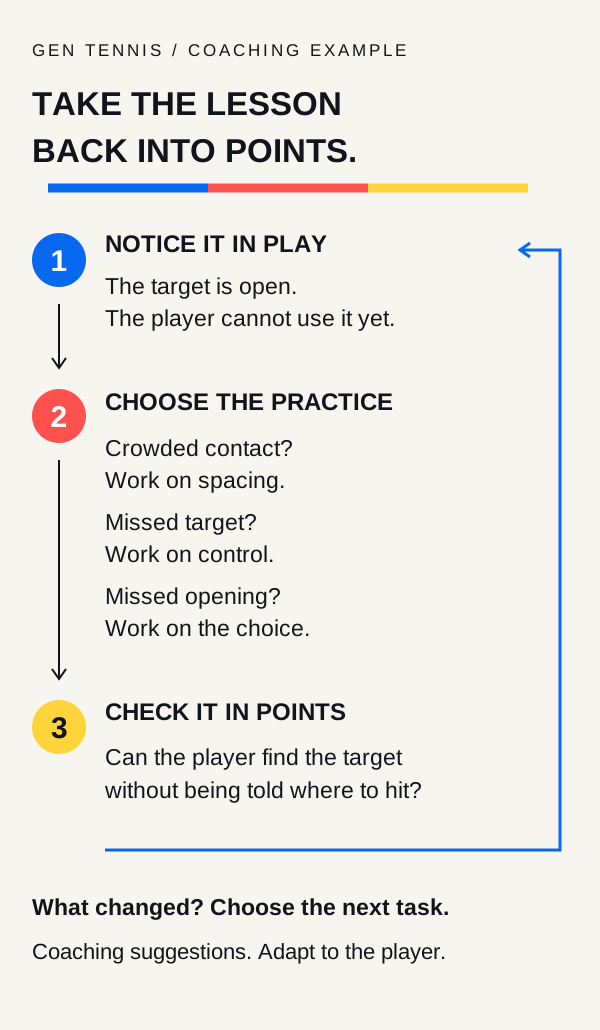
Imagine a junior who can rally cooperatively but sends every ball back to the same place in points. “Work on the forehand” is too broad. A more useful learning problem is: can the player recognize an open area and direct a manageable ball there? The following is a GEN Tennis coaching example, not an official federation lesson plan.
Begin with a cooperative rally into a generous target. If the player gets crowded by the bounce, the coach can work on movement and spacing. If the player arrives well but cannot direct the ball, the coach can simplify the feed and help with racket control. That focused repetition has a job: make a particular choice easier to execute.
Next, offer a choice between two broad targets, then play points without announcing the target. Watch whether the child recognizes space while keeping the exchange playable. If recognition disappears as soon as scoring begins, more identical feeds may not answer the problem. Reduce the pace or simplify the choice, then test again in play.
The same connection matters for serving, returning and moving forward. A coach can isolate a detail when needed, but should be able to explain when and how the player will use it against another person. Games and technical work can inform each other throughout a session.
Competition should give the coach something to work with
A child’s first competitive experience need not resemble a professional tournament. USTA lists Team Challenge as an introduction to competition, Junior Team Tennis as local team play and Junior Circuit as non-elimination events. These are different settings for practicing the jobs around a point as well as the strokes.
When choosing an event, ask whether the child will have suitable opponents, understandable scoring and enough opportunities to play. Afterward, bring the coach one observable problem: the player could return in warm-up but struggled when the serve direction changed, for example. That leads to a more useful next session than “they need to win more.” Our separate first-tournament guide covers the practical day; here the concern is what competition teaches the training plan.

Know which organization is responsible for what
A national federation’s curriculum, coach resources and competition structure are one layer. Regional or local bodies may coordinate opportunities closer to home. The club, community provider or academy and its coaches deliver the sessions the player attends. Ask who owns the weekly plan and who communicates when outside camps, lessons or events add another demand.
The FFT guide identifies regional technical support for implementing its program. In Britain, the LTA describes regional and national performance stages separately from its introductory youth offer. A selected training opportunity is therefore a specific service with entry conditions, not a promise that every beginner moves through one continuous ladder.
If an academy or performance program is proposed, ask which responsibilities it will actually take on: daily coaching, competition planning, school coordination or something else. Get the fees, selection and review arrangements from that provider. A federation relationship does not answer those questions by itself, and an academy is not automatically a national training center.
Check the coach’s support—and the player’s next step
Coach education is part of delivery, not merely a badge on a website. LTA Youth provides program training, lesson plans and a competency framework; USTA’s ADM includes coach and official education among its principles. Ask who will coach this group, what relevant preparation they have and how they adapt a session when children need different challenges.
For a player offered additional performance support, the next conversation should cover what changes this month: partners, coaching responsibilities, travel, cost and the review date. For a player not selected, the immediate coaching work still needs a clear purpose. Selection deserves its own discussion; it should not replace the explanation of how the child will learn.
At your next review, ask the coach to name one current learning problem, show where it appears in points and explain the next practice task. Then ask your child what they are trying to do. If those answers connect, the pathway has become something more useful than a diagram: a plan the player can understand and use.
Our editorial standards · Questions or corrections? Contact the editor.
Sources
- ITF: Tennis Play and Stay — adapted equipment and serve, rally, score
- USTA: American Development Model — key principles
- USTA: Net Generation PlayTracker — event formats and eligibility
- LTA: Youth coaching — stages, training and resources
- LTA: Youth competencies — movement, technique, tactics and competition (PDF)
- FFT: Guide de l’Optimisation Galaxie Tennis — teaching objectives and match play, pages 15–18 (2025 PDF)
- LTA: Performance Player Pathway — regional and national stages