
At GEN Tennis, our starting point is that winning today and becoming a better player are connected, but they are not always the same assignment. You can win a match by relying on familiar habits that limit your development. You can also lose while learning to use a better serve, make a more appropriate attacking decision or stay engaged when the score turns against you.
That does not make the score irrelevant. When you enter a match to compete, trying to win is part of respecting the contest. It means recognizing what works against this opponent, with your current abilities, under today’s conditions. The challenge is to know which objective comes first, and to avoid confusing a result with the quality of the decisions that produced it.
Our FLOW Tennis winning philosophy puts it this way:
Develop the game you want to own. Compete with the game you have today. Keep improving your decisions in both.
This is GEN Tennis’s coaching framework, not a claim of a scientifically validated advantage over other methods. It gives us a useful starting question: What am I trying to achieve in this match, and what is my best available next play?
Snoopy understands the problem
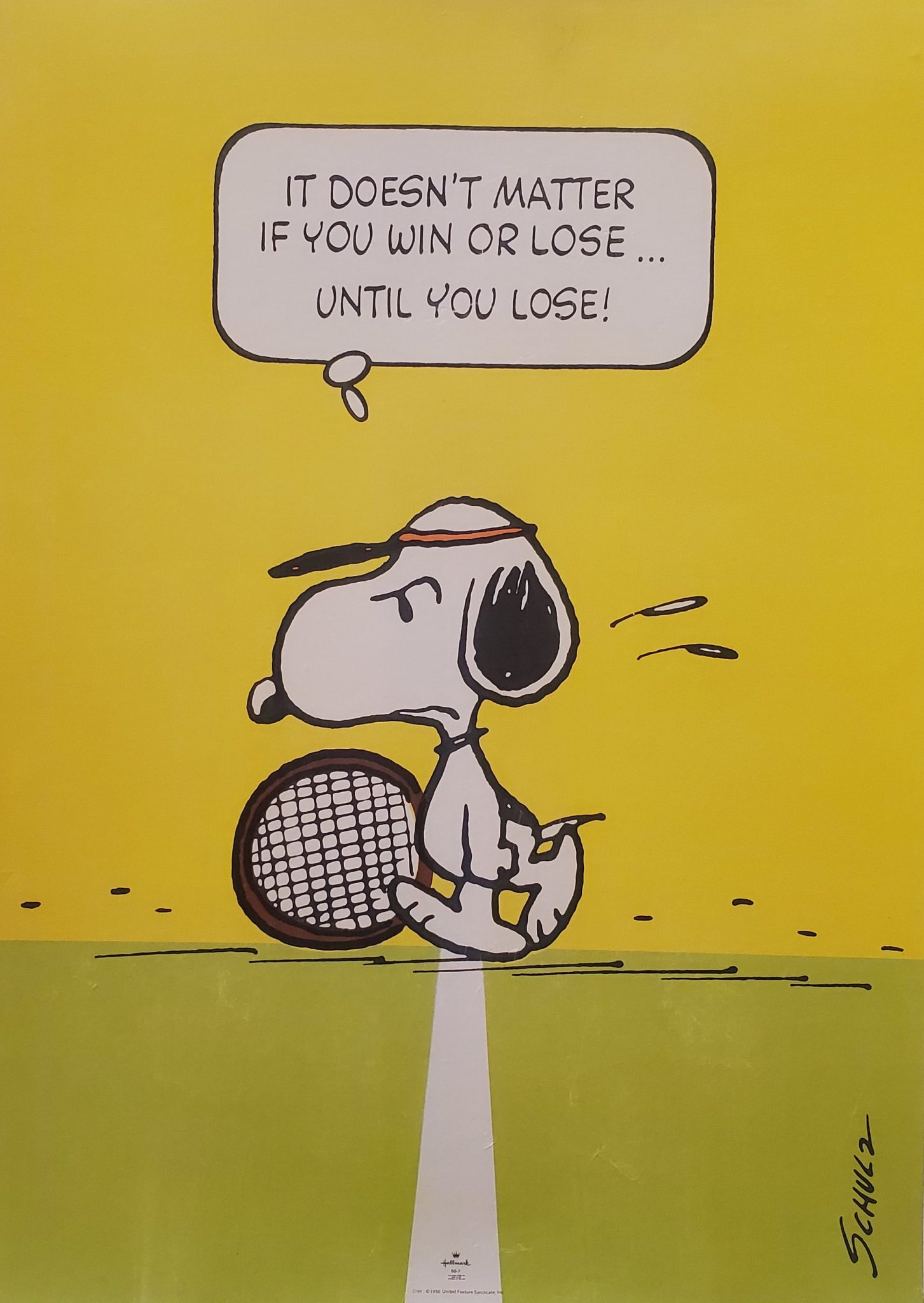
The poster’s punchline turns an abstract principle into a personal experience: losing feels different when it happens to us. We can sincerely believe in enjoyment, learning and sportsmanship, then feel very differently at 5–5 after missing a comfortable volley. Parents can experience the same shift from the sideline. A match described as good experience on the drive there can become a disappointing result on the drive home.
The answer is not to pretend that losing feels good. It is to establish what matters before emotion starts changing the agreement. A useful philosophy of winning must work when we are disappointed, not only when we are explaining ourselves afterward.
Decide what this match is for
In development-led play, a player gives a chosen skill meaningful use under pressure. A junior working on a more dependable second serve might keep using the agreed motion in a practice set, rather than reverting to a familiar tap whenever the score gets close. Success includes what the player attempted, how the ball behaved and what needs further work. It does not require calling every miss progress.
In result-led competition, the immediate task is to find a workable way to win with the skills available. The same player might choose a larger serve target or a different first-ball pattern. Introducing an unpracticed technical reconstruction at break point is a different proposition from trusting something already trained.
These priorities can coexist. A match can have a result goal and one development intention. What creates confusion is changing the primary goal without acknowledging it: demanding experimentation, then criticizing the child for the score; or claiming to prioritize improvement while avoiding the uncomfortable stroke every time it matters.
Agree on three things before playing: the main objective, one action that serves it and what would justify changing the plan. In a league match, that might mean competing to win, returning firmly through a large crosscourt area, and changing position if the serve repeatedly jams you. In a practice set, it might mean rehearsing the first volley after an approach, then reviewing whether your positioning allowed a controlled contact.
Three coaching approaches, three different jobs
The mental side of tennis is often reduced to confidence or toughness. Different coaches address different problems within it. The comparison below is our interpretation of their published work, not a claim that they endorse FLOW or offer interchangeable systems.
Brad Gilbert: solve the match in front of you
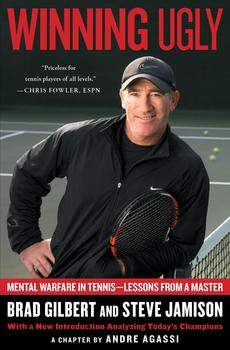
Brad Gilbert with Steve Jamison
Publisher details and chapter excerpt
In Winning Ugly, written with Steve Jamison, Gilbert treats preparation and opponent analysis as competitive skills. The publisher’s chapter-one excerpt, copyrighted 1993, explains how he develops different plans for different opponents rather than assuming one preferred style will always work. His aim is modest in one important respect:
“And that’s all I’m trying to do when I play, improve my chance of winning.” [1]
The useful lesson is to connect a reliable skill to an observed problem, whether that involves height, depth, pace or movement. The title is not permission to cheat; the same excerpt rejects deliberate lateness as unsportsmanlike.
Our application: identify a pattern worth testing, then observe its effect. A backhand is not a weakness simply because it is a backhand. If the opponent handles your crosscourt ball comfortably but struggles when moving forward, your original diagnosis needs updating.
For a developing junior, this approach also needs a longer-term check: protecting a weakness can help today, but it cannot be the entire training plan.
Timothy Gallwey: give attention a useful job
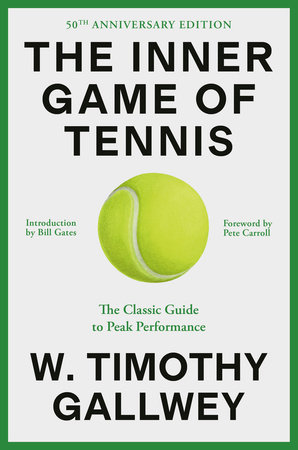
W. Timothy Gallwey
50th Anniversary Edition
Explore the book at its publisher
Gallwey’s The Inner Game of Tennis, first published in 1974, examines how self-doubt, judgment and constant internal instruction can interfere with playing. Its emphasis on “relaxed concentration” offers a different starting point from tactical analysis. His official institute describes coaching through awareness rather than an uninterrupted stream of corrections. [2, 3]
Our application: once you have chosen a target, stop holding a technical committee meeting during the swing. Attend to information you can use: the incoming ball, your spacing and the intended ball flight. In practice, observe where the ball went before deciding what the miss says about you.
That does not make technique unnecessary. A player can be attentive and still need instruction on movement or contact. Gallwey’s Self 1 and Self 2 are parts of a coaching model, not literal divisions of brain anatomy. Our existing Inner Game explainer examines the learning claims and their limits more closely.
Jim Loehr: practice the time between points
Loehr’s author-written introduction to The 16 Second Cure emphasizes what players do between rallies, rather than treating those intervals as empty time. A USTA account of his 2022 parent webinar adds another dimension: evaluate the character a young person develops through competition, rather than using victory as the only scorecard. [4, 5]
Our application: build a repeatable transition from the previous point to the next. Notice what happened, settle, choose an intention and prepare to play. Keep it simple enough to fit the event’s rules and your own needs; the article title is not a universal timing prescription.
For parents, the second part matters just as much. Honest calls, respectful behavior and responsibility for one’s choices remain important when they do not produce a trophy. These are coaching priorities, not guarantees that a particular ritual creates mental toughness.
How the approaches fit together
| Approach | The question it helps answer | A useful boundary |
|---|---|---|
| FLOW | What is today’s objective, and what action fits the conditions? | Choose the purpose deliberately; do not invent a new one to excuse every result. |
| Gilbert | Which available pattern can trouble this opponent? | Match tactics should not become permanent avoidance of development needs. |
| Gallwey | What deserves my attention while I play? | Less self-criticism does not remove the need to learn technique. |
| Loehr | How do I become ready for the next point, and what conduct am I practicing? | A routine supports a task; it is not a result guarantee. |
The apparent conflict between thinking and not overthinking becomes smaller when we separate their timing. Analyze before the match and between points. During the rally, use a clear intention and remain responsive to the ball. Review afterward. Trying to solve every problem at the instant of contact is an unreasonable assignment.
What the champions actually say
Famous players are useful witnesses to their own experience. They are not proof that one mindset works for every child or adult. Their words also deserve context: a retirement essay, a commencement speech and a post-match interview answer different questions.
Roger Federer: commit fully, then release the point
At Dartmouth on June 9, 2024, Federer said he had won almost 80% of his singles matches but only 54% of the points. Those are figures he supplied in a speech, not a statistical analysis conducted for this article. His point was that even an exceptional career contains constant small losses.
“But when it’s behind you, it’s behind you...” [6]
He paired that release with full commitment while a point is being played. He also described deliberately challenging opponents’ strengths earlier in his career to expand his own options. That creates an interesting contrast with simply targeting weaknesses: sometimes the purpose is to broaden your game, not take the most comfortable route through a point.
Our reading: take the attempt seriously without carrying its emotional weight into every subsequent rally. The percentages are not a formula. Winning 54% of points does not automatically produce an 80% match-winning record; how points fall within games and sets matters.
Rafael Nadal: compete hard without needing contempt
In his December 17, 2024 essay The Gift, Nadal described his relationship with rivals:
“I was not fueled by hatred of my rivals, but a deep respect and admiration.” [7]
He also wrote about not treating himself as invincible after success or as a failure after defeat. The useful distinction is between wanting to beat someone and needing to diminish them.
For an adult who complains about losing to an opponent with awkward strokes, this is a practical challenge. The opponent’s game has created a problem. Calling it ugly does not explain how to solve it. For a child, respect does not mean entering a match already defeated; it means recognizing the other player’s abilities while looking for opportunities.
Nadal’s account is personal. It does not turn his professional sacrifices or choices about physical problems into instructions for junior families.
Serena Williams: ambition does not make losing easy
Asked about recovering from defeat in a June 7, 2016 Glamour interview, Williams said:
“I work harder. I study to see where I went wrong. But I carry the loss.” [8]
She described her coach encouraging her to move past defeats as she moved past victories. Our application: extract something trainable, then end the review. Her candor is more useful than the idea that a champion never struggles with disappointment.
Novak Djokovic: bring the problem back to the present
After winning the 2014 Wimbledon final against Federer, Djokovic was asked about his inner dialogue in the deciding set. His answer included:
“Just think about what is happening now and what you can influence.” [9]
He also described a concrete fifth-set task: consolidate his service games and look for opportunities on return. That connects attention to action. Being present did not mean ignoring tactics or pretending that the earlier missed opportunity had never happened.
Our application: after losing a lead, replace the whole-match story with the next manageable job. What serve target can you commit to? Where will you aim the return? What has the opponent just shown you? Those questions do not eliminate nerves; they give the next point a direction.
Turn the philosophy into a match plan
The following is GEN Tennis coaching guidance. The scenarios are illustrative, not reports of clients, interviews or measured outcomes.
1. Build the first two shots around something dependable
Before serving, choose a target and anticipate a plausible reply. If your serve through the body tends to produce a central return, prepare to organize behind that ball rather than admiring the serve. If the return comes somewhere else, respond to what actually arrives. A pattern is preparation, not a script the opponent has agreed to follow.
On return, decide whether you are trying to neutralize a difficult serve or take advantage of a manageable one. A blocked return into a large area may be sensible against pace. The same passive ball may hand control to an opponent whose second serve gives you time. Choose from the ball and your capabilities, not from a permanent identity as an aggressive or defensive player.
2. Identify how you are losing points
“I’m playing badly” offers no useful instruction. Distinguish between missing before the rally develops, being pushed behind the baseline, arriving crowded at contact and choosing attacks from poor positions.
Each suggests a different response. Several missed returns may call for a larger target or an adjusted starting position. Repeated short rally balls may require a change in height and depth. Missing while stretched wide is a different problem from missing a balanced attacking ball.
Do not assume every lost point needs correction. Sometimes the opponent plays well. If your reasonable return forces an exceptional winner, that does not automatically make the return a mistake.
3. Make one adjustment you can evaluate
Suppose you have missed several flat forehands in the wind. One option is to choose a higher trajectory and a target farther inside the lines, while continuing to swing with commitment. Watch whether this improves contact and depth, and whether the opponent can now attack the ball too easily. Margin is useful only if the resulting shot still does a job.
Against someone who dominates longer rallies, accepting more attacking risk may be sensible. The lesson is not always to hit another safe ball. It is to choose the risk with a reason.
Our guide to when to change direction down the line explores one such decision. Keep a plan long enough to learn something from it, but change it when a repeated pattern supplies a clear reason. There is no magic number of points that proves a tactic.
4. Let the score sharpen commitment
A close score can make players do opposite unhelpful things: stop swinging or attempt a shot they would rarely choose at 15–15. Neither follows automatically from the situation.
At break point, select a pattern you have reason to trust, while recognizing what the opponent may anticipate. A well-practiced attacking serve can be appropriate. So can a more conservative target. “Play safe” is incomplete advice unless you specify the shot, the margin and the risk you are managing.
If you are ahead, continue observing. A lead does not require protecting every point defensively. If you are behind, the next game still begins with playable decisions; desperation does not create a new stroke repertoire.
5. In doubles, solve a shared problem
If your partner is struggling at the net, “be more confident” may not change anything. Discuss positioning, serve direction or which player takes a particular ball. Choose one shared adjustment for the next game, rather than offering a list of faults.
The plan must fit both players. A spectacular poaching idea is not useful if the team has not agreed who covers the space it leaves. Respectful, specific communication gives you something to test together.
For parents: do not move the goalposts after the match
A parent and coach can agree that a child should keep using a developing second serve. If the first question after a loss is why the child did not simply get the ball in, the stated development objective has disappeared precisely when it became difficult.
Before the event, clarify the priority with the player and coach. Which skill is ready to appear in competition? Which technical changes still belong in practice? What would count as a good decision even if execution fails? The child should understand the plan, not merely become the subject of an adult agreement.
Afterward, allow disappointment without requiring an immediate explanation. Our suggested opening is: Do you want to talk about the match now or later? When the player is ready, keep the discussion specific: What did you notice? What did you change? What would you like help practicing? These are suggested questions, not a script every child must follow.
USTA’s September 11, 2024 guidance for tennis parents emphasizes goals and routines beyond the result and a relationship with the child that extends beyond tennis. [10] A win should not buy affection, and a loss should not remove it. Recognizing an opponent’s good play is compatible with taking the next practice seriously.
Keep emotional appearance separate from effort. A quiet child is not automatically passive; a visibly intense child is not automatically competing well. Describe observable behavior instead: whether the player prepared for returns, attempted the agreed task, made honest calls and stayed involved in the contest.
Nor should development become an explanation that protects adults from accountability. Repeated losses may reveal a mismatch in competition level, an unclear plan or a skill that needs teaching. Review those possibilities with the coach. Do not conclude that every problem is mental, or that the child simply needs to want it more.
Review the decision and the result separately
Use four possibilities rather than labeling everything good or bad from the score alone. This is an original GEN Tennis review aid, not a validated assessment instrument.
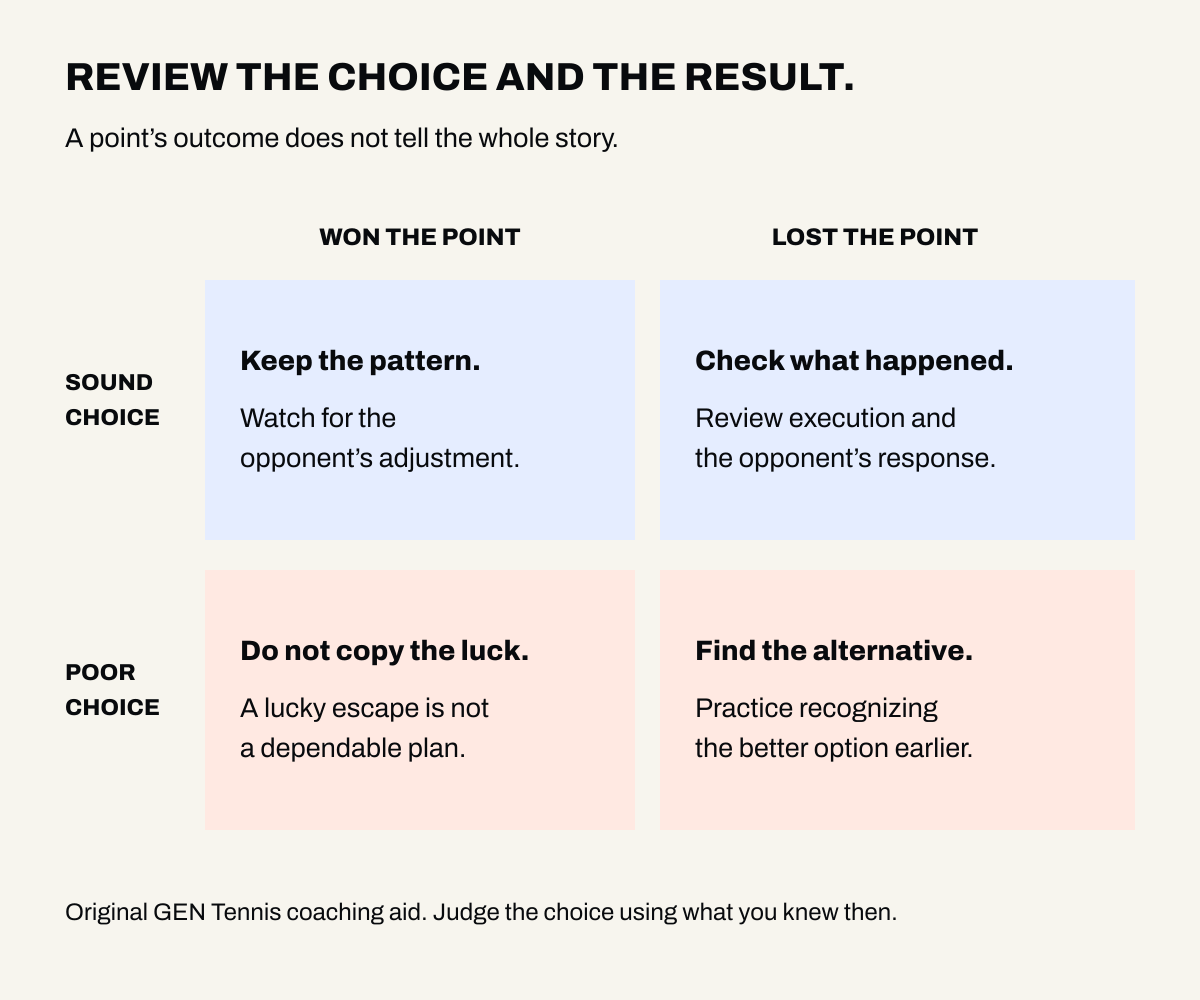
| What happened? | What should you learn? |
|---|---|
| A sound decision won the point | Keep the useful pattern, while watching for the opponent’s adjustment. |
| A sound decision lost the point | Check execution and the opponent’s response before abandoning the choice. |
| A poor decision won the point | Do not turn a lucky escape into your default plan. |
| A poor decision lost the point | Name the available alternative and practice recognizing it earlier. |
A “sound decision” means one supported by what you could reasonably observe at the time, your available skills and the purpose of the match. It does not mean the shot a coach can identify perfectly after seeing the result.
A review can fit on a small note: one effective pattern, one recurring difficulty and one next practice task. “Stop choking” is not a practice task. “Rehearse my second serve to a large target, then use it in a short scored game” gives the next session a purpose. Record the conditions as well as the outcome so you can compare like with like.
The objective is to become more competitive without making every score a verdict on your identity. Work on the game you want to develop. Recognize the game available today. Give the next point a clear intention, and learn enough from the match to make tomorrow’s choices better.
Primary statements, published coaching material and institutional guidance checked October 15, 2026. Practical exercises and comparisons are GEN Tennis interpretation. No new interviews, hands-on coaching study or endorsement of FLOW is claimed.
Our editorial standards · Questions or corrections? Contact the editor.
Sources
- 1. Brad Gilbert with Steve Jamison, Winning Ugly: official chapter-one excerpt — Excerpt copyright 1993; listed paperback edition May 31, 1994.
- 2. W. Timothy Gallwey, The Inner Game of Tennis: official publisher description — Original book 1974; 50th-anniversary hardcover June 4, 2024.
- 3. The Inner Game Institute: account of its approach — Undated method-owner source; not an independent evaluation.
- 4. Jim Loehr, The 16 Second Cure, part one — March 2008. Accessible introduction reviewed; full members-only article not accessed.
- 5. USTA, How tennis builds character: Tips and reflections — Shawn Foltz-Emmons, July 20, 2022; account of Loehr’s webinar.
- 6. Roger Federer’s Dartmouth commencement address: complete transcript — June 9, 2024.
- 7. Rafael Nadal, The Gift, The Players’ Tribune — December 17, 2024.
- 8. Serena Williams interviewed by Melissa Harris-Perry, Glamour — June 7, 2016.
- 9. Novak Djokovic’s Wimbledon final press conference, ASAP Sports transcript — July 6, 2014.
- 10. USTA, Six ways to promote overall well-being for parents and children in high-performance tennis — Haley Fuller, September 11, 2024.