Prepare for the first point
A college player may arrive well before the first ball, move through a physical routine, hit with a teammate, prepare serves and returns, change a shirt, check the lineup and get ready to compete. From the outside, all of that can be called the warm-up. It is easy to hear “an hour” and imagine an hour of stretching or nonstop exercise.
Those are different things. A generous preparation window can be sensible, especially when a player needs a separate practice court and has team responsibilities. The evidence does not establish that every tennis player needs 60 minutes of continuous activity, or that a longer routine is automatically better.
For a junior, a college athlete or an adult coming straight from work, the aim is similar: make the opening demands of tennis familiar before the score starts to matter. That means more than a few comfortable forehands. It includes moving, stopping, changing direction, reaching overhead, tracking the ball and producing a serve without making the first point the first serious effort of the day.
Why the warm-up matters
Tennis asks you to move between very different actions. You might accelerate toward a short ball, slow down to make room for contact, recover, then turn and move again. The serve adds an overhead action that an easy baseline rally does not rehearse. Even a technically familiar stroke has to fit the bounce, surface and conditions that day.
Active preparation raises muscle temperature and gives you a progressive introduction to those demands. It also lets you notice how you feel before intensity and scorekeeping take over. In practical terms, you are looking for movement that becomes more comfortable and coordinated, then more responsive, without arriving at the first game already tired.
There is direct tennis evidence for the performance side. In a 2016 experiment with 12 elite male juniors, dynamic preparation produced better sprint, jump and serving results than a static-stretching-focused comparison immediately afterward and after 30 minutes of simulated play. Most differences were no longer evident at 60 minutes. That is a small study in a specific population, but it supports taking the opening stages of play seriously.
A warm-up also creates an opportunity to shift attention. A coach can ask a player to notice the bounce, choose a target and recover after contact. That is a coaching use of the routine, rather than proof that a particular drill improves concentration or prevents injury.
Separate physical preparation, hitting and the official warm-up
These activities can overlap, but keeping their purposes clear makes planning easier.
- Physical preparation — Build from easy movement into comfortable mobility and increasingly tennis-specific actions. — A long list of exercises does not prove that the player is ready.
- A separate practice hit — Find contact, movement and rhythm across the strokes needed that day. — Access to a court is not guaranteed, and the whole hit need not be hard.
- The official prematch warm-up — Use the event's permitted final hit before competition. — Its time limit is a competition rule, not a complete physical-preparation prescription.
Under Rule 29(e) of the 2026 ITF Rules of Tennis, the official warm-up has a maximum of five minutes unless the organizers decide otherwise. Check the event format. Some collegiate competitions use a different arrangement, including no warm-up with the opponent.
This is why the few minutes shown before a televised match cannot explain everything the player has done. Likewise, a two-minute social video may be one sequence, an edited selection or the final movement refresh. Its running time is not a reliable measure of the athlete's entire preparation.
What federations actually recommend
The USTA and Britain's LTA both provide useful starting points, although their guidance should not be mistaken for a single protocol tested in every population.
The USTA's prematch preparation guidance, published January 1, 2017, suggests beginning to raise body temperature roughly 30-40 minutes before the match. That describes when to begin. It does not prescribe 30-40 uninterrupted minutes of exercise.
In its dynamic warm-up guidance, the USTA includes moving preparation such as jogging, lateral movement and controlled lunging. The practical principle is to move through useful ranges before asking for tennis intensity. Some older explanations make very broad claims about stretching; the research is more conditional, as discussed below.
The LTA's match-preparation guide, featuring coach Matt Smith, also recommends mobilizing before stepping on court and arranging time to prepare strokes where possible. Equipment and mental preparation belong in the overall plan too. Its description of professional preparation is not a demand that a recreational player copy a professional's timetable.
For the hitting portion, the USTA's 10-minute warm-up, published January 26, 2021, progresses from short-court contact to baseline patterns, net play and serve-return situations. The useful reminder is to include the start of the point. Treat it as a separate hitting exercise, rather than assuming a tournament will allow ten minutes with the opponent.
What recent professional examples show
Professional routines offer examples of preparation, not controlled evidence of why a player wins. The useful detail is the purpose and progression, rather than the exercise that looks most impressive on Instagram.
Djokovic: the public warm-up is only one part
The Australian Open published an official walk-on and on-court warm-up video featuring Novak Djokovic and Carlos Alcaraz before the men's final on February 1, 2026. It is a clearly identified event reference. It does not document everything either player did earlier.
A short clip of bouncing, footwork or mobility can prompt a good coaching question: what is the player preparing to do next? It cannot establish the whole routine, the appropriate repetitions for someone else or a special training benefit by itself.
Watch: Djokovic’s off-court movement
Zverev: preparation can be individual
In its May 19, 2026 practice report, Roland-Garros described Alexander Zverev using resistance bands with fitness trainer Jez Green before hitting with Djokovic. This is a documented example of work before the racket session. The report does not supply a transferable prescription of sets, resistance or duration.
For another player, the lesson is to know the purpose of an exercise and how it fits their plan. Owning the same band is not the essential part.
Alcaraz: a light start, then the work of the day
The ATP's June 19, 2025 report from Queen's Club describes Alcaraz beginning with light hitting through the middle, then working crosscourt and on serves and returns with Jenson Brooksby. The reported 40 minutes refers to the practice session, not a universal warm-up duration.
The report also mentions blood-flow-restriction work beforehand. That is a specialized intervention, distinct from ordinary resistance-band exercises; it is not part of the general routine proposed here. The broadly useful observation is the progression toward the actual demands of grass-court play.
Sabalenka: familiar preparation can include variety
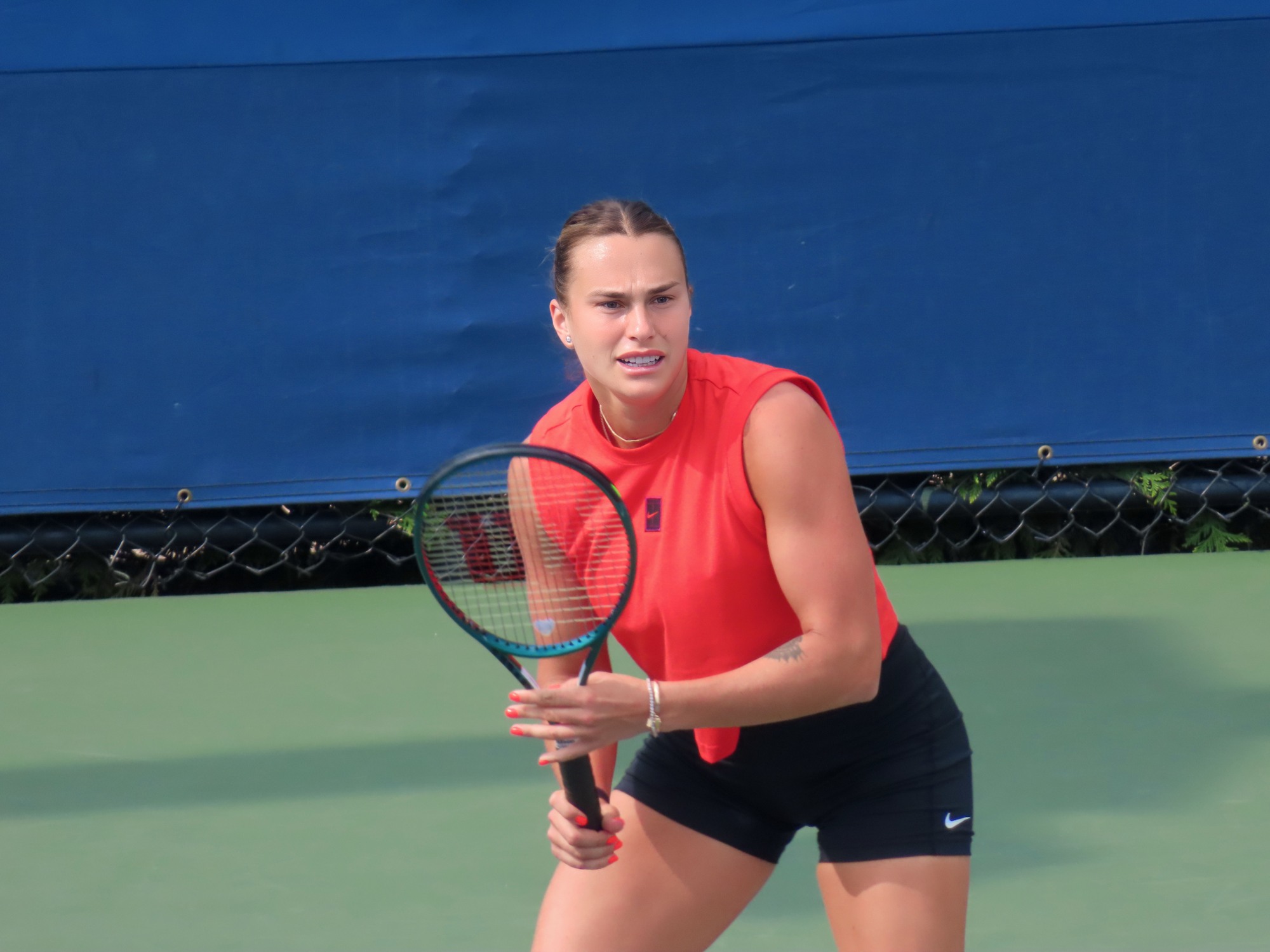
In a WTA report dated April 25, 2026, Aryna Sabalenka explained that she uses one-handed backhands and left-handed hitting before practice. The report followed a one-handed winner in Madrid and links the original WTA Instagram post.
That Instagram post concerns the match shot; it should not be presented as a demonstration of her whole warm-up. Her explanation shows one player's familiar variation. It does not mean a beginner needs to learn an opposite-handed stroke before a lesson.
Watch: preparing to move on grass
A practical sequence: gradually make it more like tennis
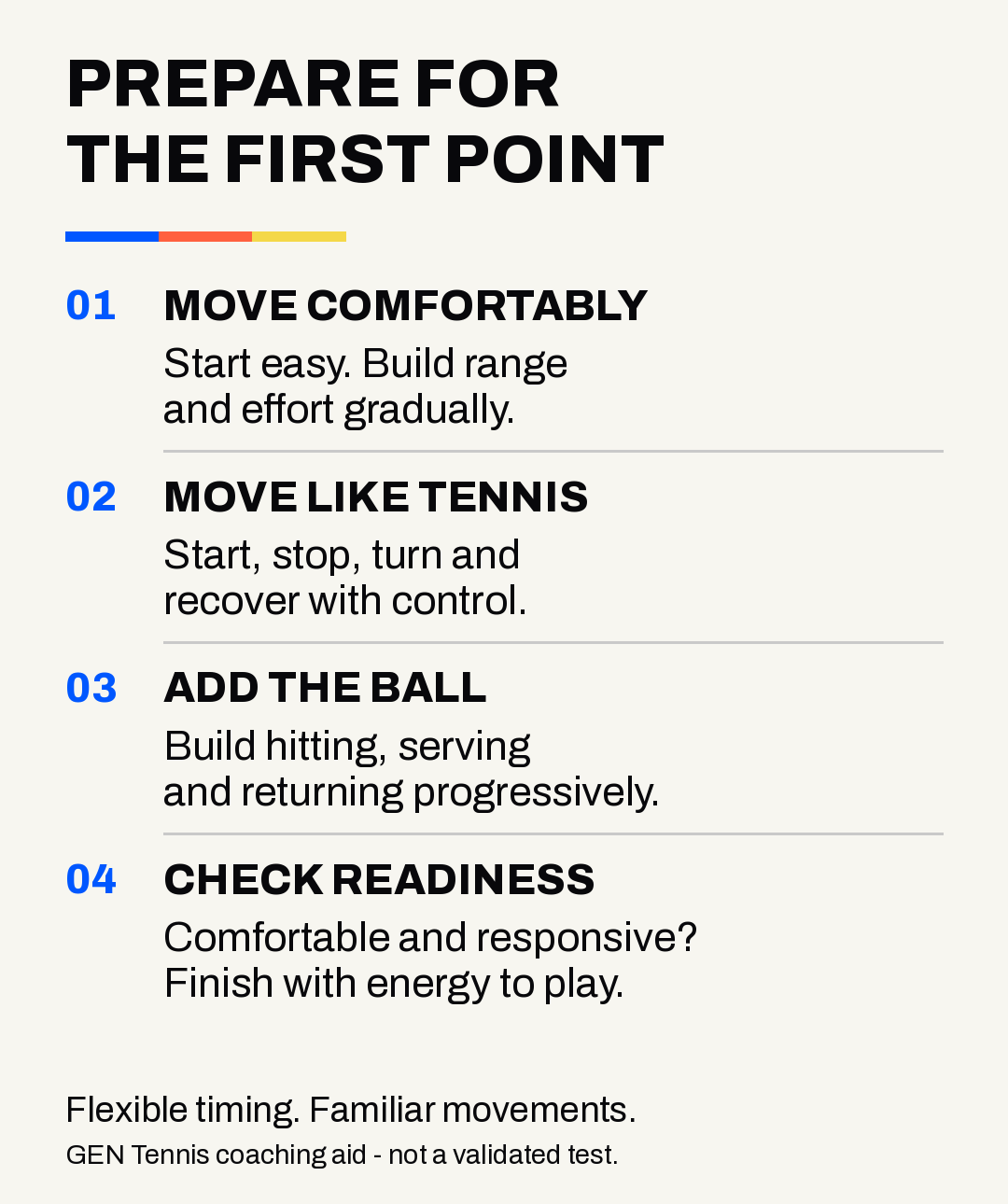
The following is a GEN Tennis coaching framework informed by the guidance and research above. The examples and timings are adaptable starting points, not a federation mandate or a clinically validated routine for everyone. Use movements already familiar to the player; a prematch warm-up is a poor time to learn a demanding new exercise.
1. Begin with easy whole-body movement
Start with a few minutes of comfortable walking, easy jogging or another familiar option suited to the space and the player. Introduce forward and sideways movement gradually. A stationary bike can be an alternative when that is part of an established preparation plan.
The early task is modest: move more than you were moving in the car, classroom or office, and let effort rise gradually. You should still be able to speak comfortably. Do not chase a sweat threshold; sweating varies with the weather and the person.
For a group of children, a simple movement game can do this job. Give them space, an understandable task and a way to move without collisions. Long queues behind a cone contribute little active preparation.
2. Move through the ranges you will use
Mobility means being able to move through an available range with control. Here, it might include gentle ankle movement, shallow squats or familiar lunges, controlled trunk turns and arm movements that gradually reach overhead. Choose a small selection, rather than treating every joint as a separate workout.
Begin with comfortable ranges and expand them only as movement feels easier. A player who already has an individualized shoulder or hip routine can include it as agreed with their coach or clinician. A light resistance band is one option when its use has been taught; body-weight movement may be sufficient for another player. More resistance is not automatically better preparation.
For an adult who has been sitting all day, this stage is also a useful check. Does turning feel easier after gentle movement? Can you move into a shallow lunge comfortably? Pain that persists or changes the movement is a reason to adjust or stop, rather than force the exercise to complete the list.
3. Add starts, stops and changes of direction
Tennis preparation needs more than jogging around the court. Rehearse a split step, a few controlled lateral steps, a turn toward a wider ball and a balanced recovery. Include slowing down: being able to arrive under control matters as much as reaching the ball.
Build from planned movement to a simple cue. For example, a partner can point left or right, or gently toss a ball for the player to move toward and catch. Increase speed over a few short repetitions, leaving recovery between them. Keep the area clear of loose balls.
Catching and tracking tasks can introduce reading a moving object while organizing the feet and hands. They are optional preparation activities, not evidence of a lasting improvement in vision or reaction time. The task should become clearer and more coordinated, not increasingly frantic.
4. Build contact and court coverage
Begin hitting at a distance and pace that allow comfortable contact. Short-court tennis is useful for many players, but it is not a compulsory test of touch. A beginner can use an easier ball or a predictable feed; an experienced player may move back sooner.
As contact settles, add depth, width and movement. Agree on the progression with the partner: cooperative balls first, then a little more court to cover. Include volleys or overhead preparation when relevant, and build serving gradually instead of leaving every overhead action until the first service game.
Move from comfortable serves toward the pace and placement needed that day. Give the receiver genuine opportunities to read a serve and play a controlled return. In a separate practice hit, a serve, return and next ball can connect preparation to the beginning of a point. Respect the rules and courtesy of an official opponent warm-up; that is not the place to insist on your own practice drill.
5. Finish ready for the next task
If the next task is a technical lesson, finish ready for that lesson's first exercise. If it is a practice match, include a few representative point starts. If it is competition, finish with the court routine and decisions the event allows.
This connects naturally with FLOW Tennis: prepare to read the incoming ball, organize movement and contact, then recover for what follows. It is a teaching connection, not a claim that FLOW has been scientifically validated as a warm-up protocol.
The final repetitions can be sharper without becoming a fitness test. Heavy breathing that does not settle, increasingly awkward movement or a tired serving shoulder is not the desired finish.
How long should juniors, college players and recreational players allow?
The same sequence can occupy different amounts of time. Training experience, the day's demands, court access, weather and individual needs all matter. These are planning examples to discuss with a coach, not minimums established by research.
Juniors: make it understandable and repeatable
For a younger beginner, try a compact movement game, a few familiar mobility actions, a simple ball task and an easy transition to hitting. A starting plan might use around 5-8 minutes of movement followed by 5-10 minutes of manageable ball work, adjusted by the coach. Much of the learning can happen through play.
For a competitive junior, a separate physical routine of roughly 10-15 minutes and a progressive hit may be useful when facilities and the schedule permit. The player should be able to explain what each part prepares them to do. Neither age nor ranking alone tells you exactly how long it should last.
Parents can help with arrival, suitable clothing and checking the actual court arrangements. Let the coach lead exercise choices. A calm, familiar routine is more useful than adding a new professional drill because it looked impressive that morning. Our first-tournament guide covers the wider planning questions.
College players: the hour has a real precedent
The NCAA's 2025-26 Division I Tennis Host Operations Manual, section 30, allocates 60 minutes of prematch warm-up court time under its championship match-day guidelines. That supports the idea that substantial preparation time belongs in competitive tennis. It is a court-allocation rule, not a study showing that every athlete needs an hour of exercise.
Other events differ. The 2026 ITA Kickoff Weekend participant guide guarantees second-match teams 30 minutes of warm-up under specified court arrangements. Its format also states there is no warm-up with opponents in singles or doubles. Players cannot assume a final opponent hit will fill a gap in their own preparation.
Here is one way to organize an hour before a team match with no opponent warm-up. This is a GEN Tennis example, separate from either organization's prescribed schedule:
- 60-50 minutes — Check the start arrangements, organize equipment and complete any required check-in. Earlier check-in deadlines still apply.
- 50-38 minutes — About 12 minutes of progressive physical preparation.
- 38-18 minutes — About 20 minutes of a separate practice hit, including serves, returns and relevant point starts.
- 18-8 minutes — Recover, organize equipment, use the bathroom if needed and confirm the team plan.
- 8-3 minutes — Brief familiar movement to restore readiness if needed; complete the coach's final preparation.
- 3-0 minutes — Follow the event's introductions and start procedures. There is no assumed extra hit with the opponent.
This is an hour set aside, with rest and logistics inside it. A team should adapt it to its actual court allocation and competition rules. A regular college practice may integrate preparation into the first part of the session; the championship timetable does not require an additional hour before every practice.
Recreational players: protect the useful parts
If your court booking is only an hour, you do not need to turn it into a two-hour appointment. One workable plan is 8-12 minutes of physical preparation beforehand, where there is safe space, followed by around 10 minutes of progressive hitting within the booking. Adjust the time to your needs and the session.
Agree with your partner that preparation includes serving and returning. Otherwise, the familiar pattern is 15 minutes of enjoyable baseline rallies followed by a sudden full-speed first serve. A short, organized routine can cover more relevant ground than a longer unplanned hit.
An older player or someone returning after a break may need a gentler progression or an individual plan; age alone does not supply a stopwatch target. Begin with the actions you can perform comfortably. If time is short, reduce the ambition of the first drill or the playing session rather than trying to compress everything into a frantic minute.
Where stretching belongs
Dynamic movement involves moving through a range. Static stretching involves holding a position. Mobility is the broader ability to access and control movement. They are related, but they are not interchangeable names for a warm-up.
A systematic review by Behm and colleagues, published online in December 2015 and in print in January 2016, found that the immediate performance effects of static stretching depend partly on the amount of stretching and what follows. Greater total static-stretching time per muscle group tended to have larger negative effects when performance was tested soon afterward; including subsequent dynamic activity changed the picture.
The practical default is active preparation before tennis. Brief individualized static stretching can have a place, followed by movement and progressive hitting. Extended flexibility work can be planned separately. Avoid both extremes: “stretching is the whole warm-up” and “any static stretch ruins performance.”
What is actually tried and tested?
There are tested components and programs. There is not one proven timer-and-exercise recipe covering every junior, college athlete and recreational adult.
The 2016 junior experiment supports dynamic preparation for early performance in its study population. A separate 2012 experiment involving 26 young elite players found modest serve-speed benefits from the tested dynamic or upper-body plyometric additions. Neither study shows that everyone should copy its exercise volume, that an hour is optimal, or that a warm-up wins matches.
Injury prevention is a different question. A 2020 randomized trial of TennisReady in adult recreational players found no significant injury reduction from its unsupervised program. Adherence was low, which limits what can be concluded about other ways of delivering preparation.
The newer Tennis 10+ study, first published online November 26, 2025, enrolled 317 recreational adults. Its short program combined dynamic warm-up with post-play stretching. Injury differences between adherence groups were generally absent. At 12 months, higher adherence was associated with lower injury frequency and fewer overuse injuries. It was an observational cohort with follow-up losses, so the association does not establish cause and effect.
These findings support honest language: use preparation to approach tennis progressively and support readiness. Do not sell one warm-up as protection against injury, or mistake a repeated training program for evidence about a single session.
What if the start is delayed, the day is hot or space is limited?
After a substantial wait, reassess how you feel. A brief repeat of familiar movement may be useful before going on court. Research on re-warm-ups in team sports supports managing long gaps, but it does not establish an exact tennis cutoff or justify repeatedly performing hard sprints while waiting for a court. Follow the event's rules about any renewed hitting.
In hot conditions, keep the preparation proportionate and avoid accumulating unnecessary exertion while waiting. The WTA's heat guidance includes preparing in the shade; follow the event's heat procedures too. Feeling hot does not show that you have rehearsed the tennis actions. In cool conditions, suitable layers and avoiding a long inactive gap may help preserve the preparation already done.
With little space, use comfortable movement in place and controlled shadow swings where the racket will not endanger anyone. This can cover some physical preparation, but it cannot reproduce reading a real bounce or returning a serve. When court access arrives, introduce those missing tasks progressively.
If you are managing an injury or have persistent pain, work from the plan agreed with your clinician and coach. A longer warm-up is not a way to clear yourself to play through a problem.
Before you start scoring, check what changed
Use a few practical questions rather than treating elapsed time as a certificate of readiness:
- Can I move in the directions I expect to use, including slowing down and turning, with reasonable comfort and control?
- Have I progressed from easy contact toward the pace of the first planned drill or point?
- Have I prepared the overhead actions I will use, including serving?
- Am I reading the ball and recovering after contact, rather than only swinging at predictable feeds?
- Do I feel ready to begin, with breathing settled and energy available, rather than depleted?
For the next few sessions, keep a simple note: what you did, how long you waited afterward and how prepared you felt in the first ten minutes. Compare similar sessions and discuss repeated problems with a coach. This is a useful personal observation, not a controlled test or injury prediction. Our practice-notes guide can help keep the record specific.
The habit to build is straightforward: arrive with enough time to move, prepare the actions the session will demand, and let the progression tell you when to begin the next task.
Our editorial standards · Questions or corrections? Contact the editor.
Sources
- 2016 experiment with 12 elite male juniors
- Rule 29(e) of the 2026 ITF Rules of Tennis
- prematch preparation guidance
- dynamic warm-up guidance
- match-preparation guide
- 10-minute warm-up
- walk-on and on-court warm-up video featuring Novak Djokovic and Carlos Alcaraz
- May 19, 2026 practice report
- June 19, 2025 report from Queen's Club
- WTA report dated April 25, 2026
- original WTA Instagram post
- NCAA's 2025-26 Division I Tennis Host Operations Manual
- 2026 ITA Kickoff Weekend participant guide
- systematic review by Behm and colleagues
- 2012 experiment involving 26 young elite players
- 2020 randomized trial of TennisReady
- Tennis 10+ study
- team sports
- WTA's heat guidance