The face matters. So does how it meets the ball.
Can closing the racket face create topspin? It can contribute, because orientation changes the collision. But closing the strings is not a complete instruction for producing a useful topspin forehand. Racket motion, the arriving ball and the interaction with the strings all matter.
Topspin means forward rotation relative to the ball’s direction of travel. Seeing a ball land short or long does not tell you its spin rate: launch, speed and contact position also affect where it goes. The practical question is how to produce the flight you want and repeat it.
This question came from reader-supplied screenshots of a reel by Matt Jones, @matt_jones_tennis. His caption challenges deliberately closing the face to make spin and emphasizes the swing. We credit that starting question; the original reel’s permalink, date and complete footage remain unverified. The explanation below draws on impact experiments and forehand research.
Define closed before using it as a cue
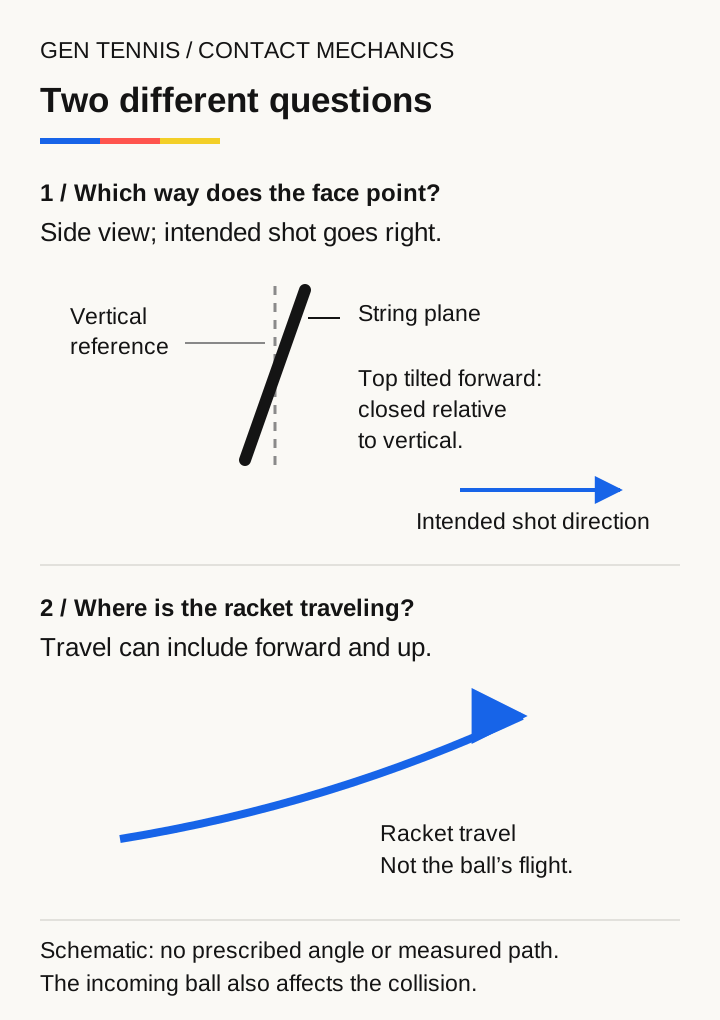
Here, a square face means the string plane is vertical relative to the court. Closed means its hitting surface tilts toward the ground; open means it tilts upward. Face angle describes orientation. Swing path describes where the racket travels. A tilted face can travel upward, forward or sideways.
A closed face during preparation also describes a different instant from the face at impact. The finish happens later again. You cannot establish an exact contact angle from one uncalibrated video frame: perspective, motion blur and uncertain timing can change what the racket appears to be doing. Our beginner-forehand guide explores why copying a professional’s position can miss the learner’s actual task.
Spin comes from a turning force during contact
Think of the collision in two directions: into the stringbed and along it. A force acting with a turning effect about the ball’s center changes its spin. The relevant motion is the racket relative to the incoming ball, including the motion of the ball’s surface caused by its existing spin.
That is why the same-looking swing need not produce the same outgoing ball against different feeds. In Cross and Lindsey’s 2019 impact experiment, balls struck a stationary, hand-held racket. Incoming speed, angle, spin and contact location were varied. Their results connect the incoming conditions to changes in rebound and rotation. This isolates collision behavior; it does not test a coaching program.
The face influences more than launch
Turning the face changes the directions into and along the strings. It can therefore change both spin and launch. Cross and Lindsey’s 2016 string-impact analysis describes increasing spin through a steeper swing or forward racket tilt under the conditions discussed. A claim that the face has no role in spin goes too far.
There is evidence from players, too. A 2017 study by Kwon and colleagues examined 13 collegiate men. A more closed face and greater upward racket speed near impact were associated with more topspin. Swing steepness alone was not significantly associated with spin in their analysis. The feeds were controlled, and accuracy was tested separately on court. These correlations establish neither one ideal angle nor a guarantee that consciously closing your face improves accuracy.
Brushing is a useful image, with limits
The USTA’s topspin teaching tip uses a low-to-high brushing cue. That can help a player discover upward racket motion. The ball and strings also deform during impact; brushing should not be read as a rigid racket scraping neatly around an unchanged ball.
Lindsey’s 2011 laboratory work investigated lateral string movement and rebound spin. Cross and Lindsey’s later work shows that string displacement contributes throughout the collision, making the familiar snap-back explanation incomplete. These experiments help explain the mechanism; they do not establish that a particular string will fix your forehand.
“Up and across” may help someone coordinate a swing, but sideways travel across the body is not a universal requirement for topspin. Treat it as a cue to test. It is not a reason to force a wrist roll at contact or chase a particular finish.
Use the flight to choose the next experiment
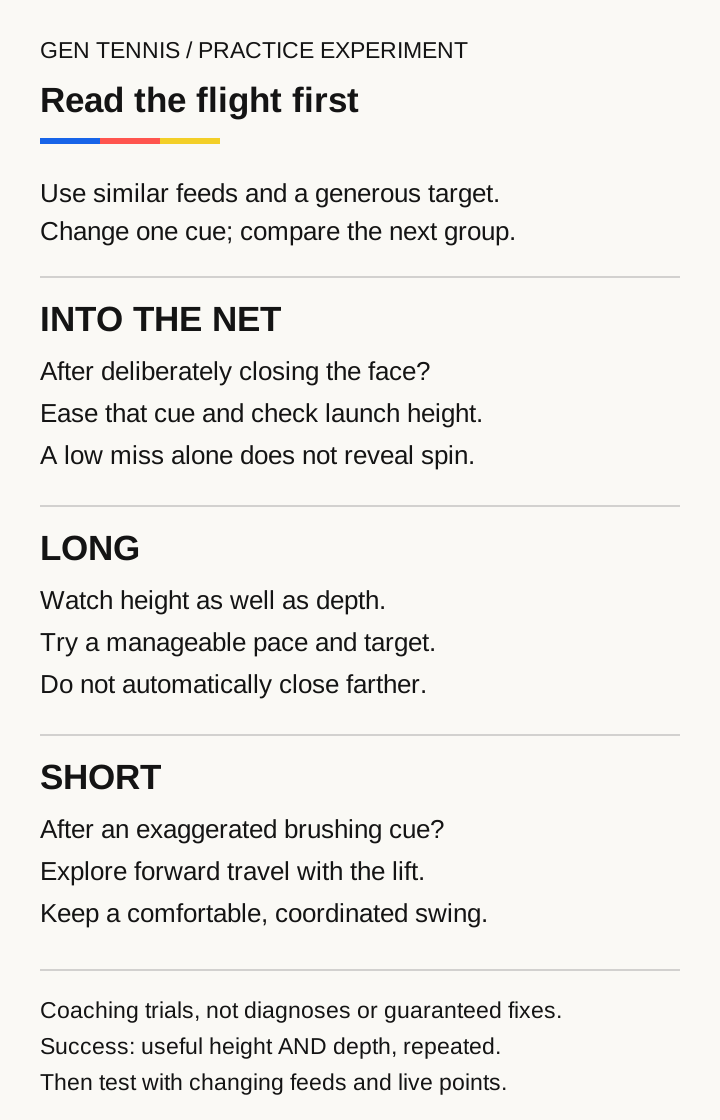
The following are GEN Tennis coaching suggestions, not diagnoses from ball flight alone. Start with comfortable feeds, a broad crosscourt target and one adjustment at a time.
- You deliberately close the face and drive the ball into the net. Remove that extra closing instruction first. Compare the initial launch and net clearance at a manageable pace; do not immediately compensate by swinging harder.
- The ball launches long. Notice whether it leaves unusually high or travels too far on a lower flight. Review face orientation alongside speed, contact height and the incoming ball with a coach. A long ball does not identify one faulty variable.
- You brush steeply but leave an easy short ball. Try sending the next manageable feed toward a deeper, generous target while retaining an upward component. Explore forward travel as well as lift. More visible brushing is not automatically a better rally ball.
Give the adjustment room to work
If contact is crowded or rushed, use our timing and spacing guide before adding another hand correction. A useful swing still needs a workable relationship between your body, racket and the arriving ball.
This fits FLOW Tennis: READ → MOVE → ORGANIZE → STRIKE → RECOVER. Read the feed, leave room, coordinate the stroke, send the ball and prepare again. FLOW is a coaching framework, not a finding of these impact studies.
Try a short block of similar feeds, then vary height and depth before playing live points. Record clearance, depth and repeatable contact rather than guessing revolutions per minute. Keep the adjustment if it helps you manage changing balls. The useful outcome is a forehand you can place and repeat, with spin serving that purpose.
Our editorial standards · Questions or corrections? Contact the editor.
Sources
- Matt Jones: @matt_jones_tennis. Inspiration from reader-supplied reel screenshots; original post date and permalink unverified.
- Cross & Lindsey: Racquet Control — Part 1 (July 22, 2019). Controlled stationary-racket impacts.
- Cross & Lindsey: Spin and String Surface Roughness (February 8, 2016). Laboratory mechanism study.
- Kwon et al.: Influence of Tennis Racquet Kinematics on Ball Topspin Angular Velocity and Accuracy (December 1, 2017). Correlational study of 13 collegiate men.
- Lindsey: String Snap-Back and Spin (January 30, 2011). Laboratory impacts; equipment findings are not player-performance guarantees.
- USTA / Karl Davies: How to create topspin. Coaching guidance, not an impact experiment; page undated.
Keep reading.
Your child’s forehand doesn’t need to look like a pro’s
Timing, spacing and rhythm in tennis: move into the shot, not into the ball