Give the beginner a playable task
Daniel Spatz’s Instagram post raises a useful question for anyone teaching a young player: how much of a professional forehand belongs in a beginner’s first lessons? In the caption, @danielspatz_california favors a simple racket-head position and cautions against asking children to imitate physically developed professionals. His post is the inspiration for this article.
The practical starting point is to give a child a manageable way to receive and send the ball, then develop the movement as the task becomes more demanding. A forehand can look simpler than a professional’s and still be doing useful work.
Start with the ball the child is trying to hit
Imagine a beginner who can send a gently fed ball over the net but loses contact whenever an adult adds another instruction about the wrist, racket face or backswing. The adult may be describing something visible in professional tennis. That does not establish that this detail is the most useful next step for this child.
Before changing the swing, ask what is breaking down. Is the child reaching for the ball? Is it arriving too high or too quickly? Can the racket be managed comfortably? Does the child understand where to send the shot?
Those questions help a coach choose between changing the task and changing the movement. Slowing the feed, reducing the distance or using suitable equipment may create a better opportunity to learn than adding another position to remember.
A racket position is only part of a stroke
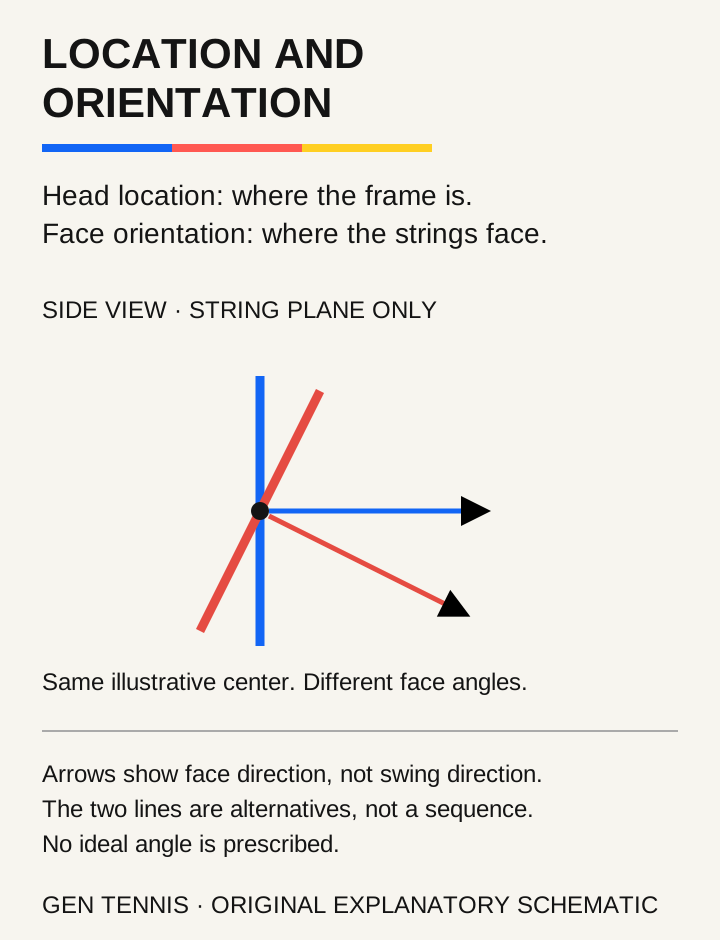
The racket head’s location and the direction its strings face are related but different things. A racket can be behind the player while its strings face in several directions. A closed face during preparation also describes a different moment from the face meeting the ball.
That distinction matters when a parent freezes a professional video. The image shows one instant in a moving action. It does not tell us what instruction the player learned, how the movement developed, or what a beginner should consciously reproduce.
For coaching purposes, look at the movement through the incoming ball, contact and recovery. A useful question is whether the player can organize the racket in time and send the ball toward the intended area. Reproducing a particular photograph is a much narrower task.
Daniel’s caption also speculates about how Aryna Sabalenka may have started learning. We do not have evidence here establishing her childhood forehand progression. Her example can prompt a coaching question without becoming a claim about her development.
What the research actually supports
In a 2014 experiment by Tim Buszard and colleagues, children performed a forehand task with nine combinations of racket size and ball compression. Their best hitting performance occurred with the smallest racket and lowest-compression ball tested. The lower-compression ball also supported a more upward swing path and contact farther in front and to the side.
This is evidence that the equipment and incoming ball can affect how children perform a forehand. It does not establish one ideal backswing, prove that every child needs the same racket-face position, or demonstrate a universal progression toward an elite stroke. It was a specific task, not a record of an entire playing career.
The ITF’s Tennis Play and Stay approach similarly emphasizes slower balls so beginners can serve, rally and score early. Its practical relevance is straightforward: build conditions in which the learner can actually play, rather than expecting adult equipment and a demanding ball to produce adult technique.
Simple does not mean leaving everything alone
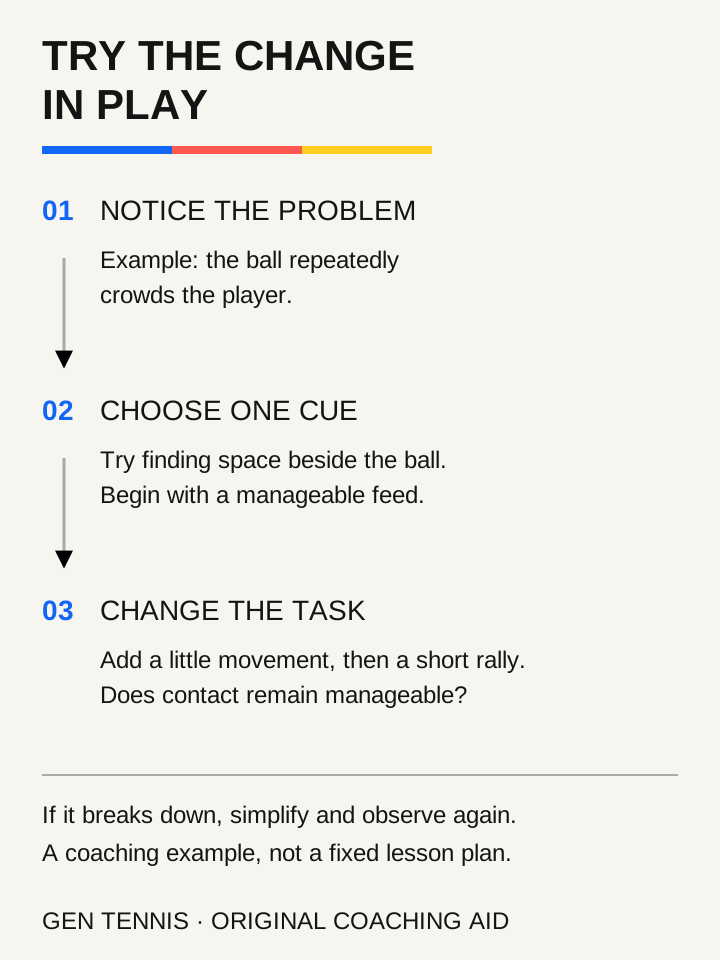
A coach still has a job to do. If a child repeatedly crowds the ball, struggles to organize the racket or cannot direct a manageable feed, useful guidance may be needed. The issue is choosing a change that addresses an observed problem.
Our coaching suggestion is to begin with one clear task and one relevant cue. For example, ask the player to send a comfortable forehand toward a large crosscourt area. If contact is crowded, work on finding space beside the ball before introducing several changes to the arm and racket.
Then observe more than one attempt. Does contact become more repeatable? Can the child do it after moving a little? Does the improvement remain when a short rally replaces the feed? A movement that works only while the coach places every ball in the same spot still needs to be explored in play.
Let the stroke develop with the player
There is no need to promise that a beginner will eventually adopt a particular closed racket-face position. Equally, an initially simple preparation does not have to remain unchanged forever.
As the player encounters different heights, speeds and distances, the coach can revisit preparation and contact. The reason for a change should be something the player needs to accomplish, not a desire to make the swing resemble a favorite professional.
This fits the teaching emphasis in FLOW Tennis: read the ball, move, organize, strike and recover. Here, organizing means arriving with a usable relationship between the body, racket and ball. That is a coaching framework, not a claim that research validates every detail of the method.
Parents can help by asking the coach, “What is this adjustment meant to help my child do?” For equipment questions, our first-racket guide offers a separate starting point.
A professional forehand can be an excellent source of curiosity. Let the child notice preparation, movement and where the ball goes. Then bring the lesson back to the player in front of you: what can they do now, what is making the task difficult, and what is the next useful change?
Our editorial standards · Questions or corrections? Contact the editor.