Before you copy a professional
A young player watches a professional serve, notices the sideways setup and deep shoulder turn, and tries to reproduce the picture. The feet look similar. The movement feels less comfortable. Should the player keep practicing until it works, or reconsider what they are copying?
Eye dominance is one factor worth discussing with a coach. It can contribute to an assessment of how a player organizes a stroke, but it does not provide a complete technique prescription. The practical objective is to find a position that supports a clear view, comfortable movement and repeatable contact.
Credit for the inspiration belongs to Patrick Mouratoglou. His recent Instagram post about dominant-eye awareness and serving stance inspired this article and highlights a detail players can overlook when copying professionals. You can find his public posts at @patrickmouratoglou. His dominant-eye masterclass provides additional coaching context. The research assessment and practice suggestions below are GEN Tennis’s own work; they are not presented as his endorsement or a collaboration.
What does “dominant eye” mean?
Eye dominance describes a preference for input from one eye under particular conditions. It does not mean that a player normally uses only that eye. In ordinary binocular vision, information from both eyes contributes to the view.
There is also more than one kind of dominance. Sighting dominance is the eye you favor when aligning a target through a small opening. Sensory dominance concerns the relative influence of the eyes when their images compete. Neither label simply means “the eye with sharper eyesight.”
A 2010 vision study by Yang, Blake and McDonald found weak relationships between its sensory-dominance measure, a sighting test and measures of visual function. That distinction matters: a quick court-side test cannot describe every aspect of how a player sees.
Hand and eye preferences can match or differ. A right-handed player who favors the left eye in a sighting test has a crossed hand-eye profile. A right-handed player who favors the right eye has a same-side profile. These are descriptions, not grades of tennis potential.
Why Mouratoglou’s serve example is worth examining
In his published analysis of Roger Federer’s serve, Mouratoglou connects Federer’s large shoulder turn and tossing-arm path with what he identifies as left-eye dominance. He cautions players against copying that arrangement without considering their own visual orientation.
We are reporting Mouratoglou’s interpretation of Federer, not an independently verified clinical assessment. Its useful coaching question is whether the setup lets the individual player follow the toss comfortably while organizing the rest of the action.
For the player watching a professional, separate three things:
- The feet: where the player starts and how the base changes.
- The body: how the pelvis, trunk and shoulders organize the motion.
- The head and gaze: how the player follows the ball during that motion.
Copying the first does not reproduce the other two. A still photograph also cannot tell you what the player is looking at, how the toss developed or how the motion feels.
This is especially relevant when a junior tries to reproduce an extreme-looking position. Ask what the position contributes before making its appearance the goal. A useful model can teach rhythm, preparation and commitment without becoming a template for every joint angle.
What the tennis research actually shows
A 2026 study by Moreno, Losilla and Capdevila assessed hand-eye profiles in 173 selected high-level developing players aged 11–23. Its footwork analysis involved a smaller group of 61. It found associations between hand-eye profile and stance preferences in certain forehand and backhand movement tasks, but not every task.
This supports taking individual differences seriously. It does not establish that assigning a stance by eye dominance improves accuracy, wins matches or prevents injury. The study did not test a serve intervention. Its authors identify performance and training effects as questions for further research. Left-handers and one-handed backhands were sparsely represented, limiting conclusions for those groups.
A separate serve experiment by Giblin, Whiteside and Reid, published online in 2016 and in a 2017 journal issue, tested eight elite young players with eyes open and closed. They missed contact on 16 of 24 eyes-closed serves. Removing vision also changed the action’s timing and ball positions.
That small experiment demonstrates the importance of visual feedback under its test conditions. It does not identify a best dominant eye or an ideal stance. The importance of seeing the toss and the claim that eye dominance determines serve technique are different propositions.
A simple check, with a limited purpose
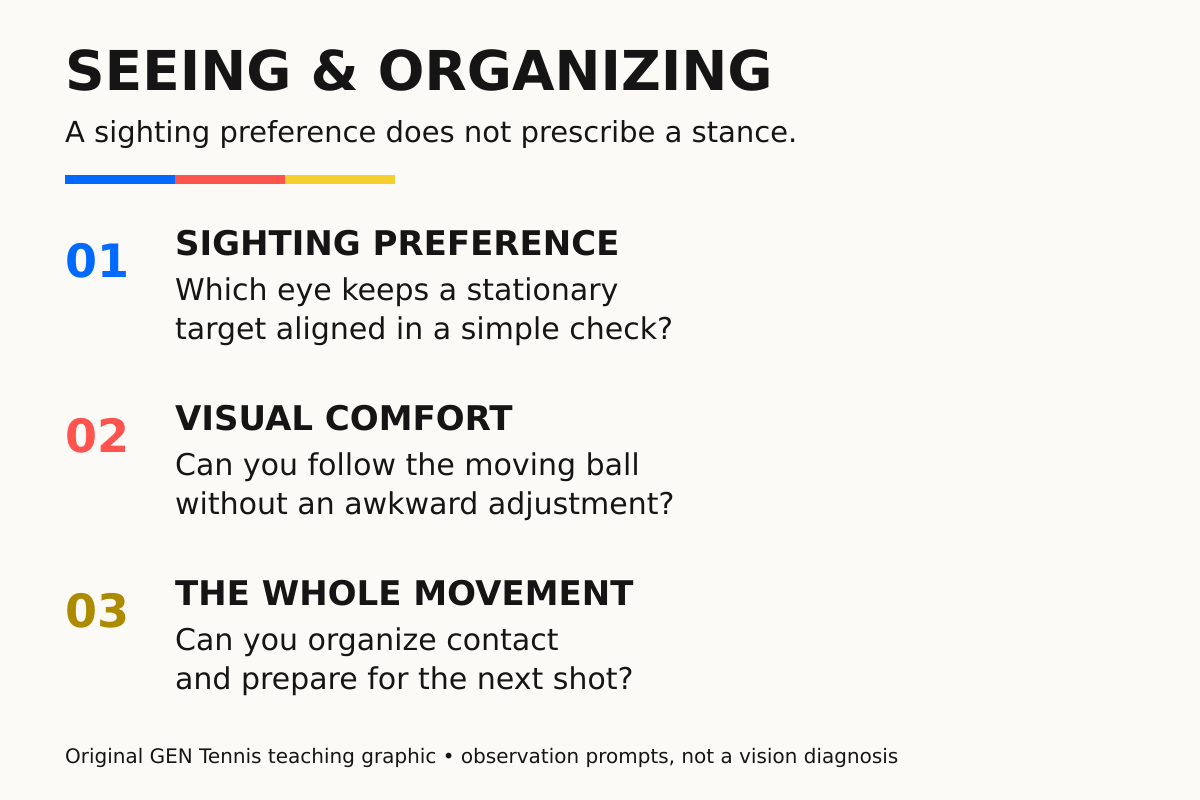
To explore sighting preference, Cleveland Clinic describes a basic test: choose a distant stationary object, frame it through a small opening between your hands with both eyes open, then close each eye in turn without moving your hands. The eye that keeps the target aligned is probably your preferred sighting eye. Repeat to see whether the result is consistent.
Treat that result as a conversation starter. It is not an eye examination or a reason to reconstruct a working stroke. If the result seems unclear, record that rather than forcing a category. Do this while stationary, away from live play.
Serving: investigate the problem before changing the stance
Start with a specific observation: “I lose the toss when I turn,” “I feel cramped looking upward,” or “My contact changes when I try that setup.” Those statements give a coach something to investigate. “I’m right-eye dominant, so my serve is wrong” does not.
Our coaching suggestion is to review the normal serve first. Keep the full body and toss visible on video, with the player’s consent. Ask the player what they could see and feel; a camera can show head position, but it cannot establish where their eyes were looking.
If the current setup seems to create a viewing problem, compare it with one modest adjustment at comfortable effort. A coach might explore the starting alignment, the amount of turn or the toss location, depending on the actual problem. Change one element initially and note any other changes that follow.
Do not interpret “make the ball easier to see” as an instruction to face the net throughout the serve or eliminate shoulder rotation. Equally, do not force a deeper turn simply because a professional uses one. Keep both eyes open during normal practice and preserve an action the player can repeat without discomfort.
Judge the comparison by the whole serve: how clearly the player follows the toss, the quality of contact, control toward a generous target and readiness for the next ball. A more comfortable view that comes with a less controllable action calls for further adjustment, not an immediate verdict.
Forehand and backhand: check the view, spacing and movement together
Mouratoglou has also discussed eye dominance when reviewing a young player’s groundstroke drill. He questioned using a closed arrangement on both sides and suggested a more semi-open forehand for the player he believed to be right-eye dominant. This is his coaching interpretation, not a laboratory measurement of that player’s vision.
For your own practice, begin with the ball and the movement task. Our open-versus-neutral forehand guide explains a distinction that becomes particularly useful here: foot arrangement and shoulder preparation are not the same thing. An open base can still include an upper-body turn.
Use the following as GEN Tennis observation prompts, not eye-based stance rules:
| Situation | What to examine | Useful comparison |
|---|---|---|
| Manageable forehand | Crowding or a late head adjustment | Compare comfortable neutral and semi-open arrangements on similar feeds; retain natural upper-body preparation. |
| Forehand pulled wide | An extra step across that delays contact or recovery | Let the stance develop from movement; assess both the reply and readiness to move again. |
| Uncomfortable backhand preparation | Spacing, turn and whether the ball stays easy to follow | Use a slow feed and review head position, contact room and recovery together. |
A backhand places the task on the other side of the body. Check it separately instead of assuming that a useful forehand adjustment should be mirrored automatically. One-handed and two-handed backhands also organize the arms differently; an eye-test result alone is not a reason to switch between them.
Avoid converting “keep your head steady” into “hold your head rigid.” As a coaching cue, aim for comfortable visual attention without an unnecessary last-second lurch. The player still has to turn, move and recover.
A practical comparison for the next lesson
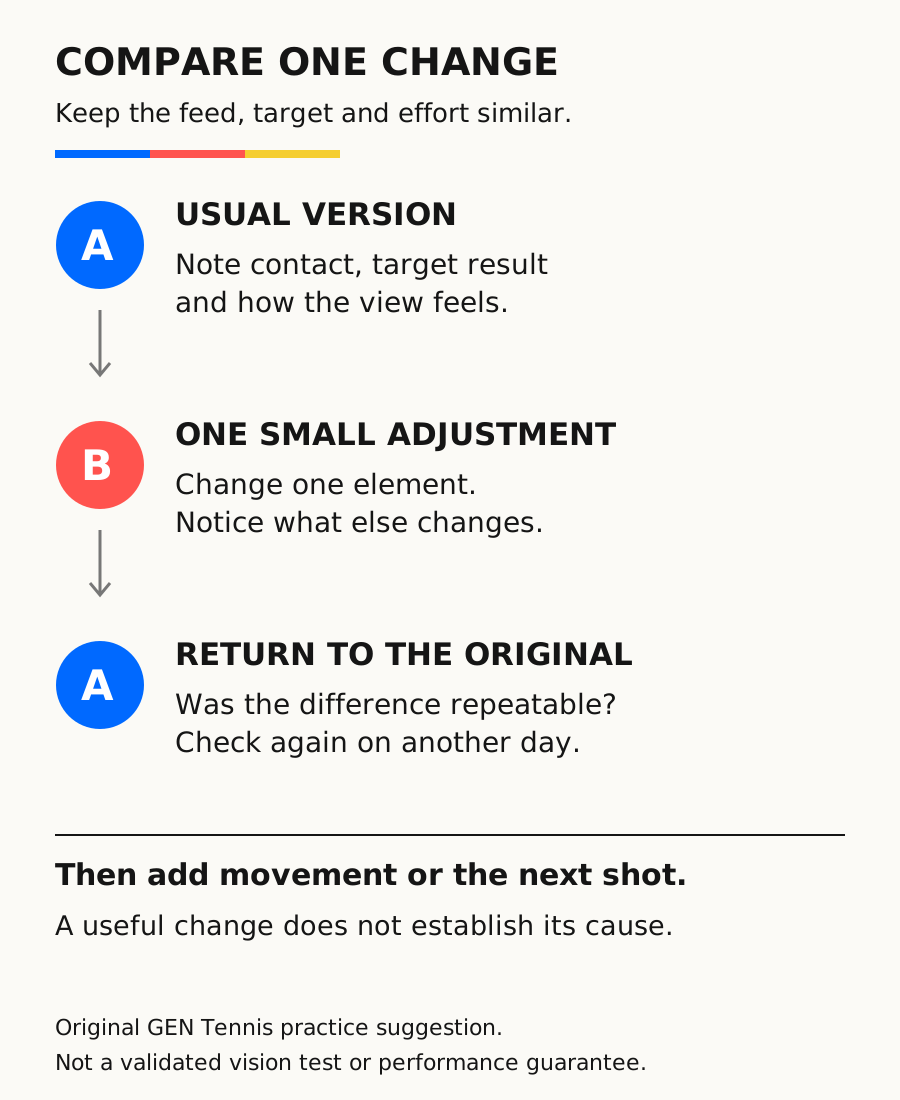
This is a GEN Tennis practice experiment, not a validated vision test. Work on one stroke at a time after a normal warm-up.
- Name one problem. Choose something observable, such as losing track of the toss or repeatedly feeling crowded on the forehand.
- Establish the usual version. Play a short block at comfortable effort toward a generous target. Record clean contacts, target results and the player’s description of visual comfort.
- Try one adjustment. Keep the feed, target and effort similar. On the serve, avoid changing the grip, footwork pattern, toss and swing simultaneously.
- Return to the original version. This helps reveal whether the apparent improvement was simply warming up, a friendlier feed or a few unusually good attempts.
- Repeat on another day. One encouraging block is worth investigating, not enough to establish the cause.
- Add an appropriate next demand. If the change remains useful, introduce movement or a following shot. Does it still help when the task becomes less predictable?
A practical record needs only three observations: what changed, what the player noticed and what happened to the ball. If a new arrangement improves contact, that is useful evidence for that player. It does not, by itself, prove that eye dominance caused the improvement.
What parents should take from this
Watch professional tennis with curiosity. Ask a child what a movement helps the player do, then bring that question into a lesson. The answer may involve vision, but it may also involve spacing, timing, strength, mobility, the incoming ball or years of practice.
Use eye dominance to broaden observation, not to label a child’s ability or impose a permanent playing identity. Do not change a child’s racket hand because of a quick sighting test. There is no basis in the evidence discussed here for separate blanket stance prescriptions for boys and girls.
Concerns about blurred vision, double vision or difficulty seeing belong with an eye-care professional, rather than being explained away as a technical preference. The Cleveland Clinic guidance similarly recommends discussing vision concerns with an eye specialist.
Within FLOW’s Read → Move → Organize → Strike → Recover sequence, this topic connects reading the ball with organizing a usable position. Our application is to notice the player’s experience, test a specific adjustment and check whether the benefit survives a changing task. The research cited here does not validate the FLOW system itself.
Mouratoglou deserves credit for prompting that closer look. The question to take into the next lesson is: Can I follow the ball comfortably, organize my movement and make the contact I intend? Let the answer guide the adjustment.
Our editorial standards · Questions or corrections? Contact the editor.
Sources
- Patrick Mouratoglou: Your dominant eye and your technique, Tennis Masterclass, Episode 3. Original coaching resource; inspiration and context, not scientific validation.
- Patrick Mouratoglou: Federer serve analysis. Direct author post and accessible transcript supporting the attributed serve explanation.
- Patrick Mouratoglou: Groundstroke footwork and spacing commentary. Direct author post supporting the attributed forehand example.
- Moreno, M., Losilla, J.-M., and Capdevila, L. (2026): Assessment of Hand-Eye-Laterality and Its Relationship With Technique in High-Level Tennis Players, Apunts Educación Física y Deportes, 163, 58–68. Published January 1, 2026; full text examined.
- Yang, E., Blake, R., and McDonald, J. E. II (2010): A New Interocular Suppression Technique for Measuring Sensory Eye Dominance, Investigative Ophthalmology & Visual Science, 51(1), 588–593. Full text examined.
- Giblin, G., Whiteside, D., and Reid, M. (2017; online 2016): Now you see, now you don’t: the influence of visual occlusion on racket and ball kinematics in the tennis serve, Sports Biomechanics, 16(1), 23–33. University research-repository abstract examined; full paper not accessed.
- Cleveland Clinic: Dominant Eye, medically reviewed May 23, 2024. Patient explanation and sighting-test instructions.