

Choose the job before choosing the academy
Choose a tennis academy by matching a specific program to a specific need, then checking who will teach you, what an ordinary day contains and what the complete commitment costs. A famous name and impressive courts can help you build a shortlist. They cannot tell you whether the program fits this player, at this stage, for this length of time.
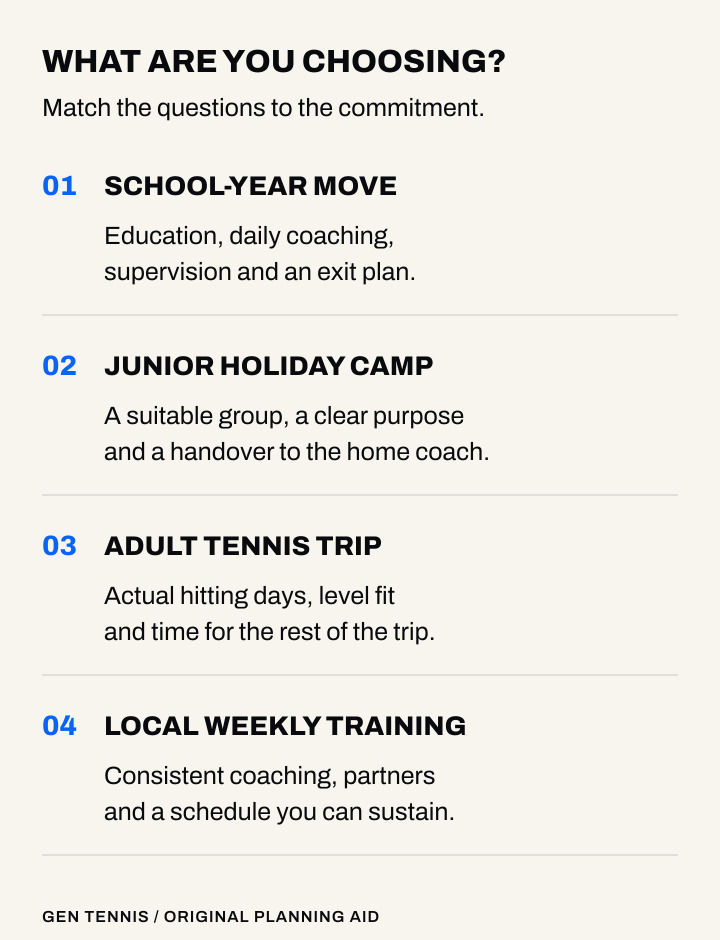
For a junior considering a school-year move, the decision includes education, living arrangements and everyday support. For a child attending a holiday camp, the question may be whether a short block of coaching will be enjoyable and useful when they return home. For an adult, it may be whether the tennis fits their level, available energy and holiday plans. Those are different comparisons, even when the same academy sells all three.
Start with one sentence: ‘We need a stronger regular training group without disrupting school,’ or ‘I want three mornings of doubles coaching and afternoons free.’ This makes it easier to reject a package that sounds exciting but solves a different problem. The advice below is our planning framework, supported by examples from official program pages; it is not a ranking or a report of visits to these academies.
Compare the program, not just the brand
Rafa Nadal Academy in Manacor, Mallorca, illustrates the distinction within one organization. Its annual offer separates Tennis & School, for ages 12–18 with in-person schooling, from Tennis Plus, for players 16 and older combining a more intensive tennis schedule with online study. The annual period runs September–June, with a semester option. Admissions involve evaluation rather than simply choosing a holiday date. Ask which route is actually being proposed and why.
The academy’s separate Daily Tennis Camp for adults over 18 offers two hours of group tennis and 45 minutes of physical preparation per day, bookable for one to seven days. That is a short coaching visit, not a miniature version of the school-year program. Confirm the sessions attached to your arrival and departure dates, as well as the group assessment and accommodation arrangements.
Mouratoglou’s Player Weekend Camp Adult in Biot, France, is another specific offer: Saturday and Sunday mornings outside summer, with a maximum of four players per court. The published morning lists a 9:45 welcome, a 10:00 warm-up and tennis from 10:30 to 12:30. Accommodation, lunch and extras are excluded from the course fee. A timetable can show a lunch period without lunch being included in the purchase.
For a U.S. school-year example, IMG Academy’s boys tennis program in Bradenton, Florida, describes an August–June program combining tennis training with academic life. That is a different commitment from a weekend camp. Its program structure is useful to investigate; it does not establish that every applicant will receive the same training group, competition schedule or financial offer.
These examples were checked against the official pages on October 16, 2026. They demonstrate different products, not equivalent packages or recommendations. Obtain the current written offer for the exact dates, campus and participant before comparing prices. A future academic-year price is not a quote for the present year.
Ask how a lesson becomes a better game
A useful academy conversation moves beyond hours and court surfaces to the connection between technique, movement, decisions and match play. Ask the coach to describe a normal progression for a player like yours. What would they observe first? What would the player practice? When would that skill be used against an opponent, and how would the coach decide what comes next?
For example, a junior who reaches short balls but loses control may need work on recognizing the opportunity, arriving with useful spacing and choosing an appropriate target. A program should be able to explain how its drills and points connect to that problem. ‘We train every aspect of tennis’ leaves the family with much less to evaluate.
Ask how players are grouped and when groups can change. Age, current level, physical readiness and the purpose of the session can matter in different ways. A small group is not automatically a well-matched group, and four players on a court does not, by itself, tell you how much individual feedback each receives. Ask who leads the session, whether that person remains consistent and who reviews the player’s overall plan.
For a beginner, ask how the coach adjusts the ball, space and task so the player can actually rally and play points. For an experienced junior, ask how individual priorities survive a group schedule. For an adult doubles player, ask whether the advertised program includes decisions and movement with a partner, rather than assuming that general tennis training does.
Read an ordinary week, including the gaps
Request a sample week for your actual program and season. Separate tennis instruction, physical preparation, match play, meals, study, travel and unstructured time. Then ask which parts are guaranteed, optional or dependent on numbers and weather. ‘Five hours on site’ and ‘five hours of coached tennis’ are not interchangeable descriptions.
Competition needs the same scrutiny. Does the program include coached practice points, internal matches or travel to outside events? Who selects the events, handles entries and accompanies juniors? Ask whether competition replaces training sessions and which transport, entry and accommodation costs sit outside the quoted fee. An exciting tournament calendar is not necessarily the calendar your child will follow.
An adult booking around a holiday should check actual hitting days, not just hotel nights. A junior attending a short camp needs a manageable start and a clear handover at the end. Ask for a small number of observations and next steps the home coach can use, rather than expecting a week away to permanently rebuild a game.
For a school-year move, tennis is only part of the decision
Before a long stay, establish who is responsible for the child during school, training, evenings, weekends and travel. Ask for the supervision arrangements, the named person a child can approach with a concern, the route for parents to raise a complaint and the procedure if the player wants to come home. A reassuring atmosphere during a tour is not a substitute for clear answers.
Education deserves its own conversation. Confirm the school, teaching language, daily attendance expectations, support when tennis conflicts with class and how records will transfer if the student leaves. Discuss the proposed arrangement with the current or receiving school. For a player considering college, verify relevant admission and eligibility requirements with the institutions concerned; an academy’s pathway language is not an admission or scholarship guarantee.
Include the child in the decision without making them responsible for the family’s financial commitment. What do they want from the move? What worries them? What happens if they enjoy the tennis but dislike the living arrangement? Agree on a review date and practical exit options before an expensive change becomes difficult to question.
Build a complete cost, then compare the alternatives
Use the same period and currency for each option. Put the headline fee beside the costs that make the program usable. Ask for inclusions and exclusions in writing; do not infer them from photographs, a schedule or another family’s package.
- Teaching: group sessions, private lessons, assessment, reports and any extra coaching.
- Daily life: school fees where relevant, housing, meals, laundry and local transport.
- Competition: entries, travel, accompanying staff, accommodation and meals away.
- Equipment and care: strings, balls or kit not supplied, plus applicable insurance and care arrangements.
- Family travel: flights, transfers, visas where applicable, accompanying adults and visits home.
- Changes: deposit, cancellation terms, missed-session policy and what happens if the agreed program changes.
Try the smallest commitment that answers your question
Before relocating, compare an academy offer with a concrete local alternative: a consistent coach, a suitable practice group, regular competition and a schedule the family can sustain. If the missing ingredient is good hitting partners, paying for a residential school may purchase far more change than the problem requires. If local options cannot provide the needed environment, a larger move may deserve serious consideration.
Where available, a trial or shorter visit can reveal group fit, communication and the player’s response to the day. It cannot prove what a full school year will feel like, and a holiday camp may have different coaches or participants. Ask what would carry over into the longer program and what would change.
Before committing, write down the player’s purpose, the exact offer, the unanswered questions and the review date. Afterward, evaluate whether the teaching is coherent, the player can explain what they are working on and the arrangement works in daily life. Results belong in that review, but one good or bad tournament cannot establish what an academy has contributed. The best decision is the one you can explain in terms of this player’s needs, not the name printed on the gates.
Our editorial standards · Questions or corrections? Contact the editor.