
A team place should mean a chance to play
Your child enjoys group lessons but finds a tournament weekend a lonely experience. A team sounds appealing: familiar faces, doubles partners and a result to share. Before signing up, ask a less glamorous question: how often will your child actually get on court?
Junior team tennis can be a useful next step when the level, playing opportunities and weekly commitment suit the child. The badge on the shirt tells you much less than the lineup policy. A welcoming local team with regular matches may be a better fit than a prestigious squad where a developing player rarely plays.
The United States has USTA Junior Team Tennis, usually shortened to JTT. Britain, France and Australia have their own junior team competitions. They offer useful comparisons, but they are not identical programs: a local club league and a selected regional team can serve quite different players.
What USTA Junior Team Tennis offers
The USTA’s national introduction describes JTT for ages 5–18, with singles, doubles and mixed doubles against other coed teams. Players should be ready to serve, rally and keep score. The actual age divisions, ball types, team makeup and match formats available near you depend on the local program.
One detail can cause confusion when families find older pages: the USTA says 2022 was the final year of the JTT National Championships. That does not mean JTT ended. The organization shifted its emphasis toward local play. Ask your coordinator what progression exists in your section instead of assuming that every league leads to the same national final.
Start with a local coordinator, not a national promise
San Diego’s JTT program provides a concrete U.S. example. Its information directs families toward local providers and the area league coordinator, then through level and eligibility checks. Registration uses a team number supplied by the captain or coach. That is a practical sequence: find a suitable team first, confirm eligibility, then register.
USTA junior membership is free, but that does not make the whole season free. Ask separately about team fees, coaching, court charges and travel. Costs vary by local program. The Southern California section regulations also require Safe Play approval for coaches, captains and managers, and supervision by an approved adult. Ask who will be responsible on match day.
Do not infer a playing-time guarantee from a roster spot. Ask how captains rotate players, how absences affect selection and what happens when more children are available than there are match positions. A clear answer is more useful than “everyone is part of the team.”
Britain: Youth League and National League are different choices
The LTA’s Youth League is county based, with age groups from 8U to 18U and teams from registered venues. Its junior National League operates at regional and national levels for 12U, 14U and 18U boys and girls, with summer regional champions progressing to finals. Entry to those regional events can depend on the rankings of nominated players.
For a family seeking a first team experience, the useful conversation is with the local club, park or other registered venue: which team suits this child, and how does this season work? Summer and winter arrangements can differ. Check the relevant league’s format, roster requirements and calendar rather than transferring a rule from another season. “National League” and “local team tennis” should not be treated as interchangeable promises.
France: ask the club about its interclubs pathway
In France, the term to look for is interclubs: competition between clubs. The Occitanie league’s junior competition information illustrates how regional events and national qualification can sit within a wider structure. Its 2026 information describes several junior competitions, including a 12U route linked to national qualification.
The FFT’s national 12U interclub championship is a selected field of 16 girls’ teams and 16 boys’ teams. It is not the definition of every French child’s team opportunity. Ask a local club about the appropriate departmental or regional competition, selection policy and current season. A national final is an endpoint for some teams, not a universal entry point.
Australia: club matches and representative teams are separate
Park Orchards Tennis Club in Victoria offers a useful club-level example. It enters Eastern Region Tennis junior competition on Saturday mornings, with home-and-away matches and different formats. In its Junior Open Singles/Doubles format, four players each play one singles set and two doubles sets. Other divisions use different arrangements. Parents also have rostered supervision or transport responsibilities.
That describes this club’s competition, not a single Australian national format. Nearby options may differ. It also shows why asking about the match format is worthwhile: a team fixture can contain several separate playing opportunities.
Tennis Victoria’s Associations Junior Pennant is a different proposition: selected association representatives compete at a higher level. Players do not simply enter as individuals. For a new competitor, finding suitable club matches may be the immediate task; representative selection can be a separate conversation.
What a good team environment should make room for
These are GEN Tennis’s practical suggestions for evaluating a program, not claims that joining a team guarantees confidence or keeps every child in tennis.
A developing player needs permission to learn in public. Listen to how adults discuss a double fault, a missed volley or a lost deciding point. Can teammates support the player without coaching from wherever they happen to be standing? Ask the captain to explain the competition’s coaching and conduct rules before the first fixture.
Doubles also deserves preparation. Children can practice calling for a ball, choosing return positions and agreeing on a simple plan between points. Pairings that change constantly without explanation may make this harder. Ask whether team practice includes doubles rather than assuming that singles lessons cover everything.
For a child already playing individual tournaments, a team season may add variety, or it may crowd the calendar. Use the junior budget tool to include travel and coaching, and look at the family’s available weekends. Our pathway guide explains why every activity need not be another rung toward professional tennis.
Six questions before you commit
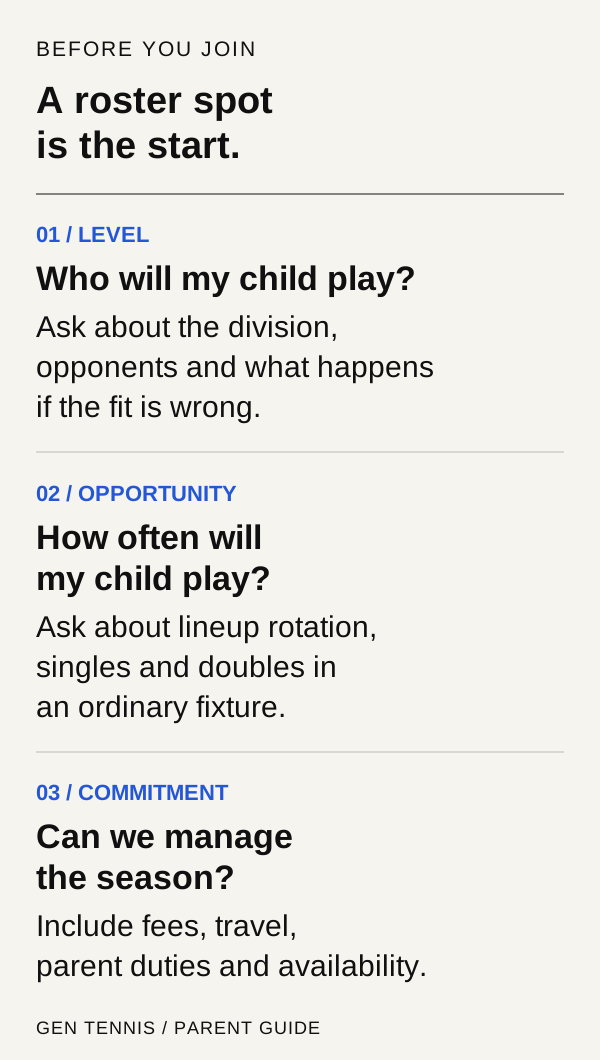
Level: Which age and playing-level division fits my child, and who checks that fit? Ask what happens if the first matches reveal a mismatch.
Playing time: How many players travel, how many play, and how is the lineup decided? Get an example of an ordinary fixture, not only a championship day.
Format: Will the child play singles, doubles or both? What ball, court and scoring format does this division use?
Commitment: What are the full costs, likely travel and parent duties? How are weather cancellations and missed weeks handled?
Support: Who supervises, what safeguarding requirements apply, and whom can a child approach with a concern?
Experience: Can the child watch a fixture or attend a suitable trial session before committing? After the first few matches, ask whether they are getting useful court time and want to return. The standings are only one part of that answer.
For the bigger picture, read how federations develop tennis players. The best team for this season is the one that turns an available place into a worthwhile playing experience for your child.
Our editorial standards · Questions or corrections? Contact the editor.
Sources
- USTA: Junior Team Tennis
- USTA: JTT frequently asked questions
- USTA Southern California: San Diego JTT
- USTA Southern California: section regulations
- LTA: Youth League and National League
- FFT: tennis competitions
- Ligue Occitanie: junior interclubs, 2026
- Park Orchards Tennis Club: junior competition
- Tennis Victoria: Associations Junior Pennant
Keep reading.
Your child’s first tennis tournament: a parent’s practical guide