
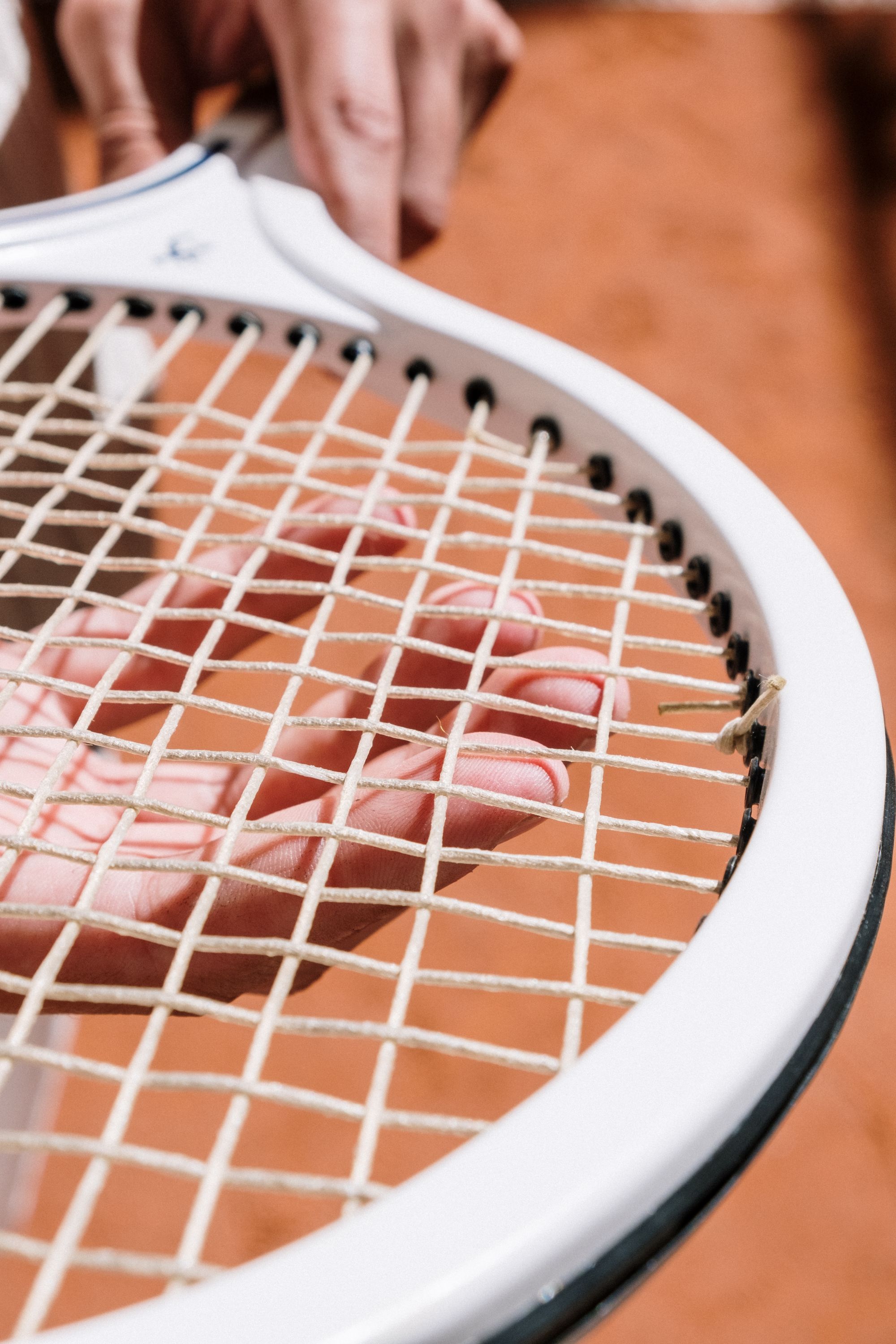
The string has not broken. Is that enough?
Your racket has the same strings it had at the start of the season. They still look like a complete grid, but a familiar rally feels different: the ball leaves the racket unpredictably, the response seems dull, or you keep changing your swing to find the depth you remember. Should you restring, change the string, or leave the equipment alone?
Restring when a string breaks, and investigate before that if wear or a persistent change in response makes the setup unreliable for you. There is no single calendar interval that establishes the right moment for every player. Start with the material, the time spent playing and a comparison with how the setup behaved when fresh.
This is a maintenance and decision guide, not a GEN Tennis string test. The practical comparisons below are suggestions for working with a stringer; they do not measure string life or diagnose a technical problem.
Three different questions: intact, consistent, suitable
An intact string bed answers a narrow question: has a string snapped? It does not establish that the racket still responds as it did after stringing, or that this particular string was a good fit in the first place.
Wilson explains that tension starts dropping as soon as the racket leaves the machine. It also distinguishes resistance to breaking from retention of playing characteristics: polyester can be durable against breakage while needing more frequent restringing to maintain a consistent response.
Keep those questions separate when you speak to a stringer. “These broke after four sessions” describes durability. “These are intact, but the response changed” describes consistency. “I disliked them from the first hit” raises suitability. The same purchase will not necessarily solve all three.
What the material changes
The USTA’s string-selection guide describes broad trade-offs among natural gut, nylon and polyester. Natural gut is elastic and generally offers a soft response, at a higher price. Nylon options include synthetic gut and multifilaments; construction matters, so the word “synthetic” alone tells you little. Multifilaments are generally more elastic and softer-feeling than polyester.
Polyester often suits players who swing fast and value a relatively firm, lower-powered response. That does not make it a default upgrade for someone who rarely breaks strings. A junior improving quickly or an adult beginning competition still needs a setup matched to the way they actually hit.
A hybrid combines different strings in the mains and crosses. The mains run broadly from the throat toward the top of the hoop; the crosses run across it. Record which material is in each direction. “I use a hybrid” is not enough information to reproduce a string job.
When comparing costs, ask for the complete restring price, including labor. Then consider how often you will replace that setup while keeping a response you like. The cheapest packet and the most economical season are not necessarily the same choice.
What to look for before you book a restring
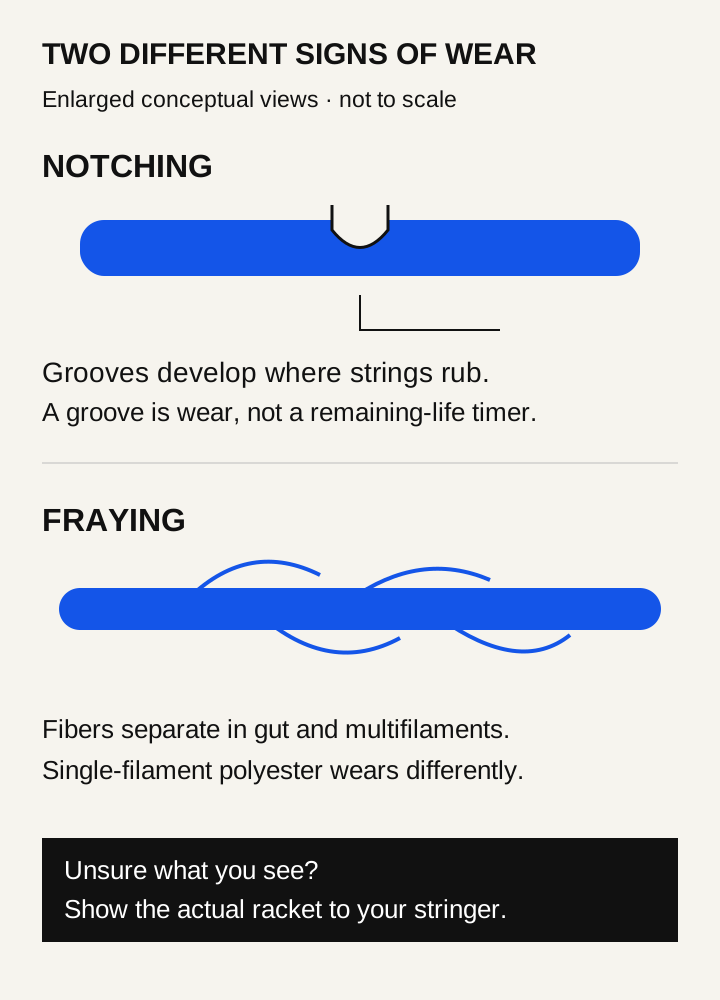
Look across the central hitting area in good light. Wilson identifies notching as grooves developing where strings rub together. It describes fraying as fibers breaking down in natural gut and multifilament strings; a single-filament polyester does not fray in the same way.
A little visible wear is information, not a countdown you can read precisely. This guide cannot tell you how many sessions remain from a photograph. If you are unsure what you are seeing, show the racket to your stringer rather than choosing a replacement date from an online image.
Also make a brief playing note. Was the change present during ordinary cooperative rallies, or only late in a difficult match? Were the balls different? Was it colder or windier? Were you making clean contact? If the concern keeps returning in familiar conditions, you have a better question to take to the shop than “my racket feels wrong.”
Pressing the strings with your fingers can reveal a subjective difference, but it does not give you a calibrated tension reading. A measurement also needs a consistent method and a useful baseline. Ask a stringer what their reading represents before comparing it with the number printed on your stringing receipt.
Why a calendar rule is only a starting point
You may have heard the rule of restringing as many times per year as you play per week. Wilson calls that an old rule of thumb and says it can be insufficient. Babolat offers a general three-month recommendation. Neither statement establishes the remaining life of your particular string bed.
A weekly player might hit gently for forty minutes or play two demanding sets. Another player may complete several long practices between your weekly sessions. Counting visits hides that difference. Log approximate playing hours alongside the stringing date, and use the record to agree a sensible review point with your stringer.
For an occasional recreational player, the first useful step may simply be identifying the old string and establishing a fresh reference. For a frequent competitor, it may be reviewing the setup before an important block of matches. For a junior family, it may be checking whether the present string choice still fits the player and the maintenance budget.
Those are different decisions, not different mandatory schedules. Do not wait for an unfamiliar setup to break just because a calendar reminder has not arrived.
Tension is a setting, not a complete description
The ITF’s equipment explanation describes strings and the ball deforming during impact. Looser strings can return the ball faster because the balance of deformation and energy loss changes. That physical tendency does not tell a player which setting will produce the most useful ball flight.
The ITF also notes that material, string length and diameter affect the system. Two rackets strung at the same reference tension are therefore not necessarily equivalent. Keep the exact string name and thickness with the tension, and specify pounds or kilograms. A bare number such as “24” is incomplete.
Use the frame manufacturer’s guidance and your stringer’s knowledge as the starting point. If you liked the setup when it was fresh, first consider restoring it before changing several specifications at once. If it never suited you, describe the problem rather than asking for an arbitrary increase in tension.
The useful question is not “what number do good players use?” It is “what change are we trying to make, and how will we know whether it helped?”
Borrow the professionals’ record-keeping
A 2015 US Open report on its stringing team emphasized consistent preparation while explaining that elite and recreational players have different equipment needs. It is historical reporting, not a list of current tour setups.
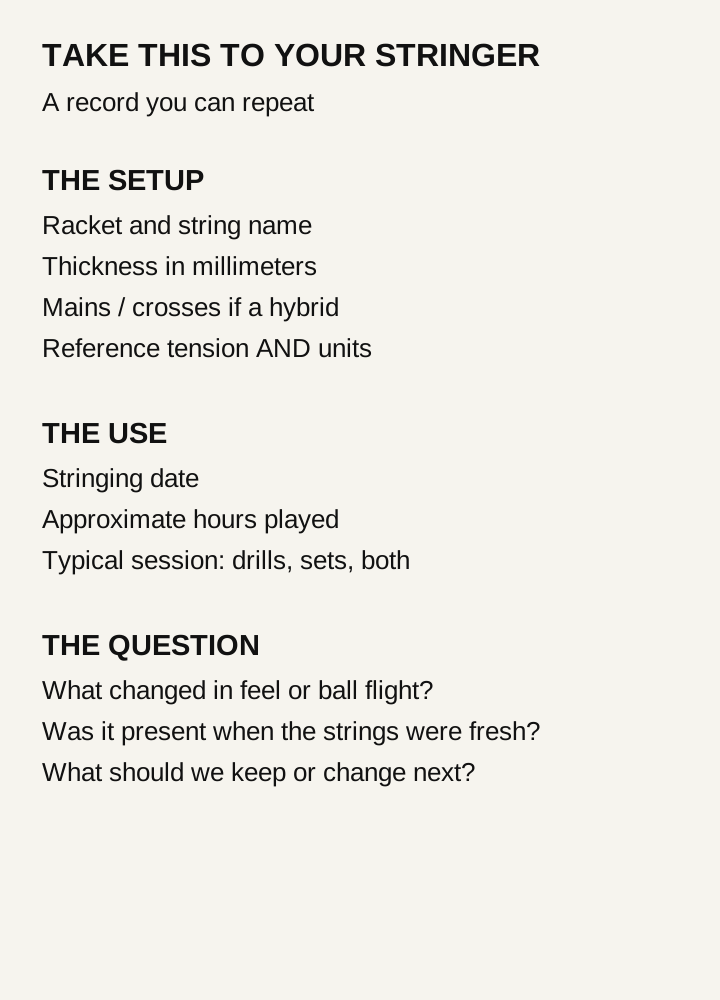
The transferable idea is to keep a reproducible record. Write down the racket, string name, diameter, mains and crosses, reference tension and stringing date. Add your playing hours and what changed. You can borrow that discipline without copying a professional’s tension or replacement frequency.
Before an important match, leave time to try a fresh string job in practice. Arriving with an untested material and tension introduces another unfamiliar variable. If you carry a backup, know what is in that racket too.
A useful test after restringing
Choose a familiar practice sequence: cooperative groundstrokes toward a generous depth target, a few volleys and your usual serve practice. Keep the racket, balls and task as similar as practical. The aim is a fair comparison, not a laboratory experiment.
If the previous setup worked when fresh, repeat its specification first. Note depth, predictability and feel without scoring every missed ball as an equipment failure. If you are comparing a different setup, agree one main change with your stringer and give yourself a reasonable opportunity to experience it in ordinary play.
Finish with three notes: what you used, what you noticed and what you will do next. “Keep this setup and review after another practice block” is a valid outcome. So is “ask about a different material.” You do not need to keep buying experiments when the present combination serves you well.
Our racket-buying guide explains why frame comparisons need the string setup recorded, too. If you want to organize the on-court comparison, use the practice planner and keep the task familiar. A useful maintenance decision should leave you with fewer equipment questions when the next point begins.
Our editorial standards · Questions or corrections? Contact the editor.