Start with things you can answer, even as a beginner
“Do you want power or control?” is not a very helpful opening question when you are still learning to rally. A ball can fly long because of racket-face angle, contact, strings or several things together. Buying a frame described as a control racket does not identify the cause.
Instead, tell the shop how often you play, what a normal session involves and your complete budget. Include whether you are learning with slower balls, returning after a break, mostly playing doubles or already practicing regularly. If you have access to a racket, record its exact model, handle size and strings. If you do not, start with a lesson or a shop fitting that lets you hold and try a suitable reference.
A manageable adult frame around 100–105 square inches is one reasonable place to begin comparing, not a requirement or a promise of easy tennis. We use that range for the model examples below. Your hand, swing, playing demands and budget decide which examples deserve a trial.
Before ordering demos, aim to know four things: an approximate grip size; adult or junior length; which finished rackets you can move comfortably; and an initial string setup. You can learn these with help. You do not have to declare yourself a “power player” first.
Our first-racket buying guide covers borrowing, demo logistics and when ownership makes sense. Here, the question is how to select the equipment itself.
Understand the frame, the hitting area and the handle
Construction: what are you actually paying for?
The frame is the structure around the strings; the stringbed is the woven hitting surface. A frame’s material and its shape both matter. “Graphite” in racket descriptions commonly refers to carbon-fiber composite construction. HEAD’s factory explanation describes graphite fibers combined with resin and arranged in different directions before molding. That arrangement, called the layup, helps explain why two graphite rackets need not flex or feel alike.
Aluminum and mixed-material recreational models also exist. Ask for the exact composition, rather than interpreting a technology name as a quality grade. A graphite label alone does not establish how a racket will swing, how flexible it is or whether it suits you. Babolat lists the $119 Boost Drive below as graphite, for example; graphite is not exclusive to the highest-price frames.
For occasional play on a tight budget, a sound, correctly sized recreational racket can be a sensible start. For regular use, compare a suitable graphite option and ask about restringing, replacement grommets and bumper availability. Grommets are the small protective fittings where strings pass through the frame; the bumper protects the top edge. Those practical details can matter more than another branded material claim.
Head size, shape, beam and length are separate dimensions
A 100-square-inch head describes the stringbed’s area. A 105 has more area; it is not five inches longer. The hoop’s outline may be more oval or have a squarer upper section. The beam is the frame’s cross-section, usually described in millimeters. Neither the outline nor the beam measurement alone tells you the size of the most useful contact region.
A larger head gives you more physical stringbed area, but clean contact still depends on judging and meeting the ball. A smaller head is not a qualification you must earn as you improve. Test whether your normal swings produce predictable contact and depth; do not choose a 98 simply because an advanced player uses one.
Length is measured from the butt cap at the end of the handle to the top of the frame. Most adult models here are 27 inches; the HEAD Speed Team is 27.2. Extra length changes reach and handling together. Include serves and balls close to your body when trying an extended frame. A shorter junior racket is a separate fitting decision, covered below.
Grip size: fit the handle you will actually play with
Grip size means handle circumference. It is different from a forehand or serve grip, which describes where you put your hand. The flat faces around the handle are called bevels; their feel helps you recognize racket-face orientation. Two brands with the same circumference label may still feel different in your hand.
For an initial size estimate, measure from the lower lateral palm crease to the tip of your ring finger with the hand open. Another starting check uses an eastern forehand hold and roughly an index-finger gap between fingertips and palm. These are fitting guides, not laws: compare neighboring sizes in person and check relaxed grip changes, not just a static photograph of your hand.
| European size | U.S. circumference |
|---|---|
| L0 / 0 | 4 inches |
| L1 / 1 | 4 ⅛ inches |
| L2 / 2 | 4 ¼ inches |
| L3 / 3 | 4 ⅜ inches |
| L4 / 4 | 4 ½ inches |
| L5 / 5 | 4 ⅝ inches |
The replacement grip is the base covering on the handle. An overgrip is a thinner wrap added over it, often for surface feel or moisture management. Adding one increases the finished circumference and adds mass; changing the base grip can also alter both. Compare tacky and absorbent surfaces if your hand slips, rather than assuming every slipping problem requires a different frame.
If you are between sizes, ask what one normal overgrip would do to the smaller handle. Building up a small handle is usually easier than reducing a large one, but several wraps can blur the bevels and change the setup. A two-handed backhand also deserves a check with both hands in place. Do not buy a larger handle because it is labeled for men, or a smaller one because it is labeled for women.
Flex and stability: useful terms with limits
A stiffness rating describes how a frame responds in a particular measurement. It does not measure the comfort of the complete racket, and figures from different methods should not be treated as interchangeable. Beam shape, composite layup, strings and contact location all belong in the discussion.
“Stable” needs a little more explanation. Does a reviewer mean the frame resists twisting on an off-center return, or that it stays composed against a fast incoming ball? Twistweight describes resistance to rotation around the racket’s long axis; it is distinct from swingweight. You do not need a twistweight target to start playing, but you should ask what a claimed stability advantage actually describes.
Weight, balance and swingweight answer different questions
- Mass: how much material the complete racket contains, expressed in grams.
- Balance: the position of its center of mass along the length. Head-light means nearer the handle than the midpoint; head-heavy means beyond it.
- Swingweight: resistance to rotation about a specified axis, usually reported in kg·cm². It depends on where the mass sits, not just how much there is.
A head-light racket can still have substantial swingweight. Compare measurements using the same setup and measurement method. Strings, an overgrip and added weights change the finished racket. These mechanics are explained by Crawford Lindsey at Tennis Warehouse University, a retailer-affiliated technical source.
27 inches = 68.58 cm
The midpoint is 34.29 cm from the butt. A balance at 32 cm is 2.29 cm toward the handle: head-light. A balance at 35 cm is 0.71 cm toward the head: head-heavy. Neither number alone supplies swingweight.
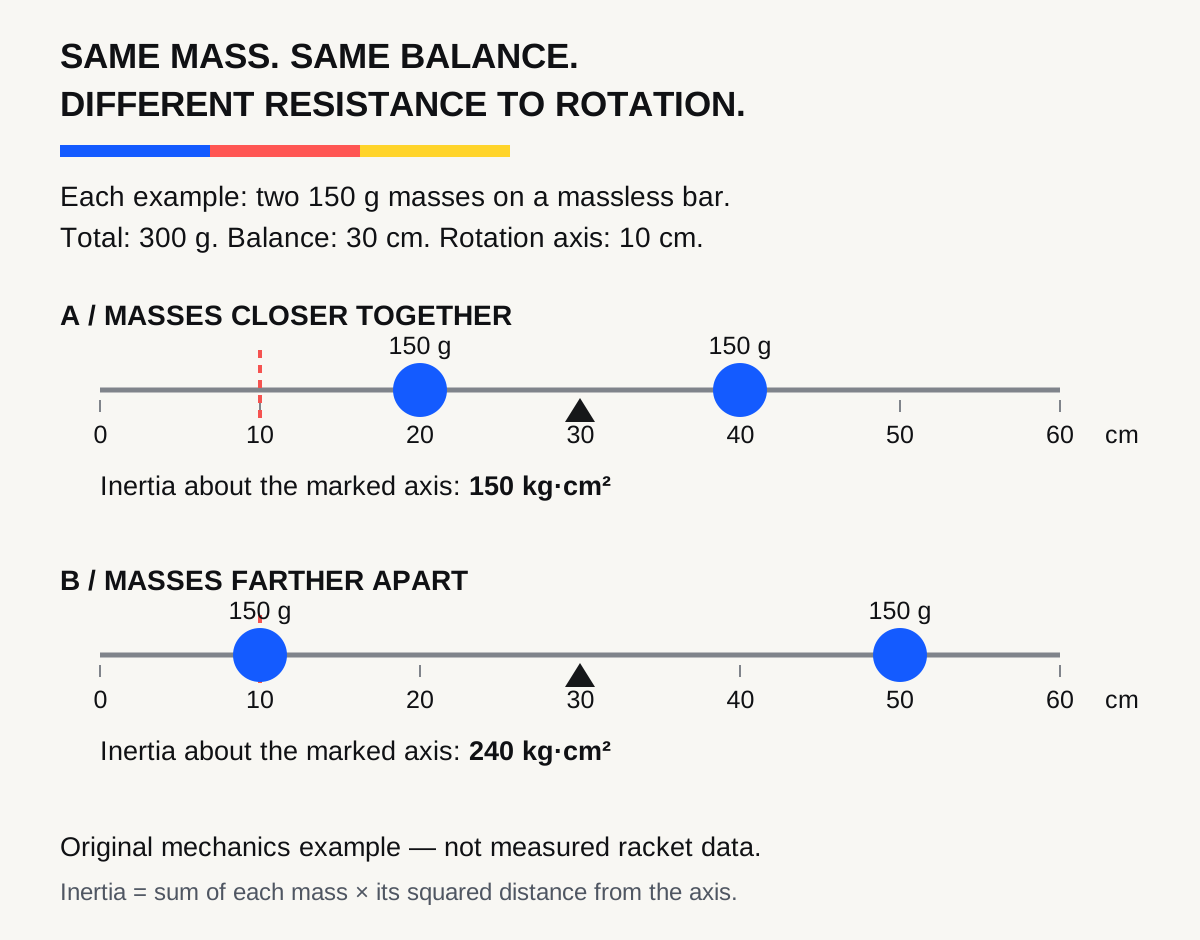
On court: if one demo feels substantial but remains easy to organize, write that observation rather than guessing its balance. If another becomes difficult late in the session, compare the finished setup and repeat the trial. Do not add customization weight before you understand the starting racket.
Strings, tension and dampeners are part of the purchase
The ball meets the strings, so a demo is a test of a complete setup. A fresh multifilament in one racket and an old polyester in another can produce different sensations and ball responses even before you consider the frames. Ask for the string’s name, thickness, installation tension and approximate age. Record “unknown” when the shop cannot confirm them.
Know the main string choices
- Synthetic gut: typically a nylon-based string built around a solid core. An economical option to discuss for a first setup; the word “gut” here does not mean natural gut.
- Multifilament: many fine fibers bundled together. Worth comparing when you prefer a softer-feeling stringbed, with price and resistance to wear varying by construction.
- Natural gut: made from animal tissue, with strong elasticity and tension retention. Usually a premium purchase; it is not necessary to learn tennis.
- Polyester or co-polyester: generally a firmer string category, often used by faster swingers seeking a particular response and resistance to breakage. A professional’s polyester setup is not an automatic upgrade for a beginner who rarely breaks strings.
Monofilament means a single-filament construction, not necessarily polyester: Babolat RPM Soft, for example, is a polyamide monofilament. Material and construction are different pieces of information.
A hybrid uses different strings in the mains and crosses. The mains run along the racket’s length; the crosses run across it. It is another adjustable setup, not inherently the best of both materials. For a beginner, a straightforward synthetic-gut or multifilament starting option is usually easier to discuss and understand than an elaborate hybrid. This is a practical starting suggestion, not a prescription for every player.
Gauge, pattern and tension: three different settings
Gauge means string thickness. Compare millimeters when numbering systems differ. Pattern is the count of mains and crosses: 16×19 means 16 mains and 19 crosses. The ten examples below share that count, but their spacing is not necessarily identical. A string pattern alone cannot promise spin or control.
Reference tension is the pull setting used during stringing, commonly quoted in pounds or kilograms. Within the same frame and string setup, a higher reference tension generally produces a firmer stringbed and a lower one a less firm stringbed. That does not automatically make your shots more accurate. The setting is not a permanent reading of stringbed firmness: strings lose tension, and material, frame and installation affect the result. Do not copy someone else’s number without knowing their string and racket. Start within the manufacturer’s guidance with a stringer’s advice, write down the setup, then change one thing at a time.
Strings can need replacement before they break. Watch for wear, fraying or notching, but also note a change in response that makes your usual contact difficult to judge. Frequency of play, string type and conditions matter; this guide does not prescribe one restringing calendar for everyone. Reassess an old demo stringbed before rejecting an otherwise suitable frame.
Dampener or no dampener: what are you feeling?
A string dampener is the small rubber or elastomer accessory fitted among the strings, normally below the lowest cross string. It changes the string vibration and the audible ring after contact. Some players prefer the quieter, more muted sensation; others like the clearer sound without it. Either preference is legitimate.
That quieter sound does not prove that the frame is softer or that less shock reaches your arm. In a 2004 laboratory study, Li, Fewtrell and Jenkins tested impacts while 20 participants held a racket stationary. They found no significant reduction in measured frame vibration at the wrist or elbow with dampeners. This was a controlled impact experiment, not a long-term injury trial or a test of every accessory. A dampener is not presented here as injury prevention or treatment.
Try this: use the same racket, strings and balls for a few comfortable rallies, first with and then without the dampener. Notice sound separately from depth, direction and handling. Once you know your preference, use a consistent accessory setup for the main frame comparison. Do not label one racket “more comfortable” solely because it arrived with a dampener and the other did not.
What should I ask the shop or stringer?
“I am learning with this frame and grip size. My complete budget is ___. I play about ___ times a week. What string, thickness and starting tension would you suggest, what is the installed cost, and what would tell us it needs reassessment?” If you liked a demo, ask whether they can reproduce its full setup rather than only sell you the same frame.
Women, men and juniors: which differences matter?
Adults: fit the person, not a gender category
Women and men can use the same adult racket models; Wilson explicitly lists the Clash 100 V3 as unisex. The relevant differences are the individual player’s hand dimensions, strength, coordination, swing and ability to repeat it over a session. Those can change the appropriate grip, mass and handling, but “female” or “male” does not supply those measurements.
A woman who comfortably handles a 300 g frame does not need to choose its lighter version because of the label. A man learning compact, controlled swings does not need a heavy Tour or Pro model to make it a proper adult purchase. Equally, a smaller hand may need a small grip on a substantial frame, while a larger hand may need a larger grip on a lighter one. Grip size and racket weight are independent choices.
Body size can help a fitter decide where to start, but the trial should settle the question. Check preparation, serve handling and later-session control in the same way for women and men. Choose the color you like after checking the actual specification; a paint scheme does not establish a different mechanical design. No racket or string in this guide is offered as a remedy for pain.
Juniors: length comes before an adult model comparison
A child needs a racket that fits now, not an adult frame to grow into. USTA describes a progression through shorter junior lengths, including 19, 21, 23, 25 and 26 inches, with full-length options considered as players grow. Age labels and height charts help identify candidates; they do not replace watching the child move and play.
USTA’s simple length check is to let the racket hang by the player’s side with its head pointing down: it should finish just above the ground. Use that as an initial check, then have the coach assess actual handling. Can the child prepare on both sides, change direction and attempt the serve without the equipment dominating the movement? Compare the neighboring length when uncertain.
Match the racket decision to the child’s ball and court stage. USTA’s youth progression connects shorter courts and lower-bouncing red, orange and green balls with appropriately sized equipment. A longer racket is not a reward for winning, and moving toward a full court does not automatically justify an adult’s preferred weight or polyester strings.
Girls and boys need the same individual fitting process. Two juniors of the same age may differ in height, hand size, development and playing experience. When a junior is ready to explore a 27-inch frame, a lower-mass adult version may be a useful comparison, but “Team” or “L” still does not tell you its grip, balance or finished swingweight. Confirm those separately.
Check the junior handle separately too: the child should be able to find and change holds without the circumference forcing an awkward grasp. The racket’s stage or color marking is not its grip-size measurement.
For a frequent junior player, also compare the construction and stringing needs of two rackets of the same length. Ask the coach and stringer to coordinate the starting setup. A young player who is learning contact does not need a copied professional string prescription; regular competition and frequent string breakage raise a different discussion. Recheck fit as the child grows rather than buying oversized equipment in advance.
Ten models, with the specifications on the same basis
Write down brand, family, generation, head size and weight version. Blade 100 is not interchangeable with Blade 98; Team, L and Pro do not mean the same thing across brands. Check the throat label and order confirmation, not just the paint. A different string pattern or extended-length version is a different comparison.
U.S. manufacturer prices checked October 15, 2026. Displayed prices exclude applicable tax and shipping. Unstrung frames also require strings and installation; the Boost Drive price includes its supplied strings. A page listing is not confirmation that your grip and color are in stock. Yonex prices below are for the retrieved Espresso Brown selections.
Every weight and balance figure below is unstrung, including the Boost Drive, which is sold with strings installed. Balance is measured from the butt end. Figures are nominal specifications, not measurements of the demos in your hand. Babolat states ±7 g and ±7 mm tolerances for its listed models. All ten use a 16-main/19-cross string pattern.
Wilson Clash 100 V3
WR17280
- Head
- 100 in²
- Length
- 27 in
- Unstrung mass
- 295 g
- Unstrung balance
- 310 mm
$249Frame; optional stringing
Wilson Blade 100 V10
WR20820
- Head
- 100 in²
- Length
- 27 in
- Unstrung mass
- 300 g
- Unstrung balance
- 320 mm
$299Frame; optional stringing
HEAD Speed Team 2026
232056
- Head
- 105 in²
- Length
- 27.2 in
- Unstrung mass
- 270 g
- Unstrung balance
- 325 mm
$239Unstrung
HEAD Speed MP 2026
232026
- Head
- 100 in²
- Length
- 27 in
- Unstrung mass
- 300 g
- Unstrung balance
- 320 mm
$259Unstrung
Babolat Pure Drive Gen11
101552
- Head
- 100 in²
- Length
- 27 in
- Unstrung mass
- 300 g
- Unstrung balance
- 320 mm
$299Unstrung
Babolat Pure Drive Team Gen11
101554
- Head
- 100 in²
- Length
- 27 in
- Unstrung mass
- 285 g
- Unstrung balance
- 320 mm
$279Unstrung
Babolat Boost Drive
121263 · Blue/Orange/White
- Head
- 105 in²
- Length
- 27 in
- Unstrung mass
- 260 g
- Unstrung balance
- 345 mm
$119Supplied strung
Yonex EZONE 100 · 8th generation
EZ08100 · Espresso Brown price
- Head
- 100 in²
- Length
- 27 in
- Unstrung mass
- 300 g
- Unstrung balance
- 320 mm
$305Unstrung
Yonex EZONE 100L · 8th generation
EZ08100L · Espresso Brown price
- Head
- 100 in²
- Length
- 27 in
- Unstrung mass
- 285 g
- Unstrung balance
- 325 mm
$305Unstrung
Dunlop FX 500 2026
MFX50026
- Head
- 100 in²
- Length
- 27 in
- Unstrung mass
- 300 g
- Unstrung balance
- 320 mm
$249.99Unstrung
HEAD’s original 2026 catalog specifies the Speed Team at 27.2 inches, slightly longer than its 27-inch Speed MP. Some retailer summaries conflict; the manufacturer catalog is linked in Sources. We have not combined manufacturer swingweight figures with retailer strung measurements to create a misleading ranking.
Turn the numbers into comparisons you can use
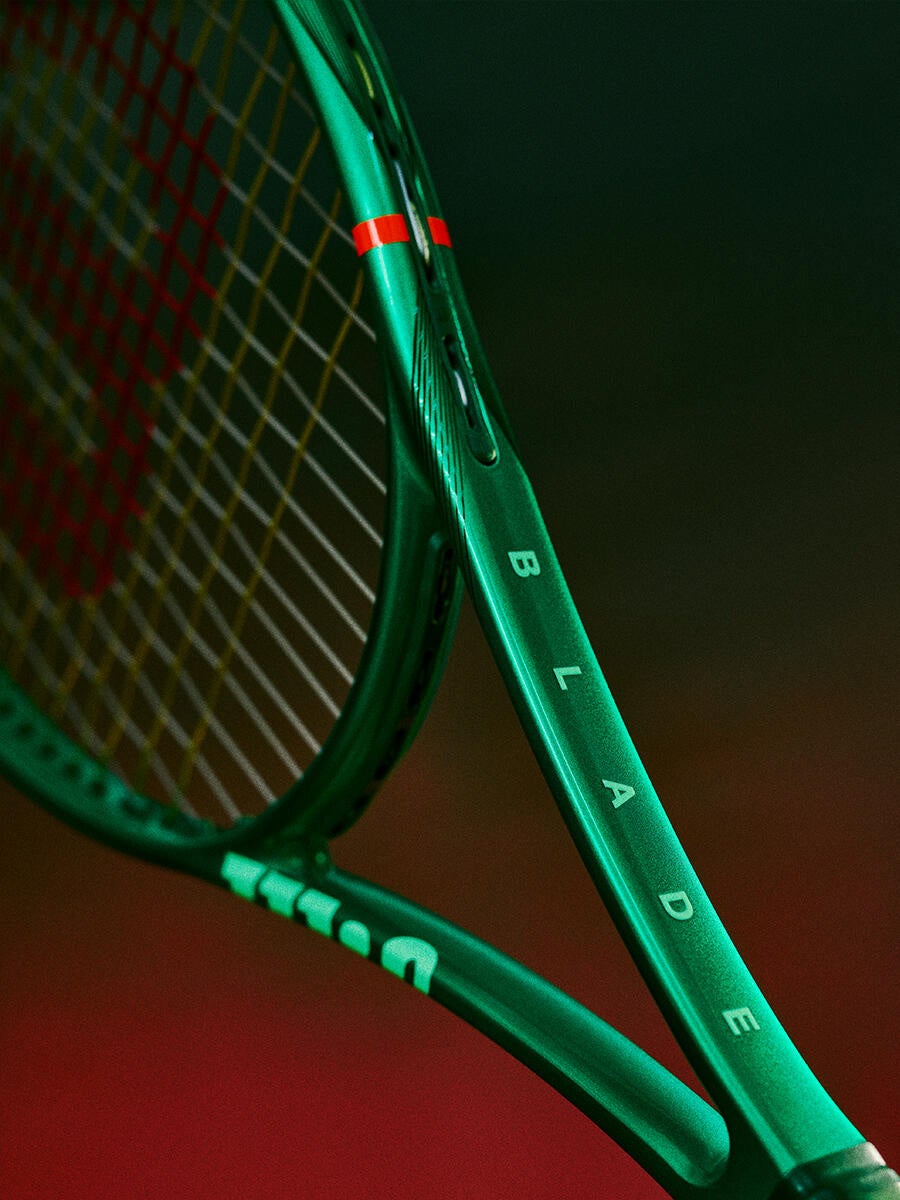
Wilson Clash 100 V3 versus Blade 100 V10: same head area, different proposition
Both are 100-square-inch, 16×19 frames. The Blade’s nominal unstrung mass is 5 g greater, and its balance is 10 mm farther from the hand. Wilson positions Clash around flexibility and Blade around control. Those labels describe the design proposition; neither tells you which will feel easier or produce better shots for you.
Try them with comparable strings. Can you keep the racket face organized on a return, change between forehand and backhand, and serve comfortably later in the session? Do not choose a Blade simply because “control” sounds like the cure for hitting long. First check contact, trajectory and the string setup.
A useful outside check is Tennis Warehouse’s February 2025 Clash 100 V3 playtest. Its testers appreciated maneuverability and comfort, but some wanted more stability or mass; one struggled with flatter-shot control. This is retailer-affiliated testing by experienced players, not a beginner survey or our test. The disagreement is a reason to demo, not a consensus verdict.
HEAD Speed Team versus Speed MP: a 105 is not simply a bigger 100
The Team combines a 105-square-inch head, 270 g unstrung mass and 27.2-inch length. The MP is 100 square inches, 300 g and 27 inches. Their beam widths also differ: 24 mm for Team, 23 mm for MP. You are comparing a package of changes, not isolating head area.
A player seeking a larger contact area can reasonably include the Team. A player considering the 300 g alternatives below can include the MP. Test whether the extra length helps your reach without making close-body shots awkward, and whether the lighter frame remains manageable against a firmer incoming ball. A larger head is a legitimate design choice, not a lower grade of equipment.
Babolat Pure Drive versus Pure Drive Team: compare a useful weight step
These Gen11 versions share a 100-square-inch head, 27-inch length and nominal 320 mm balance. The Team is 285 g rather than 300 g unstrung, and its displayed frame price is $20 lower. That makes this a useful same-family comparison if you are unsure how much mass you want.
Start with whichever you can organize comfortably, then use the other on the same tasks. Does the heavier version remain manageable when tired? Does the lighter one let you prepare more freely while keeping direction on a blocked return? A lighter racket is a different option, not a temporary stage you must outgrow.
Yonex EZONE 100 versus 100L: lighter does not describe everything
The eighth-generation 100L removes 15 g of nominal mass but moves the listed balance 5 mm farther toward the head. Both have a 100-square-inch isometric hoop and 27-inch length. Yonex’s distinctive outline is a design choice; its marketing claims are not our measurement of a larger effective hitting area than every rival.
Compare the 100L if the 100 becomes difficult to prepare repeatedly. Compare the 100 if you want to explore the heavier version without changing families. Pay attention to the handle shape and off-center contacts as well as the first clean forehand. The shared $305 displayed price makes the choice about fit, not a presumed cheaper “L” tier.
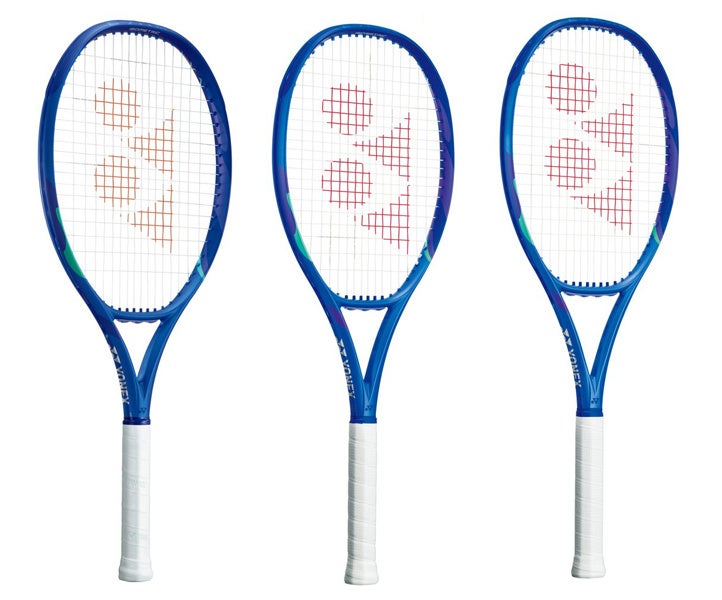
Pure Drive, EZONE 100, Speed MP and Dunlop FX 500: identical headline numbers do not settle it
These exact versions all list 100 square inches, 300 g, 320 mm, 27 inches and 16×19. Their construction and geometry still differ. For example, Dunlop lists a 23–26–23 mm beam for the FX 500; Yonex lists 24.5–26.5–23 mm for EZONE 100. Dunlop positions FX around power, while the displayed $249.99 price is below the other three.
Do not order all four automatically. Pick two available in your grip with comparable strings, then ask whether their differences matter to your rally, serve and return. If you cannot name a meaningful advantage, availability, total cost and a handle you like are reasonable deciding factors. No specification here establishes a cross-brand winner.
Babolat Boost Drive: include the affordable option honestly
At $119 supplied strung, the Boost Drive changes the entry budget substantially. Its 105-square-inch head and 260 g unstrung mass are paired with a 345 mm unstrung balance, much farther forward than the premium models above. Light on a scale therefore does not automatically mean proportionally easier through a swing.
For occasional play, ask whether it does the required job before paying for a premium frame. For frequent play, compare handling and the ongoing stringing arrangement. Confirm the installed string and its condition. “Drive” in both names does not make Boost Drive and Pure Drive the same construction at different prices.
Now choose demos that answer a question
Once the handle, length and starting setup make sense, select one reference and one meaningful alternative. Add a third only if it tests a different unresolved question. The aim is to learn which change helps you, not to audition unrelated rackets and hope the best one announces itself.
| Your question | A useful pair | What to observe |
|---|---|---|
| Does less mass help me prepare? | Pure Drive Gen11 / Pure Drive Team Gen11 | Preparation late in the session, plus direction on firmer returns. |
| Which response do I prefer at a similar head size? | Clash 100 V3 / Blade 100 V10 | Contact, blocked returns and serves with comparable strings and grips. |
| Would a larger contact area suit me? | Speed Team 2026 / Speed MP 2026 | Contact consistency; mass, beam and length also change, so this does not isolate head size. |
| Is the lighter Yonex more manageable? | EZONE 100 / 100L, eighth generation | Repeated preparation and off-center contacts, not scale weight alone. |
| Do I need the premium purchase? | Boost Drive / one suitable premium demo | The repeatable difference that would justify the complete price. |
What should good feel actually mean?
You do not need to recognize an expert’s “plush pocketing.” Separate your observations into three parts:
- Before contact: can you find the grip, prepare the racket and adjust it when the ball arrives somewhere unexpected? If it feels cumbersome, note the shot and when that happens.
- At contact: does the handle remain secure? Can you distinguish a centered hit from one near the edge? Note a ringing sound separately from an uncomfortable sensation or a twisting handle. One mishit does not diagnose the frame.
- The ball afterward: does a familiar, repeatable swing produce a trajectory and depth you can anticipate? “I had to steer every forehand short” is more useful than simply writing “too powerful.”
“Crisp,” “muted” and “connected” describe sensations, not a universal quality scale. A racket can feel satisfying on a clean feed yet become hard to prepare when you move. Conversely, unfamiliar sound need not mean poor control. Ask a coach to watch if you cannot tell whether the difference comes from the equipment or from the swing changing.
Use the same small test, then reverse the order
- Record the complete setup. Exact model and generation, grip and overgrip, string and tension if known, and dampener. Include your current racket as a reference where possible.
- Rally at a comfortable pace. Use the same partner, balls and broad target. Check preparation, centered contact, depth and direction. A beginner can use cooperative feeds or slower balls; demanding full-speed hitting adds noise to the comparison.
- Add familiar awkward shots. Try a firmer return, a body ball and a volley if those are in your game. Notice which racket you can organize, rather than rewarding the hardest winner.
- Serve and play some points. Test the complete serve motion and the following shot. If your serve is still developing, include a coach’s observation rather than ranking rackets by aces.
- Retest later and reverse the order. Return to the first frame after trying the other. Notice whether handling changes with fatigue. If the strings, conditions or your swing make the result uncertain, record the uncertainty.
Use one observation and one next question: “Easier to prepare on returns; retest the serve with a comparable stringbed.” A repeatable preference is worth more than a score invented after five hits. Stop a trial that causes pain; seek appropriate advice for persistent or concerning symptoms.
Buy the complete setup, not the promise on the frame
Ask for a written total: frame, string, labor, grip, delivery and any applicable taxes. Confirm demo credit, return conditions after stringing or play, and availability in your grip. A stocked previous generation can be a sensible purchase if you have tried that exact version; a familiar family name does not make generations interchangeable.
For a used racket, inspect the hoop, throat, bumper and grommets. Ask about cracks, repairs, added weight and replacement parts. A seller calling wear “cosmetic” is not an independent inspection. If condition is uncertain, have a knowledgeable shop assess it before treating the low price as a saving.
Think about the recurring cost as well: string replacement, grips and a second matching frame if your playing situation eventually calls for one. The tennis-year cost planner helps keep equipment beside lessons, courts and competition in the same budget.
- Buy when one complete setup works across your normal session and you can explain why it suits you.
- Compare again when the preference depends on a questionable stringbed, an uncertain model or only five memorable shots.
- Keep your current racket when the alternative does not solve a specific problem. A fresh grip, a suitable restring or more useful practice may be the next step.
The aim is to leave with a racket you understand and want to use. The model that makes another player enthusiastic is a candidate for your shortlist, not the answer to it.
Independent researched buying guide. No affiliate links or paid placement. Product facts and U.S. displayed prices checked October 15, 2026; exact grip/color stock was not confirmed. Manufacturer descriptions are identified as such. The outside playtest is retailer-affiliated; fitting and comparison exercises are suggestions, not GEN Tennis hands-on findings. Product photography and the original diagram are documented in the linked photo credits.
Our editorial standards · Questions or corrections? Contact the editor.
Sources
- Tennis Warehouse University: swingweight, twistweight and equipment physics
- Wilson Clash 100 V3: official U.S. specifications and displayed price
- Wilson Blade 100 V10: official U.S. specifications and displayed price
- HEAD Speed Team 2026: official U.S. specifications and displayed price
- HEAD Speed MP 2026: official U.S. specifications and displayed price
- Babolat Pure Drive Gen11: official U.S. specifications and displayed price
- Babolat Pure Drive Team Gen11: official U.S. specifications and displayed price
- Babolat Boost Drive: official U.S. specifications and displayed price
- Yonex EZONE 100 · 8th generation: official U.S. specifications and displayed price
- Yonex EZONE 100L · 8th generation: official U.S. specifications and displayed price
- Dunlop FX 500 2026: official U.S. specifications and displayed price
- HEAD 2026 manufacturer catalog, pp. 20–21 (distributor-hosted): Speed length and unstrung specifications
- Wilson Australia: Clash 100 V3 length specification
- Wilson Australia: Blade 100 V10 length specification
- Crawford Lindsey / Tennis Warehouse University: weight, balance and swingweight
- Tennis Warehouse: racket characteristics explained
- Tennis Warehouse: measuring grip size
- Tennis Warehouse: string materials, gauge and tension
- Tennis Warehouse: original Clash 100 V3 playtest, February 2025
- HEAD: graphite fibers, resin, layup and frame construction
- Wilson: string materials, mains/crosses and hybrid setups (general guidance; not Australian pricing)
- Babolat: string choice for developing players, updated November 27, 2024
- Babolat RPM Soft: polyamide monofilament specification
- Li, Fewtrell and Jenkins (2004): original string-dampener impact study, University of Birmingham
- Wilson: string dampeners and the audible ping (manufacturer explanation)
- USTA: racket sizing and the initial length check, January 1, 2017
- USTA Perfect Match: youth racket, ball and court progression
- Babolat: junior height, playing level, construction and string selection
Keep reading.
When should you buy your own tennis racket?
How to choose tennis shoes that fit your feet and your court