Start with the problem your next pair needs to solve
Choose tennis shoes in this order: the surface you play on, the shape of your foot, then the support, wear protection and price that fit your routine. Someone playing doubles twice a week has a different buying problem from a junior dragging a toe through daily hard-court practice. A famous model can be a poor purchase if its heel slips or its toe box squeezes you.
Take your old shoes to the shop. A worn patch under the big toe, a hole above it and a rubbed heel lining point to different questions. If this is your first pair, tell the fitter where you play, how often and whether ordinary shoes tend to feel tight across your toes or loose at the heel.
We checked manufacturer listings, original laboratory measurements and public player discussions on September 23, 2026. This is researched buying guidance, not a hands-on review by GEN Tennis. The named models are a starting shortlist for comparison, with the limitations of each source kept visible.
Buying your first pair? Give the shop a useful brief
You do not need to know whether you are an aggressive baseliner before buying shoes. Start with something concrete: ‘I am taking a weekly lesson on public hard courts, my budget is $120, and everyday sneakers usually squeeze my little toe.’ That tells a retailer more than ‘I want a professional shoe.’ Ask to compare two tennis-specific models with different shapes, including a wide version if needed.
Check your club’s surface and footwear rules first. Then measure both feet using the brand’s size guide, and bring the socks you will play in. A U.S. size number is a starting point; it does not describe toe shape, foot volume or heel hold. If you buy online, look for the exact version, width and surface designation, and read the return conditions before ordering. Keep your first comparison indoors until you know the shoes can go back.
If you already play regularly, make the brief about your current pair: ‘The heel stays secure, but my toes touch the front when I stop,’ or ‘I like the fit, but I repeatedly wear through the rubber beneath my right big toe.’ Keep what works and change the problem. Replacing a perfectly comfortable shoe just because another model is newer is not a useful upgrade.
Sole shape: a wide base is not the same as a wide fit
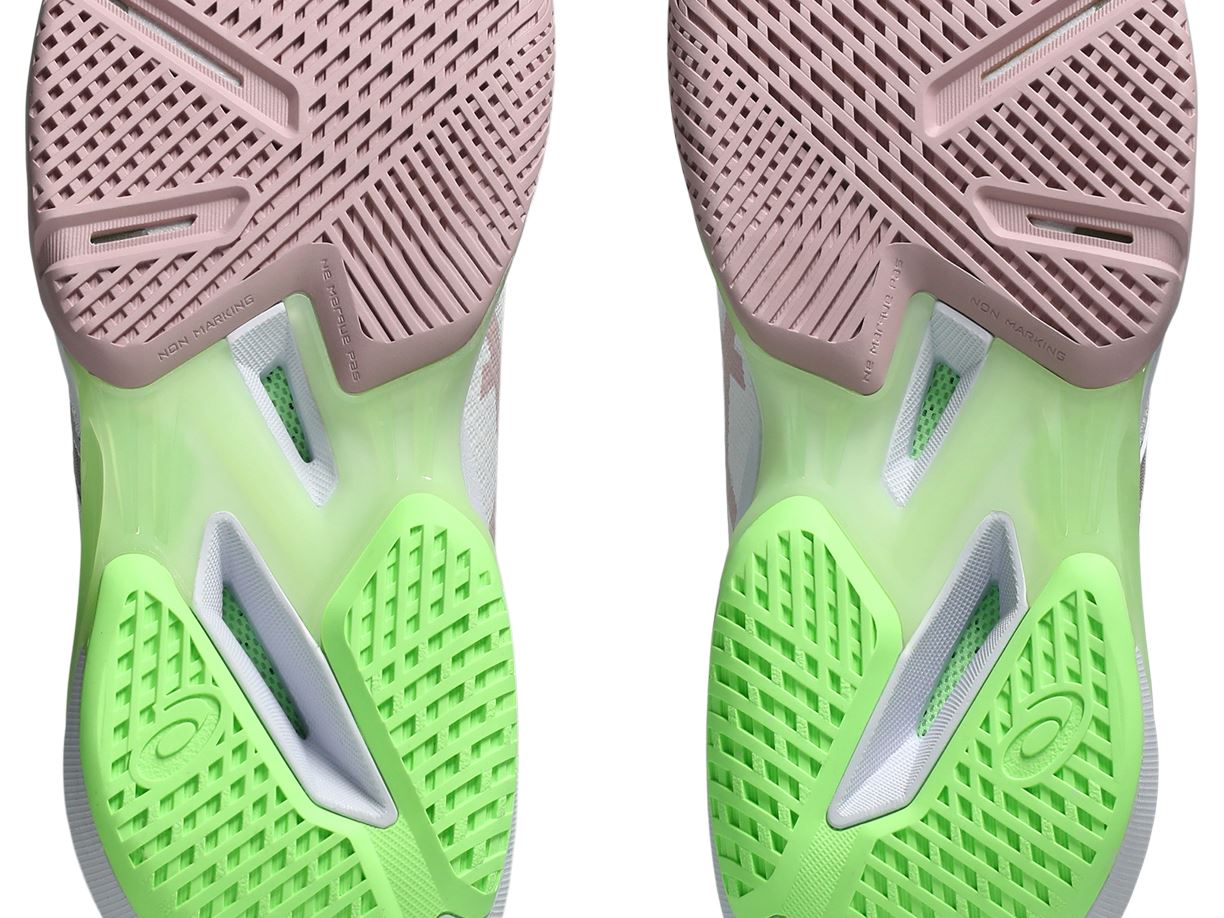
Turn the shoe over, then look at it from above and from the side. The outsole is the rubber touching the court; the midsole is the cushioning structure above it. The last is the form around which the shoe is made. Its shape helps determine the internal fit. These are related parts, but one photograph of the bottom cannot tell you how much room your toes will have.
Look for three separate things. First, the footprint: how broad is the platform beneath the forefoot and heel, and where does it flare beyond the upper? Second, the internal shape: does the shoe taper toward the toes, press across the ball of your foot or leave too much space around the heel? Third, the tread: what pattern and surface designation does the rubber have? Buying a longer shoe changes length; it does not necessarily solve the wrong toe shape.
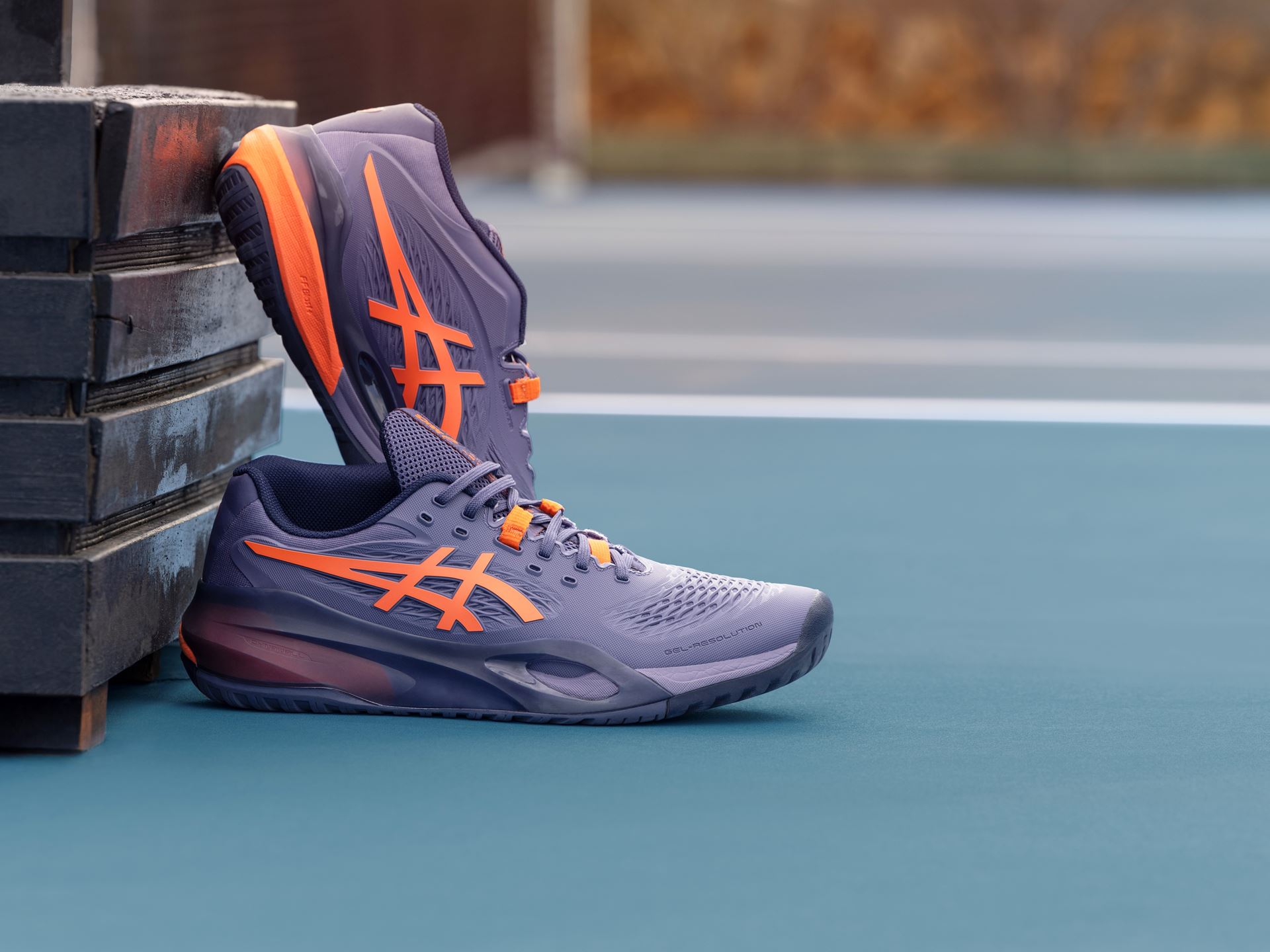
An instructive example comes from RunRepeat’s original lab test of the men’s GEL-RESOLUTION X in US size 9. It measured a 116.5 mm external forefoot platform, 96.9 mm inside at the broad forefoot and 66.6 mm near the big toe. These are three different measurements, not three competing descriptions of its width. The roomy forefoot still tapered toward the front. That is one tested size, not a fit chart for every size or the women’s version.
Sole height and curve also deserve a look. Do you feel perched above the court or comfortable planting your foot? Does the shoe bend where your forefoot bends? A visibly curved heel does not disqualify a tennis shoe: Nike’s GP Challenge 1.5 and Babolat’s SFX 4 both describe rocker geometry. Judge the whole tennis-specific design and how it holds your foot, rather than treating a single shape as automatically good or bad.
Original GEN Tennis schematics. Top-down concept and tread samples, not product silhouettes, scale drawings or traction measurements.
Your public hard court and your weekend clay court need different checks
For regular play on an acrylic hard court, start with a hard-court tennis outsole, or an all-court version the manufacturer identifies for that use. Hard-court patterns can use modified herringbone, separate traction zones and reinforced wear areas. A deep zigzag is not, by itself, proof that a shoe belongs on clay.
Clay versions commonly use a continuous herringbone pattern. The repeated zigzags are designed for traction on the loose surface. ASICS distinguishes this from its hard-court tread, while Nike offers separate Clay and Hard Court selections within the GP Challenge 1.5 range. Check the actual variant in your basket, especially on a discounted colorway.
If you play both surfaces regularly, compare dedicated pairs against the inconvenience and cost of a compromise. For an occasional clay visit, ask the facility whether your clean hard-court shoes are acceptable. Grass, artificial turf and carpet can have their own restrictions. An indoor booking could be hard court or carpet; the roof does not specify the outsole.
Wide toes, narrow heels: shop for a shape, not a brand reputation
Suppose your little toe feels squeezed, but a half-size larger lets your heel lift. Stop increasing length and compare a different last or an explicit wide option at a suitable length. Bring your playing socks and any insert you normally use; an insert changes the space available inside the shoe. Try both feet, because the less comfortable one will still have to play the match.
Avoid blanket advice such as “Nike is narrow” or “all K-Swiss shoes are wide.” The current Nike GP Challenge 1.5 description says its forefoot space has increased. K-Swiss sells a specifically labeled Hypercourt Express 3 2E. Babolat describes the SFX 4 as wide. Those model-level details are useful; none establishes that the shoe will hold your particular heel.
Men’s and women’s versions also need separate checking. ASICS explicitly flags different fit impressions for the GEL-RESOLUTION X: more space for men, a snugger feel for women. Do not transfer a reviewer’s size adjustment across versions.
Six current models to compare in the shop
This U.S. market snapshot uses the exact manufacturer pages linked in the table, checked September 23, 2026. Prices are displayed prices before tax and shipping, not a cheapest-price search; color, size and stock can change them. The examples are men’s listings so the prices and versions are comparable. Check the corresponding women’s specification separately. The “try if” column is our interpretation of the listed features, not a performance ranking.
| Model and U.S. price | Try it if… | Check before buying |
|---|---|---|
| Babolat SFX 4 All Court$76.30 sale / $109 listed originalWhite/Estate Blue · men’s | Your first question is forefoot space and price. Babolat labels this a wide fit with midfoot straps; this checked colorway was the least expensive of these six listings. | Check heel hold as well as width. Babolat suggests a smaller size for standard-width feet, but that is a starting point to try, not an instruction to buy blind. |
| K-Swiss Hypercourt Express 3 2E$130Black/White · men’s wide | You want an explicitly labeled wide option to compare with a regular-width shoe. The listing specifies a midfoot chassis, Aosta II rubber and DragGuard protection. | Try the 3 even if the 2 fitted you. The checked Black/White listing showed a sold-out selection; verify your size or another color before treating the price as an available offer. |
| adidas Barricade 14$128 sale / $160 listed originalJR9153 · Cloud White/Core Black/Lucid Red · men’s | You are comparing a hard-court option in the middle of this price range. adidas describes a Lighttraxion outsole; the range also has separate Wide and Clay listings. | The checked regular-width page recommends going up half a size based on returns. Try adjacent sizes and confirm which width and outsole you are ordering. |
| ASICS GEL-RESOLUTION X$1651041A481-100 · White/Black · men’s standard | You want to compare a structured shoe for frequent changes of direction. ASICS describes heel-extending DYNAWALL support and an adjustable lacing system; a separate Wide version exists. | Check toe taper and heel security rather than assuming the 9’s fit carries over. The brand itself flags a different fit between men’s and women’s versions. |
| Nike GP Challenge 1.5 Hard Court$144.97 sale / $170 listed originalIQ5180-005 · Steam/Light Silver/White/Black · men’s | You want to compare forefoot and heel cushioning with toe-area reinforcement. Nike lists two Air Zoom units, a midfoot plate and extra rubber toward the big toe. | Assess the updated forefoot shape on your foot. Select Hard Court deliberately: the model family also includes Clay, and premium colorways can have different prices. |
| ASICS SOLUTION SPEED FF 4$1601041A532-100 · White/Black · men’s standard | Your current pair feels cumbersome and you want a contrasting design to try. ASICS positions this model for speed, with FLYTEFOAM cushioning and SPEEDTRUSS construction. | Compare its forefoot room and heel hold with a more structured model. A speed-focused description does not establish your fit or how long your pair will last. |
What professional players wear—and what that tells a buyer
Professional examples are useful when they reveal a design priority. In its June 8, 2026 release, ASICS pairs Lorenzo Musetti with the GEL-RESOLUTION X and its emphasis on lateral support, and Belinda Bencic with the SOLUTION SPEED FF 4 and its emphasis on responsive movement. Its January 8 launch announcement also says Bencic contributed feedback to the FF 4. These are documented athlete associations and manufacturer positioning, not independent proof that one model makes you faster.
Novak Djokovic’s COURT FF 3 offers a different lesson. ASICS’s December 13, 2022 launch record describes development with Djokovic and a three-piece outsole. The useful takeaway is how specifically the shoe was developed around movement and feedback. Buying a signature model does not establish that its shape suits your foot, or that a retail pair reproduces every detail of a professional’s setup.
There is a cross-brand example, too: adidas’s December 1, 2025 Barricade announcement named Karolina Muchova, Felix Auger-Aliassime and Stefanos Tsitsipas among the players due to wear the new version in 2026. That is a dated launch association, not a claim about the exact shoe on each player today. It puts the Barricade on a comparison list; it does not move it ahead of a less expensive pair that fits you better.
For your own fitting, compare the question behind the product. Do you prefer a more substantial, held-in feel when you plant sideways, or do you dislike bulk and want to compare a model positioned for lighter movement? Whichever feel you prefer, you still need secure fit, cushioning and traction. ‘Speed’ and ‘stability’ are shopping categories, not playing-level qualifications. A beginner can try either; an advanced player does not automatically need the most expensive signature shoe.
Which pair should you try first? Four real buying situations
First pair, limited budget, toes usually squeezed: start with the Babolat SFX 4 All Court and compare it with an explicitly wide option such as the Hypercourt Express 3 2E. The checked Babolat sale listing is the less expensive starting point. Keep it only if the heel stays secure; extra forefoot room is not useful if your foot slides around.
Regular hard-court player who wants a more held-in feel: compare the GEL-RESOLUTION X with the Barricade 14. Their manufacturers emphasize structure and support. Choose the shape that holds your foot without pressure across the toes or instep. If both fit, compare the particular areas you tend to wear out and the actual price in your size.
Experienced player who finds the current pair cumbersome: include the SOLUTION SPEED FF 4 in the fitting. Compare it directly with your current shoe, then with one of the structured options above. The point is to discover whether you prefer its feel during controlled movement—not to assume that a speed label will improve your footwork. Reject it if obtaining a close fit requires squeezing your forefoot.
Player who wants cushioning but also drags the big toe: the GP Challenge 1.5 is worth examining because Nike specifies forefoot and heel Air Zoom units and extra rubber toward that toe. Match the protection to your wear photograph. If the hole is in the upper rather than underneath, an outsole durability claim alone does not answer your problem.
These are suggested comparisons, not universal winners. The fit check has veto power over every shortlist. For clay, restart with the appropriate outsole variant before carrying any of these model suggestions into the basket.
What player discussions add, and where they disagree
The useful intelligence in tennis forums is often the mismatch: someone loved version 2, bought version 3 in the same size and had a completely different experience. We read three r/10s discussions selected for fit and model-change questions. This is a small, self-selected set of comments, not a survey, a verified ownership sample or a defect-rate estimate.
In “Really hated Gel Resolution 10, what would be alternatives for wide foot?”, the original poster describes an unsuccessful move from the 9 to the X in a wide size. Replies point in several directions, including K-Swiss and Babolat. In the April 25, 2026 “Tennis shoes for wide feet” thread, another commenter describes the X as especially wide, while other players prefer New Balance or different clay models. The practical lesson is to ask where a shoe is wide and which version someone wore.
The April 19, 2026 Hypercourt Express 2-to-3 discussion raises a similar issue. Its author liked the previous shoe but found the replacement stiffer and less comfortable, while appreciating the changed tongue. That is a reason to recheck a familiar line, not evidence that every Express 3 fits badly. A version number can mean a different fit, not just new colors.
Use forums to prepare questions: Did the reviewer mean standard or wide? Which size, court and weekly workload? Was the problem the sole wearing through, the upper tearing or the heel moving? Search the exact model plus your problem, then verify the product specification. A confident recommendation without those details is hard to apply to your feet.
If you wear through shoes quickly, inspect the failure point
For a toe-dragging junior or frequent hard-court player, photograph both soles and the tops of both shoes. Rubber worn beneath the forefoot calls for an outsole discussion. A hole over the big toe calls for upper or toe-guard protection. A shoe can advertise durable rubber and still be the wrong construction for the part you destroy.
Read the guarantee before paying extra for it. Tennis Warehouse’s published six-month outsole terms, for example, allow a one-time replacement on qualifying shoes worn through the outsole into the midsole or insole. They exclude toe-guard and upper damage. That is a retailer-specific policy, not a six-month promise covering every part of every model here. Confirm eligibility on the exact product and seller.
Keep a purchase date and a rough log of court hours if durability is driving your budget. As an arithmetic example, a $120 pair lasting 60 playing hours costs $2 per hour; a $160 pair lasting 100 hours costs $1.60 per hour. These are hypothetical lifespans, not predictions for the models above. Your own wear history is more useful than someone else’s claim that a shoe lasted a season. Do not continue playing in an unsuitable worn pair to reach a warranty threshold.
If you play twice a week, spend on fit before a flagship label
Shortlist two or three pairs that meet your surface and fit needs, then compare what the extra money buys. More reinforcement may matter if you repeatedly damage the same area; it may feel unnecessary if your main problem is a bulky, uncomfortable shoe. Softness during a brief walk and security during a sideways stop are different experiences. Check both.
The checked Babolat, adidas and Nike pages all showed reduced prices on particular colorways. A sale can put a suitable model within reach without changing its construction, but another color or width may cost more. Do not accept a poor fit because the discount looks unusually good. Previous-generation stock can be useful when you already know that exact model, though remaining sizes and return terms may limit the bargain.
For a growing junior, repeat the fitting check instead of automatically buying an adult flagship or adding extra length to last the year. For an adult coming from running or pickleball, start with the tennis surface and lateral fit questions. An existing shoe’s comfort in another activity does not settle them.
A try-on routine that gives you a decision
Ask the retailer what movement and indoor home trials its return policy permits. Use the same sequence with each candidate so you can compare them consistently. Keep the box and tags until you decide.
- Try both shoes with your playing socks and usual inserts. Compare the model’s size chart with both feet rather than relying only on your everyday sneaker size.
- Stand, bend and walk. Feel where your longest toe ends while standing: it should not be pressed into the front. You should be able to move your toes without the forefoot being squeezed. Notice pressure at the heel collar, arch and top of the foot as well.
- Where space and permission allow, take gentle side steps and a controlled step forward. Check whether your foot slides inside, your toes hit the front or your heel lifts repeatedly.
- Adjust the laces normally. If security requires painful tightening, or relieving pressure makes the shoe loose, compare another width or shape.
- Compare complete pairs, not one brand on each foot: your two feet may fit differently. Wear each candidate for several minutes and repeat the same gentle movements. Treat toe contact, persistent heel lift or a pressure point as a reason to change the size or shape, not a promised break-in fix.
- Write down the exact model, version, width, surface and size that worked. If two pairs pass, choose the less expensive one unless the other solves a specific comfort, wear or fit problem you can describe. If neither passes, leave without a pair and widen the shortlist.
Our editorial standards · Questions or corrections? Contact the editor.
Image credits
Hero and product photography supplied by ASICS and adidas for editorial use, with source links below. Colors retained. Original GEN Tennis shape and tread diagrams are conceptual, not measured product drawings.
Sources
- Outsole photograph: ASICS SOLUTION SPEED FF 4, women’s model 1042A307-100, official editorial-use asset
- Hero photograph: ASICS GEL-RESOLUTION X, official editorial-use asset
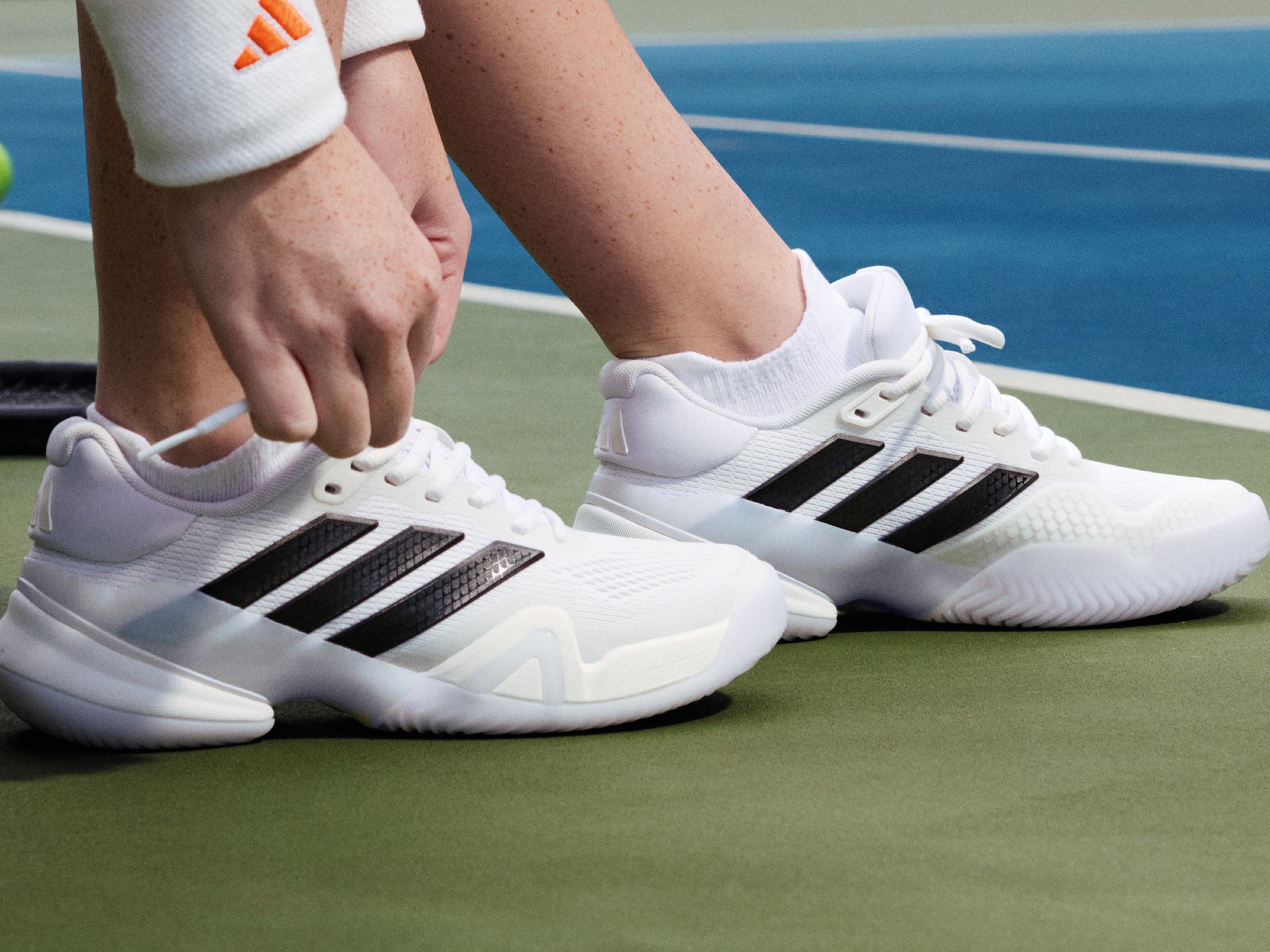
- Fitting photograph: adidas Barricade 14, official editorial-use asset
- ASICS: SOLUTION SPEED FF 4, men’s White/Black standard; $160 and construction (checked September 23, 2026)
- ASICS: playing-styles announcement, Musetti and Bencic model associations, June 8, 2026
- ASICS: SOLUTION SPEED FF 4 launch and Bencic development feedback, January 8, 2026
- ASICS: COURT FF 3 development with Novak Djokovic, December 13, 2022 (historical launch record)
- adidas: new Barricade launch, design details and announced athlete lineup, December 1, 2025
- Babolat: measuring feet and men’s shoe-size conversion guide
- ASICS: GEL-RESOLUTION X, men’s White/Black; $165, construction and fit note (checked September 23, 2026)
- ASICS: GEL-RESOLUTION range, including separately listed Wide versions (checked September 23, 2026)
- Babolat: SFX 4 All Court, White/Estate Blue; wide fit and $76.30 displayed sale price (checked September 23, 2026)
- K-Swiss: Hypercourt Express 3 2E, Black/White; $130 and listed construction (checked September 23, 2026; stock varies)
- adidas: Barricade 14, JR9153; $128 displayed sale price and sizing note (checked September 23, 2026)
- Nike: GP Challenge 1.5 Hard Court, IQ5180-005; $144.97 displayed sale price and construction (checked September 23, 2026)
- ASICS: choosing tennis shoes, surface-specific tread guidance (manufacturer advice)
- RunRepeat: original GEL-RESOLUTION X laboratory review, men’s US 9; internal and external width measurements (checked September 23, 2026)
- Reddit r/10s: GEL-RESOLUTION 9-to-X fit discussion (self-reported experiences; accessed September 23, 2026)
- Reddit r/10s: Tennis shoes for wide feet, April 25, 2026 (self-reported experiences; accessed September 23)
- Reddit r/10s: Hypercourt Express 2-to-3 discussion, April 19, 2026 (self-reported experiences; accessed September 23)
- Tennis Warehouse: six-month outsole guarantee terms and exclusions (retailer’s own policy; checked September 23, 2026)
Keep reading.
ASICS gives the GEL-CHALLENGER 15 a New York colorway
adidas brings three eras of tennis style to its 2026 collections