Europe takes the cup; the score needs context
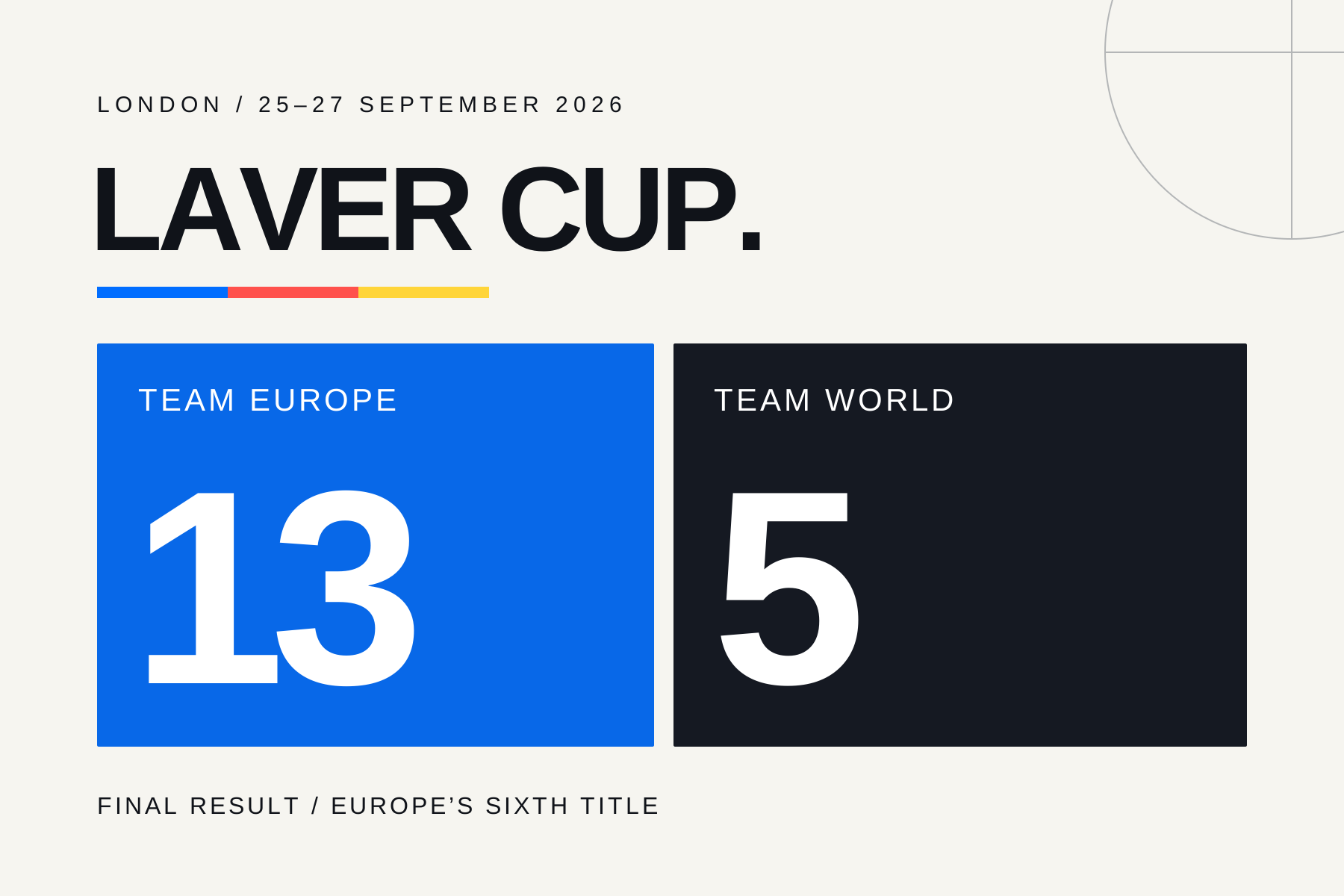
Team Europe won the 2026 Laver Cup at The O2 in London on September 27, beating Team World 13–5. Alexander Zverev secured the title with a 7–6(3), 6–3 victory over Learner Tien. It was Europe’s sixth win in nine editions of a competition that began in Prague in 2017.
That final margin makes the weekend look more comfortable than it was. Europe trailed on Saturday, Carlos Alcaraz had to save two match points, and the championship was still available to either team when Sunday began. Understanding that sequence is also a good introduction to the Laver Cup itself: a concentrated team contest whose scoring makes the last day disproportionately valuable.
The swing came on Saturday night
Europe finished Friday 3–1 ahead. Tien’s victory over Flavio Cobolli and Alex de Minaur’s comeback against Zverev then put World in front, 5–3. With Saturday matches worth two points, those two singles wins had changed the entire picture.
Alcaraz’s response against Taylor Fritz was the hinge. He won 6–3, 4–6, [13–11], saving match points at 9–10 and 10–11 in the deciding match tiebreak. His drop shot finished the contest and brought the teams level at 5–5. Casper Ruud and Zverev followed by beating Alexander Bublik and Brandon Nakashima in doubles, leaving Europe 7–5 ahead overnight.
Sunday accelerated the finish. Cobolli and Jakub Mensik beat de Minaur and Fritz 7–5, 6–3 to make it 10–5. Zverev then supplied the remaining three points against Tien. The final two scheduled singles matches were not needed. Europe had won four consecutive matches after falling behind; the clean Sunday finish should not erase the narrow escape that made it possible.
Why 13 points matter more than a match count
Six men represent Europe and six represent the rest of the world. A win earns one team point on Friday, two on Saturday and three on Sunday. The first team to reach 13 wins. Matches use two regular sets, with a 10-point match tiebreak replacing a full third set when the sets are split.
That explains the difference between a match score and the event score. Alcaraz’s 13–11 was the deciding tiebreak within his match; his team received two points for winning it. Europe’s final 13–5 was the total across the weekend. If you join the broadcast late, check the day as well as the scoreboard.
Doubles also has a substantial role. This year Europe won all three doubles matches, earning six team points. That is a useful viewing cue: watch the returner’s partner, the conversations before serve and how unfamiliar partnerships divide the court. The shared decisions are part of the competition, even when the singles stars attract the initial attention.
Federer’s idea, Rod Laver’s name
The event traces its concept to Roger Federer, who wanted to honor Rod Laver and the generation that helped establish modern professional tennis. Golf’s Ryder Cup supplied the team-event inspiration: familiar individual rivals would spend a few days working toward one result.
Laver’s name gives that modern packaging a historical anchor. The Australian completed the calendar-year Grand Slam—all four major singles titles—in 1962 and again in 1969. Those achievements straddled the divide between amateur and open tennis. After turning professional, he had been excluded from the traditional majors until the Open Era allowed professionals back.
The Laver Cup makes that connection visible through captains, team benches and the trophy ceremony. Its black court and arena presentation give it a recognizable setting; the more interesting idea is the change in relationships. A player who normally wants a rival to lose now has a reason to help him solve the next point.
Nine editions, two different phases
Europe won the first four editions. World’s first title came in London in 2022, and the trophy has changed hands three times since World retained it in Vancouver. Europe now leads the series six titles to three.
The table records final team points, with the winner listed first. There was no 2020 edition: organizers moved Boston to 2021 after changes to the international calendar created a scheduling conflict.
| Year | Host | Winner | Score |
|---|---|---|---|
| 2017 | Prague | Europe | 15–9 |
| 2018 | Chicago | Europe | 13–8 |
| 2019 | Geneva | Europe | 13–11 |
| 2021 | Boston | Europe | 14–1 |
| 2022 | London | World | 13–8 |
| 2023 | Vancouver | World | 13–2 |
| 2024 | Berlin | Europe | 13–11 |
| 2025 | San Francisco | World | 15–9 |
| 2026 | London | Europe | 13–5 |
London 2022 belongs to both teams’ history
For many fans, the defining Laver Cup image remains Federer beside Rafael Nadal during his farewell. Federer played his final professional match in the Friday-night doubles session in 2022, partnering his longtime rival against Jack Sock and Frances Tiafoe. The Europeans held a match point but lost in a deciding tiebreak.
The result and the occasion can coexist. World won the match, while the evening gave Federer a farewell shared with someone central to his career. By Sunday, World had also won its first cup. Remembering only the retirement ceremony would miss the competitive breakthrough on the other side of the net.
The return to London in 2026 carried that history without repeating its cast. Yannick Noah and Andre Agassi, who took over as captains in 2025, now lead Europe and World. The captaincy previously belonged to Björn Borg and John McEnroe. The event is beginning to accumulate its own succession story.

What to watch beyond the celebration
Our reading of this edition is that the format works best when the team changes how a match feels. Alcaraz’s escape mattered to five teammates; Cobolli and Mensik’s doubles win created Zverev’s chance to finish. A score that looks individual on the match sheet becomes somebody else’s opportunity in the team standings.
For a recreational player, that is a worthwhile way to watch. Notice what partners discuss after losing a point, who takes responsibility in the middle, and how the bench responds to a teammate under pressure. These are questions to bring to your own doubles, not a reason to copy a professional’s technique from one highlight.
The tenth edition is scheduled for September 24–26, 2027, at Intuit Dome in Inglewood, California, with Los Angeles as host city. London leaves it a useful inheritance: a recognizable history, a new set of protagonists and evidence that a lopsided final score can conceal a weekend that turned on very small margins.
Our editorial standards · Questions or corrections? Contact the editor.
Image credits
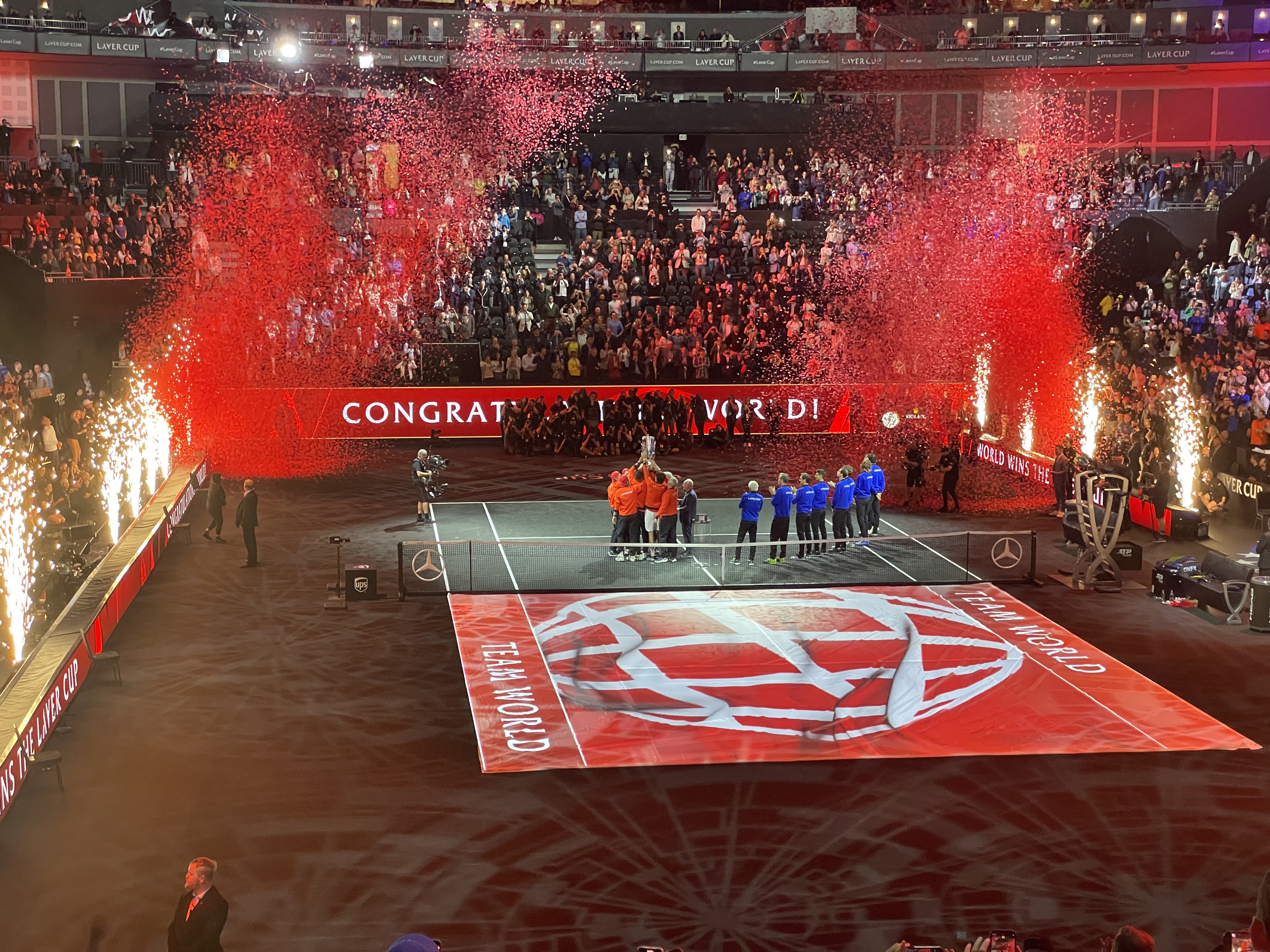
Result artwork: original GEN Tennis graphic based on the official London 2026 results. Historical photograph: Imladenov / Wikimedia Commons, September 25, 2022, CC BY-SA 4.0. Original photograph reproduced without alteration; responsive display only. It shows Team World’s 2022 victory, not the 2026 event.
Historical photograph: original file and attribution
Photograph license: Creative Commons Attribution-ShareAlike 4.0
Sources
- Laver Cup: London 2026 official match results (September 25–27)
- Laver Cup: Zverev clinches Team Europe’s title (September 27, 2026)
- Laver Cup: Alcaraz saves match points; Europe takes Saturday’s lead (September 26, 2026)
- Laver Cup: current format and scoring rules
- Laver Cup: origins and purpose
- Laver Cup: Rod Laver’s career and two calendar Grand Slams
- Laver Cup: historical results, 2017–2025
- Laver Cup: Boston 2020 moved to 2021 (April 17, 2020)
- Laver Cup: Federer’s farewell match report (September 24, 2022)
- Laver Cup: Los Angeles 2027 venue and dates (June 17, 2026)