
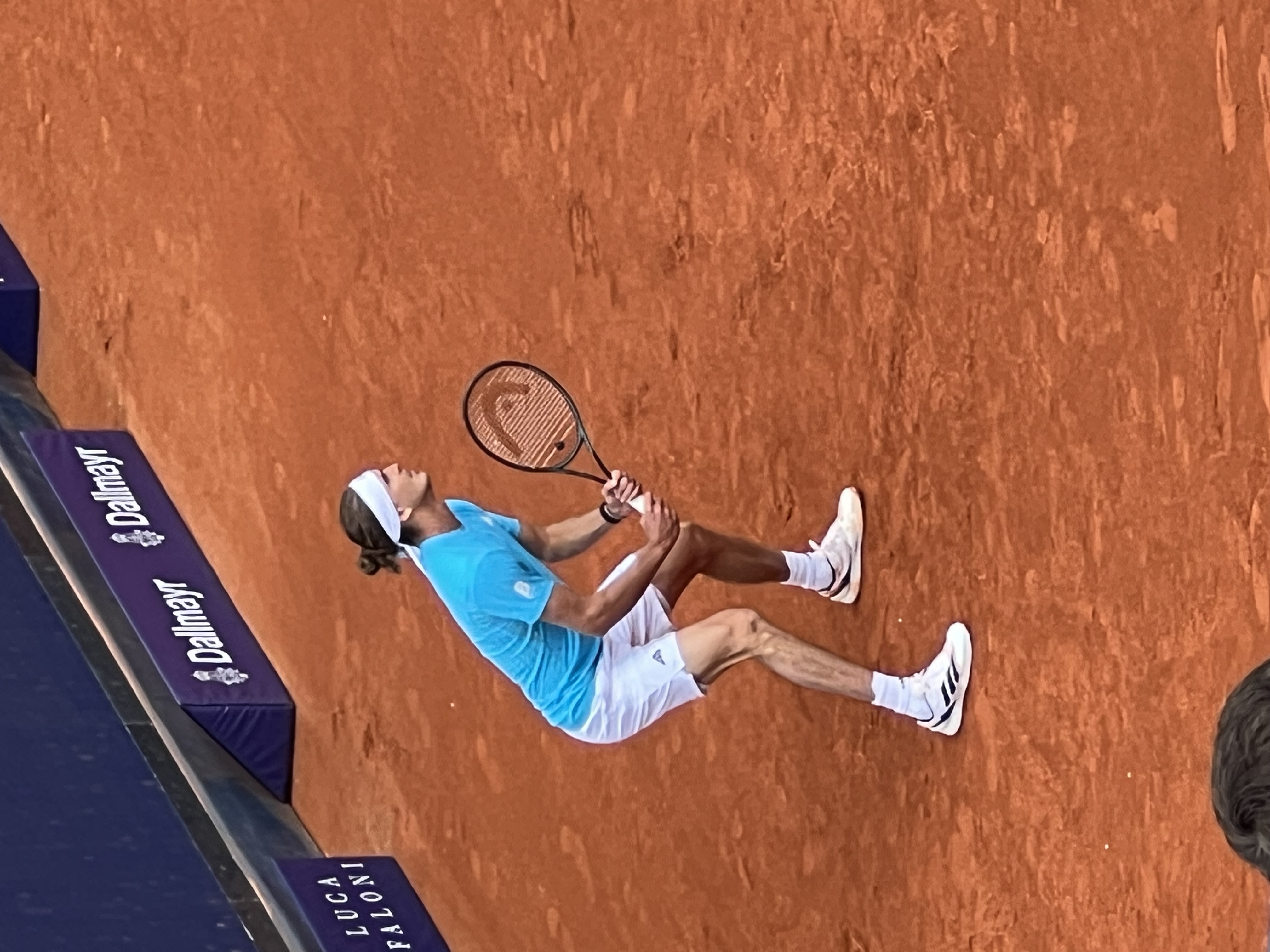
A title with a longer family history
Alexander “Sascha” Zverev beat Ben Shelton 6–3, 7–6(2), 5–7, 6–2 in the US Open final on September 13, 2026. It was his second major title, following Roland Garros in June. The result invites a question that reaches well beyond New York: what does a young player gain when tennis knowledge is already part of family life?
The Zverev example suggests several possible advantages: early familiarity with the professional environment, continuity of instruction and people who understand the player's history. Those advantages help explain the environment around his development. They cannot tell us how much of a championship belongs to coaching, physical ability, opportunity or the player's own work.
Two generations, with more than one teacher
The family's Russian roots predate Sascha's German upbringing. His father, Alexander Sr., played high-level tennis in the Soviet Union. The family moved to Germany in 1991, when Mischa was four; Sascha was born in Hamburg in 1997. HEAD's athlete biography credits his mother, Irina Zvereva, with his early technique and his father with his coaching. Both parents belong in this account.
The geography later extended to Monte Carlo, which Sascha described as home in a March 2023 public post. But the more revealing journey is between generations. His parents had experience of playing and teaching; Mischa encountered the professional tour before his younger brother. Sascha could grow up around several perspectives on the same demanding sport.
That is a different starting position from a family learning everything together. A newcomer may need to work out what a tournament day involves while also learning how to compete. An experienced tennis household can explain the surroundings before the player has to navigate them alone.
Mischa made an unfamiliar world familiar
At the US Open's August 28 media day, Sascha described accompanying Mischa to tournaments and practicing with him. The brothers are ten years apart. Sascha said that gap helped keep rivalry out of their relationship, and that knowing tour players beforehand made his own arrival less intimidating.
This is one of the clearest advantages in the story because it comes from the player himself. Before a young professional faces an established opponent, there is already a task of interpreting the occasion. A familiar face across the net may still be a formidable opponent, but the setting need not feel completely foreign.
There is also a useful distinction between receiving instructions and watching a career unfold. An older player's experience gives a younger one concrete situations to ask about: a difficult draw, a change of surface, a practice that went badly. Such exposure offers context for advice. It does not remove the need to find answers on court.
Physical gifts and learned decisions work together
At 1.98 meters, or 6 feet 6 inches, Zverev plainly has significant physical resources. In the final, he won 68 of 80 points behind his first serve, according to the US Open's match report. Its account also highlighted his movement and ability to extend rallies. Describing him as a champion who somehow compensates for limited athleticism would miss a substantial part of his tennis.
The interesting question is how a player learns to use those resources. Reach alone does not select a target. Power alone does not decide when to accept another rally ball instead of forcing a winner. Technique, choices and physical capacity meet in the same point.
One successful family cannot separate inherited traits from shared training, access or encouragement. Nor does the trophy establish that family coaching produces better players on average. Our reading is narrower: the Zverevs show how several forms of tennis knowledge can remain available to one player over many years.
A father coaching, a brother contributing
The current distinction matters. The US Open's pre-tournament account identifies Alexander Sr. as Sascha's father and coach, with Mischa an important supporting presence. It does not announce a transfer of the head-coaching role to his brother. Sascha explained the boundary this way: “when we are at the tournament, he's just my coach.”
That boundary is worth more attention than the surname. A parent may know a player's habits exceptionally well, yet still need to leave room for disagreement and independence. Long familiarity can make feedback precise; it can also make an old interpretation difficult to question. These are possibilities to consider, not claims about private Zverev family conversations.
Continuity need not mean excluding other views. Sascha has also worked with outside coaches, including Juan Carlos Ferrero and Ivan Lendl. For any close team, a useful question is whether new evidence can change an established opinion. Trust is most useful when it supports an honest discussion.
Irina's place, and Mischa's public voice
After the final, Sascha thanked his mother for supporting his ambitions after his childhood diabetes diagnosis. That tribute adds another dimension to the technical story: a player's relationship with tennis includes what the people around them believe is possible. His account is personal, not a medical lesson or a promise about another child's path.
For readers interested in the family's perspective, Mischa also cohosts Tennis Channel's podcast A BIS Z… with Sascha. Its published archive includes a December 2024 episode featuring Irina and a March 2025 conversation with Jim Courier. These are specific starting points for further listening, rather than evidence of a newly verified publishing schedule.
A former player's perspective can make tennis decisions easier to understand. A brother's perspective offers particular closeness to the subject. Readers can value that access while remembering that personal experience and an independent assessment answer different questions.
What another tennis family can borrow
Most parents cannot supply professional experience at the dinner table. They can still help preserve continuity: keep a brief record of the player's current priorities, ask the coach how practice connects to competition and give the player space to describe what feels difficult.
An older club player or trusted mentor may help explain unfamiliar tournament routines. A coach can provide technical judgment without requiring a parent to become the second coach. These are practical suggestions, not substitutes for the access the Zverev brothers had.
The transferable idea is to build an environment where experience becomes understandable and useful. The young player still needs room to make decisions, make mistakes and develop a relationship with the game that is their own.
Our editorial standards · Questions or corrections? Contact the editor.
Sources
- Cover photograph: Steven Pisano, The Net, 2015 US Open qualifying, Court 11 / Wikimedia Commons. Archival photograph; display crop excludes sponsor signage.
- Cover photograph license: Creative Commons Attribution 2.0
- US Open: final result, match statistics and Zverev's tribute to his mother — Scott Sode, September 13, 2026
- US Open: Zverev on his father, Mischa and growing up around the tour — Adesina O. Koiki, August 28, 2026
- HEAD: athlete biography by Chris Bowers, updated June 2026; family history, height and coaching background (sponsor source)
- Alexander Zverev: public Monte Carlo home post, March 30, 2023
- Tennis Channel: A BIS Z… podcast archive, including Irina Zvereva (December 4, 2024) and Jim Courier (March 13, 2025); checked September 17, 2026
- Photograph: Zverev BMW Open 2026 by Partynia — original photograph and attribution on Wikimedia Commons
- Photograph license: Creative Commons Attribution 4.0