
You can play a point before you master the whole court
Yes, adults can begin tennis with a slower, lower-compression ball and a shorter playing area. The purpose is to make the exchange manageable enough to learn while playing: send the ball over the net, respond to your partner and decide where the next shot should go. You do not need a full-court serve before those decisions become interesting.
That is the NXT starting point: tennis becomes less intimidating when you understand the task. A first session does not have to be an audition at the baseline, with the fence doing most of the receiving. Change the setup so you and your partner have a game to play.
Slower balls are not reserved for children
USTA's Red Ball Tennis uses lower-compression balls with a slower bounce and a smaller playing space. Its published format includes underhand serving and simplified scoring. In Britain, the LTA's Tennis Xpress adult beginner course also uses slower-bouncing balls, alongside instruction in rallying, serving and scoring. Modified equipment is an established adult entry route, not something you have to apologize for using.
The useful question is what happens after contact. Can your partner reach the ball, organize a swing and send it back? If every exchange is a hurried rescue, try a slower ball and an easier feed. This is a practical adjustment, not a diagnosis of your coordination or a guarantee of faster learning.
What do red, orange and green mean?
These are recognized ball stages, not simply decorative colors. The ITF's 2026 specifications distinguish Stage 3 red, Stage 2 orange and Stage 1 green balls. Their specified rebound ranges increase in that order. Check the stage on the packaging rather than assuming every brightly colored ball is a beginner ball.
For a first short-court try, ask a coach or provider for a red ball. Orange or green may be useful as the playing distance and task change; the choice should follow what lets both players sustain the activity. You do not have to buy all three before starting. Ask whether a beginner session supplies balls and rackets, and try its equipment first.
Do not confuse this with choosing the most expensive racket. The ball and the task are today's variables. If you join a named program, follow that program's equipment and playing format; our game below is a separate practice suggestion.
Use the service lines as your first back boundaries
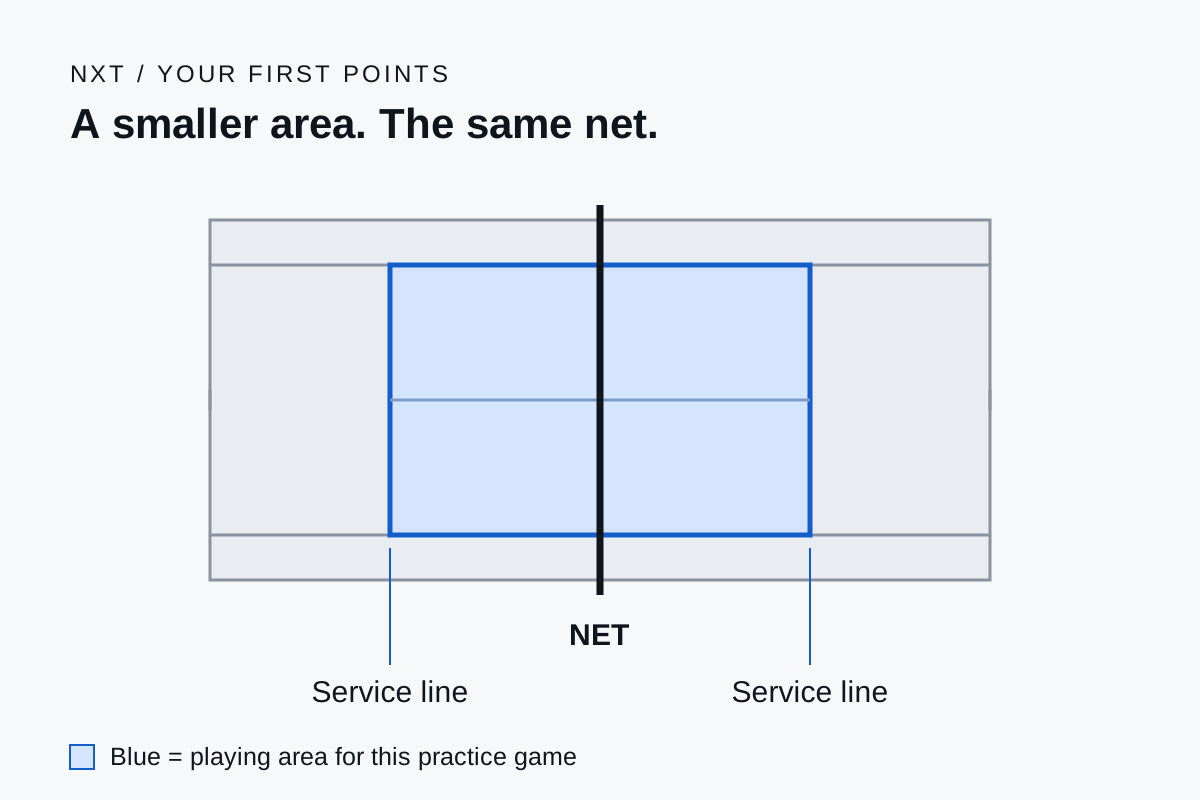
On an available tennis court, identify the net, the two service lines parallel to it and the inner sidelines used for singles. For this game, use all four service boxes as one small court. The service lines become the back boundaries, the singles sidelines remain the side boundaries, and the center service line does not divide the rally target. Leave the net where it is.
Stand on opposite sides near the service lines and begin with gentle shots. You are shortening the required hitting distance, not trying to fit a full-speed swing into a smaller target. Give the ball enough height to clear the net and aim toward the middle of your partner's space.
The diagram shows this suggested setup, not an official red-ball competition layout. Follow facility rules, keep loose balls out of the playing area and leave clear space to move. If the net is still difficult to clear, ask a coach about a suitable shorter-court setup rather than changing the facility's equipment yourself.
Try a five-ball rally, then give it a score
Start cooperatively. One player drops the ball, lets it bounce and gently hits it across. Allow one bounce before each return and count each successful shot aloud. Try to reach five together. Five is a suggested challenge, not a test you must pass; a two-shot exchange can be a useful starting point.
When both players can start and continue an exchange, try the following GEN Tennis practice game. These are agreed house rules, not the official rules of singles or USTA's Red Ball format.
- Begin each point with the same gentle drop-hit feed. Replay a feed that does not land in the agreed area.
- Let the feed bounce, then play the point. For this game, let every shot bounce once before hitting it; do not volley.
- After a valid feed, the player who hits into the net, hits outside the boundaries or lets the ball bounce twice loses the point. A ball touching a boundary line counts in.
- Use 1, 2, 3 scoring and play first to five points, with no two-point margin required. Alternate who feeds each point.
The smaller game still gives you decisions
Once the point starts, look for a choice rather than a spectacular shot. If your partner is standing to one side, can you direct a controlled ball into the other half? After you hit, can you return toward a position from which either side is reachable? Placement and recovery give the rally a purpose without requiring much speed.
Coming from pickleball? Bring your willingness to trade shots and keep score. You do not need to settle the racket-versus-paddle debate before enjoying this game. Treat the tennis ball's bounce and the racket's response as something to explore, not something you should already know.
Make the next change small
When the exchange feels repeatable, change one condition: allow a little more depth, try a different ball stage, or introduce an easy serve with a coach. Avoid changing the ball, court size and scoring challenge together. If rallies disappear, restore the previous setup and identify which change made the task harder.
There is no deadline for reaching the baseline, and short-court play can remain part of your tennis. For your next visit, ask a beginner group whether it uses modified balls and introduces points early. The useful first achievement is having an exchange you understand and want to try again.
Our editorial standards · Questions or corrections? Contact the editor.
Sources
- USTA Red Ball Tennis: ball, equipment and published playing format (checked September 17, 2026)
- LTA Tennis Xpress: adult beginner instruction with slower-bouncing balls (checked September 17, 2026)
- ITF 2026 Rules of Tennis: Rule 1 court markings and Appendix I ball stages; our practice game is not an official competition format